
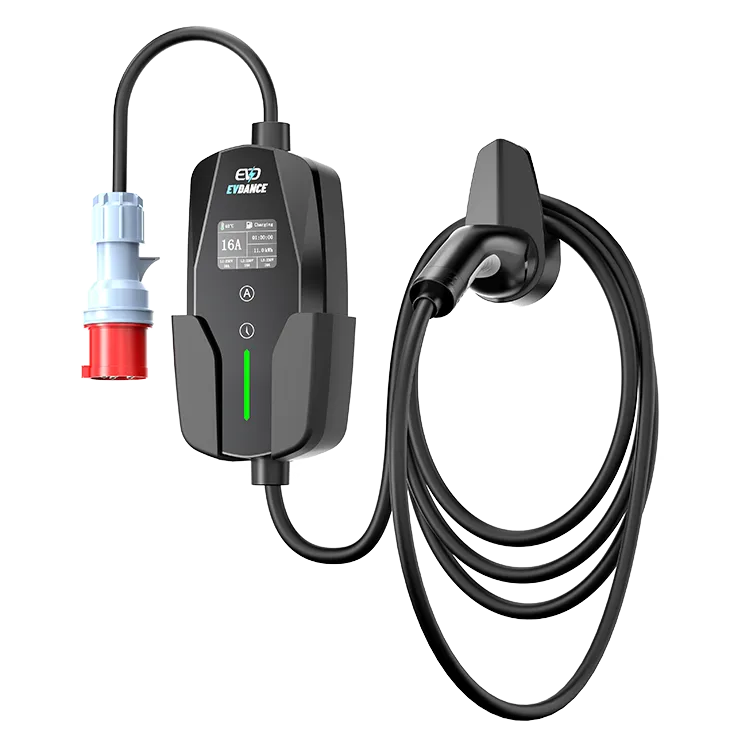
On an agricultural site, the practical farm EV charger is often the socket already on the barn wall. Where a building has a 16 A five-pin CEE socket on three-phase, the ACS1605PE plugs into it and charges a farm car or pickup at up to 11 kW — nothing is installed, and it unplugs when the socket is needed for machinery. Everything is conditional on that socket — its class, its condition, and parking within reach of its 7.6 m cable.
Key Takeaways
- Everything is conditional on a 16 A five-pin CEE socket on three-phase already existing — check class, condition and supply first.
- The 16 A and 32 A classes are different fittings; never adapt between them.
- Reach is the layout question: park within the 7.6 m route.
- One unit charges one vehicle at a time, at the rate it accepts, and travels between buildings.
Start With the Socket Class: 16 A Is Its Own Fitting
Agricultural buildings carry CEE sockets in two common classes: the 16 A five-pin class, fitted for lighter machinery — this charger’s class — and the 32 A class, for bigger equipment and the 22 kW EV-ACS3205PE. The two look alike and fit nothing but their own class; our guide to CEE plug classes shows how to tell them apart by the printed rating. Never adapt between classes to make a plug fit: charging is a continuous load held for hours, and adapters are not the answer.
Two more checks: the socket’s condition — a fitting that has spent years in a barn earns a visual inspection, and anything worn, loose or discoloured is an electrician’s job before it carries a car — and the supply behind it, whose spare capacity is an electrician’s one-time assessment. Nothing about a farm guarantees three-phase power; confirm your own buildings rather than assuming. The background is in our explainer on single-phase vs three-phase charging.
Reach Is the Real Layout Question
A wallbox is placed where the car parks; a portable works the other way round. The cable is 7.6 m, and the measurement that matters is along the ground it travels, not the straight line:
| Parking pattern | What decides whether 7.6 m is enough |
|---|---|
| Car beside the building that holds the socket | Socket and charge port on the same side — the shortest run |
| Vehicle across the yard from the socket | The route around obstacles, not the map distance; if it does not reach, the vehicle moves — the cable is never stretched or extended |
| Socket inside the workshop, car outside | The door position, and a path that stays out of machinery routes |
| A second building with its own 16 A socket | Nothing to solve: the unit unplugs and travels |
What 11 kW Does Across a Farm Night
The arithmetic is simple, and labelled as arithmetic: at up to 11 kW, an hour draws up to about 11 kWh, and an eight-hour night up to about 88 kWh — roughly 79 kWh stored after a ~10% allowance for losses. Set that against your own vehicle’s daily use: one overnight session at that rate covers a great deal of driving. Charging times are worked through in our guide to charging times at 7 kW, 11 kW and 22 kW.
The vehicle decides the real rate, and one portable charges one vehicle at a time — a second vehicle waits its turn.
The ACS1605PE in This Scene
The ACS1605PE is EVDANCE’s 11 kW three-phase portable charger: 16 A at 230/400 V, a CEE five-pin plug, Type 2 to the car, a 1.77-inch display, a 7.6 m cable and an IP66 enclosure — sealed against the dust and water jets a yard produces. The rating covers the unit, not the handling: wipe the plug before a dusty socket, cap the connector out of the car, store the unit dry. It carries a 3-year standard warranty, as part of our residential charging range.
Frequently Asked Questions
Does every farm have the right socket?
No. Three-phase supply and 16 A five-pin sockets vary by property and country, and a farm is no more guaranteed to have them than any other building. Check your own sockets’ ratings and have an electrician confirm the supply first.
Can it charge a tractor or other farm machinery?
It connects to Type 2 vehicles — cars, pickups and vans. Whether a particular machine can charge from it depends on that machine’s own inlet and charging system, which most agricultural machinery does not share with cars. Check its manual or maker first.
Can I use an extension lead if the car cannot reach the socket?
No. Move the vehicle to the socket instead. Extension leads and adapters are not a way to stretch a continuous 11 kW load across a yard — the 7.6 m cable defines the working circle.
Related Reading
- CEE Plugs Explained: Choosing 16A or 32A for a Three-Phase Portable EV Charger
- Single-Phase vs Three-Phase EV Charging: 7kW, 11kW and 22kW Explained
- How Long Does It Take to Charge an EV at 7 kW, 11 kW and 22 kW?

