
A portable charger in mobile use has no single shelf: the ACS1605PE is stored wherever it last worked — home garage this week, workshop or second property the next — and may sit there for weeks between visits. The routine that protects it is the same at every address: put it away dry, both ends covered, the cable in wide loops, off the floor — and check it when it comes out again.
Key Takeaways
- Give the unit an off-floor spot at every site, and note where it is.
- The routine is identical everywhere: dry first, both ends covered, wide coils.
- An idle spell ends with a visual check before the next session.
- The manual’s stated storage range governs long idle spells.
The Pattern: One Charger, Several Addresses
A fixed wallbox is stored by definition. A mobile portable rotates: it charges where a 16 A CEE socket exists, then stays at that site or rides to the next one. That creates two quiet problems: storage conditions differ by site, and you have to know where the unit is. Keep a note, in a phone or on the case, of which site it is at. The trip that saves is not trivial.
Give it a defined spot at each site: a hook or shelf near its socket, off the floor, clear of doors and machinery. A unit with an address at every site gets put away properly.
Put It Away the Same Way at Every Site
- Dry before storage. A unit that has charged in rain or damp gets wiped down and left to dry before it is covered or cased. Moisture sealed in with it is the one kind storage cannot undo.
- Cover both ends. Use the covers supplied with the unit where they are fitted. Grit stored against the connector face or the plug pins travels into the next charge port and the next socket. If an end has no cover, ask the maker about one rather than improvising a wrap that traps damp.
- Coil wide. Large loops following the cable’s natural curve, never tight around the unit. A tight coil held through a long idle spell is how jackets take a set — part of what decides how long a charging cable lasts.
- Off the floor, out of the weather line. Floors are where buildings keep their grit and puddles. A hook, shelf or case keeps the unit out of both, and from under anything stored on top of it.
Storage Spots in a Rotating Life
| Spot | What it protects | What to watch |
|---|---|---|
| Hook or shelf beside the socket it serves | The default: dry, visible, ready | Keep clear of doors and machinery paths |
| Coiled on the floor by the socket | Nothing — the spot that causes the damage | Grit, standing water, tyres and boots all pass here |
After an Idle Spell: Look Before You Plug In
A unit idle for three weeks in an outbuilding has been somewhere nobody was watching. Before its next session, look:
- The cable jacket as you uncoil: cuts, crushed spots, damage.
- The CEE plug: pins straight, clean and dry; housing whole; cable firm in its entry.
- The Type 2 connector: face clean and dry, nothing lodged inside.
- The socket at this site gets the same look — face, openings, fit; inspecting the pair is a routine of its own in our portable charger safety guide.
- The display lights normally on power-up.
Dirt gets dealt with first — our guide to cleaning an EV charger connector covers the method. Damage is a stop: a torn jacket, bent pin or dead display takes the unit out of service until assessed.
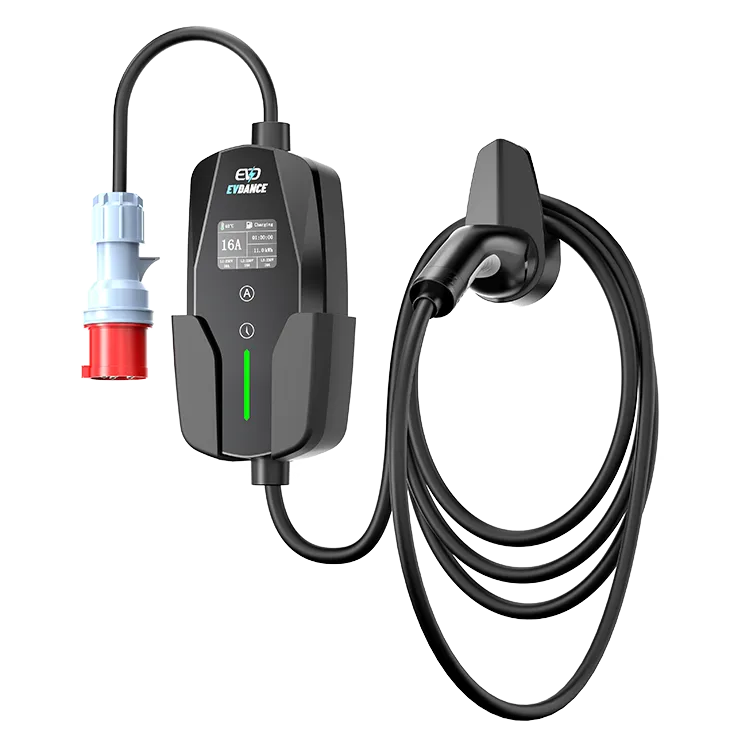
The unit in this routine is the ACS1605PE: an 11 kW three-phase portable, 16 A at 230/400 V, CEE five-pin plug, Type 2 connector, a 1.77-inch display, a 7.6 m cable and an IP66 enclosure, with a 3-year standard warranty. Read the rating honestly — IP66 covers dust and water, not storage temperature; the manual’s stated range is the rule for long idle spells. Our guide to portable charger IP ratings explains the scale.

Frequently Asked Questions
Can it stay in the car between sites?
For the journey, yes — cased, capped and secured against sliding and crushing. As a standing home the car is the weakest address: fine between trips, but long spells of extreme weather belong indoors.
How long can it sit unused in an outbuilding?
No fixed period is stated; the enemies are damp, grit and nobody looking. Stored dry, covered and off the floor, it waits well.
The connector is dusty after storage. Can I plug it straight in?
No — dust in the connector face is pushed into the car’s charge port at the next session. Clean it first, following the connector cleaning guide; if you find damage rather than dirt, the unit stays out of service until assessed.
Related Reading
- How Long Do EV Charging Cables Last, and Can They Be Repaired?
- How to Clean an EV Charger Connector
- Are Portable EV Chargers Waterproof? IP Ratings Explained for Drivers

