
About five times as much energy per hour. A granny charger delivers roughly 2.3 kW (about 10 A from a 230 V household socket); the ACS1605PE delivers 11 kW from a three-phase supply. The same energy added takes roughly a fifth of the time — but only in a car that can accept 11 kW three-phase. In a single-phase car the gap narrows sharply, and overnight both chargers finish the same job.
Key Takeaways
- At full rate the ACS1605PE adds energy about five times as fast as a granny charger: 11 kW against roughly 2.3 kW.
- A single-phase car narrows the gap to about 3.7 kW against 2.3 kW — faster, not five times faster.
- Overnight both finish a normal day’s energy; the difference shows in short windows and big batteries.
- The speed needs its socket: a 16 A three-phase CEE socket, which the granny cable does not.
The Arithmetic: Same Energy, Two Speeds
Charging time is energy divided by power. The times below are arithmetic at the two rates, with about 10% allowed for charging losses — calculations, not measured results.
| Energy to add | Granny charger at about 2.3 kW | ACS1605PE at 11 kW |
|---|---|---|
| 10 kWh | About 5 hours | About 1 hour |
| 20 kWh | About 9–10 hours | About 2 hours |
| 40 kWh | About 19 hours | About 4 hours |
Read the middle row as a typical evening top-up. On a granny cable it is most of the night; at 11 kW it is done before dinner is over. Our comparison of Level 1, Level 2 and DC fast charging shows where these two rates sit in the wider picture.
Where the Gap Narrows: Your Car Decides
The 11 kW figure is a three-phase figure: 16 A on each of three phases. What your car does with it depends on its onboard charger:
- A car with an 11 kW three-phase onboard charger takes the full rate, and the table above applies.
- A car with a single-phase onboard charger draws on one phase only: 16 A at 230 V, about 3.7 kW. The comparison becomes 3.7 kW against the granny cable’s 2.3 kW — still faster, but nothing like five times.
- Any car near full slows down at the end of a session. The last few percent taper on both chargers, so the comparison is fairest on energy added mid-pack.
Our overview of portable EV charger types sets out the classes: the granny cable is single-phase by design, and no charger changes what the car accepts.
When the Difference Actually Matters
Overnight, honestly, it often does not. A car plugged in at 8 pm and unplugged at 7 am gets its 20 kWh from either charger. The gap shows in shorter windows: an evening top-up before an early trip, a second car waiting for the same space, a working vehicle home at midday and out again. It also shows on big-battery cars, where a worthwhile granny session runs past a full day. And the granny cable keeps its own place: it works from the household socket every home has — exactly the socket this unit cannot use. Our guide to charging from a normal socket covers that side fairly.

The ACS1605PE in This Comparison
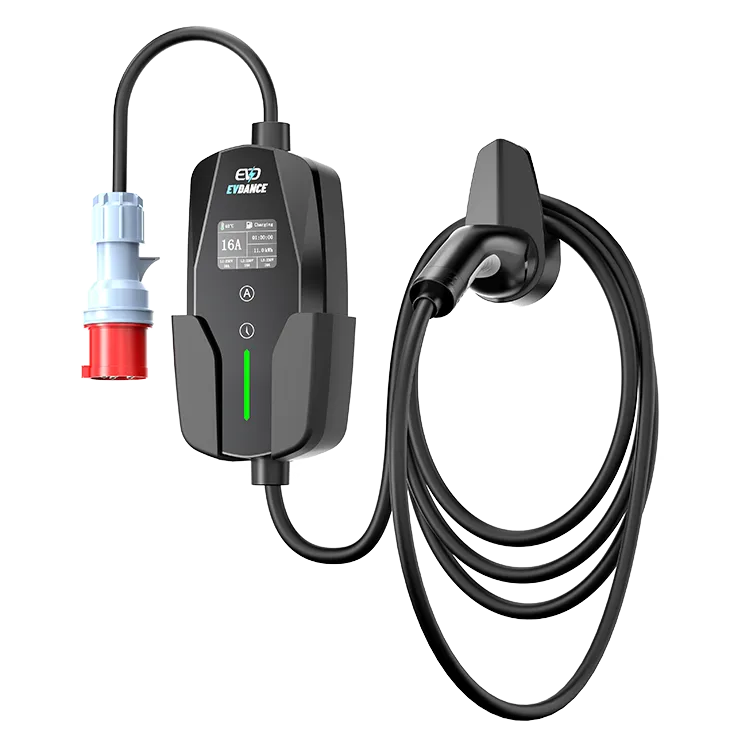
The ACS1605PE is an 11 kW three-phase portable charger: 16 A per phase at 230/400 V, a CEE five-pin plug, Type 2 to the car, a 1.77-inch display, IP66 sealing and a 7.6 m cable. Two preconditions come with the speed. It needs a 16 A three-phase CEE socket — it does not plug into a household socket at all. And the listing names no adjustable settings for this model: the rate is set by the supply and the car, with no lower setting to fall back on. It carries the 3-year standard warranty.
Frequently Asked Questions
Is a granny charger unsafe compared with this unit?
No. A granny charger plugged directly into a sound household socket, with the plug checked for heat, is a legitimate occasional charger. The difference here is speed and socket type, not a safety category; both are continuous loads needing the same socket care.
Will my car actually charge at 11 kW?
Only if its onboard charger accepts 11 kW three-phase. Check the car’s specification: a single-phase onboard charger will take about 3.7 kW from this unit, and a smaller three-phase unit takes its own rating. The charger cannot raise the car’s limit.
Can I use the ACS1605PE where I use my granny charger?
Not at the same socket. The granny cable works from a household socket; this unit needs a 16 A five-pin CEE socket on a three-phase supply. Where one exists — a garage, workshop or outbuilding — the unit plugs straight in. Where it does not, fitting one is an electrician’s job.
Related Reading
- Level 1 vs Level 2 vs DC Fast Charging: A Practical Comparison
- Portable EV Charger Types Explained: 10A, 16A, 32A and Three-Phase Models
- Can I Charge an Electric Car From a Normal Socket?
- Single-Phase vs Three-Phase EV Charging: 7kW, 11kW and 22kW Explained

