
EV charger production is neither fully automated nor fully manual, and the mix is deliberate. Machines do the work that must be identical every time — placing board components, logging test results — while people do the work that varies: routing cables, seating seals, packing market variants. For a buyer, the useful question is not which factory is “more automated”, but which steps each method covers, and what records prove the result is consistent.
Key Takeaways
- Charger production mixes both methods on purpose: machines for identical, measurable steps; people for variable, judgement-based steps.
- Automated steps fail systematically, manual steps fail individually — the controls for each are different.
- The buyer’s evidence is the record: revision logs, torque settings, per-serial test results and packing checklists.
- Manual stages are what make private-label variant work practical.
Steps That Automate Well
Automation earns its place where a step is highly repetitive and its result is measurable. On a charger line that means surface-mount placement and reflow soldering of board components, automated optical inspection of the finished board, firmware loading, and the end-of-line test station, which runs the same routine on every unit and logs pass or fail against the serial number. Label printing belongs in the same group: the data comes from a system, not handwriting.
The common thread is the record. An automated step does not just repeat a motion; it produces evidence — a revision number, an inspection result, a test log — that a buyer can ask to see months later.

Steps That Stay Manual — and Why
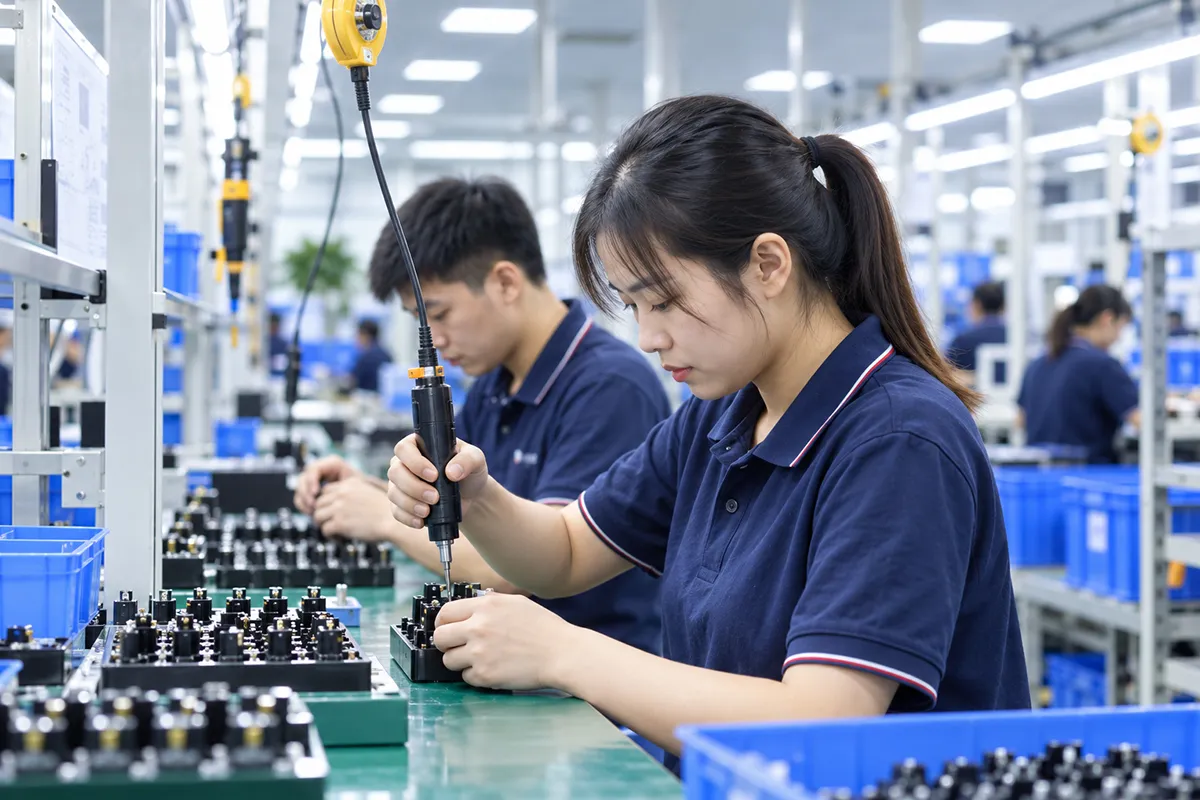
Other steps resist automation because they change with every model and market. Routing and dressing a cable inside an enclosure, fitting connectors and cable glands, and seating gaskets and seals all involve judgement about fit and feel. Closing a housing that mixes screws, clips and a tethered cable is similar. Packing is the clearest case: the plug variant, manual language and accessory set differ by destination, and the check that matters is a person comparing the carton against the approved sample. Rework is manual by definition — every failed unit is its own problem.
| Step | Typical approach | Evidence it is under control |
|---|---|---|
| Board population (SMT) | Automated | Board and firmware revision records |
| Cable and harness fitting | Manual | Work instructions at the station, matched to the approved sample’s revision |
| Safety-critical fastening | Hybrid: power tools with a set torque | Torque settings held at the station, with spot-check records |
| End-of-line testing | Automated station, loaded by hand | A pass/fail log tied to each unit’s serial number |
| Branding and packing | Manual, against the approved sample | A packing checklist worked through per batch |
What the Mix Means for Quality and Flexibility
Each method fails in its own way. An automated step fails systematically: a wrong setting or a worn feeder affects every unit until someone catches it, which is why first-article checks after a setup or changeover matter. A manual step fails individually: one operator, one unit, one missed instruction — which is why work instructions, training and supervision carry the quality there. Neither risk is removed by choosing the other method.
The mix also sets flexibility. Automated stages favour long runs of one configuration; manual stages absorb the variant work that private-label orders consist of — different plugs, artwork, manuals and accessory sets on the same base unit. Our factory audit checklist for importers lists the floor-level signs of both: instructions present and current at manual stations, and test results recorded rather than remembered.
Both Methods Across the EVDANCE Range
The EVDANCE range spans both ends of this mix: portable chargers built around a control board and a fitted cable, wallboxes such as the EV-ACT5006T 48 A Level 2 wall charger, and cabinet-built stations such as the EV-AC03201T dual-connector AC station. EVDANCE is a Shenzhen manufacturer founded in 2011, exports to more than 30 countries, offers private label from 100 units and backs the range with a 3-year standard warranty. To discuss a build and the line that would assemble it, see the products page, the OEM and private-label programme, or contact us.
Frequently Asked Questions
Does more automation mean fewer defects?
Not by itself. Automation makes the automated steps consistent and logged, but the defect risk then concentrates at the manual steps and at changeovers between variants. Judge the records each step produces, not the robot count.
Why don’t factories automate cable and packing work?
Because it changes with every model, plug variant and destination market. Automating low-repetition variant work is rarely economic, and the check that matters at packing — carton against approved sample — is a judgement call.
What should I look for on a line visit?
Current work instructions at manual stations, a test station that logs results per serial number, and a disciplined first-article check whenever the line changes over to a different model or variant.
Related Reading
- EV Charger Factory Audit Checklist for Importers
- How an OEM EV Charger Project Works, Step by Step
- What Drives the Unit Cost of an OEM EV Charger
- Chinese EV Charger Manufacturers: Factory, Trading Company or Marketplace Seller?
