
Not on its own — and the reason is a mismatch of shape, not of effort. A solar canopy produces a modest flow of energy spread across the daylight hours, while a DC fast-charging session is a large amount of power drawn in minutes. The canopy feeds the site’s meter over the day; the grid service delivers the session.
Key Takeaways
- A canopy delivers energy across the day; a DC session demands power in minutes — the shapes do not match.
- The canopy offsets purchased energy at the meter; the grid service still delivers every session.
- Connection and peak capacity are designed for a dark evening, canopy or not.
- The honest pairing is long-dwell AC plus compact DC; array size comes from the PV designer’s site study.
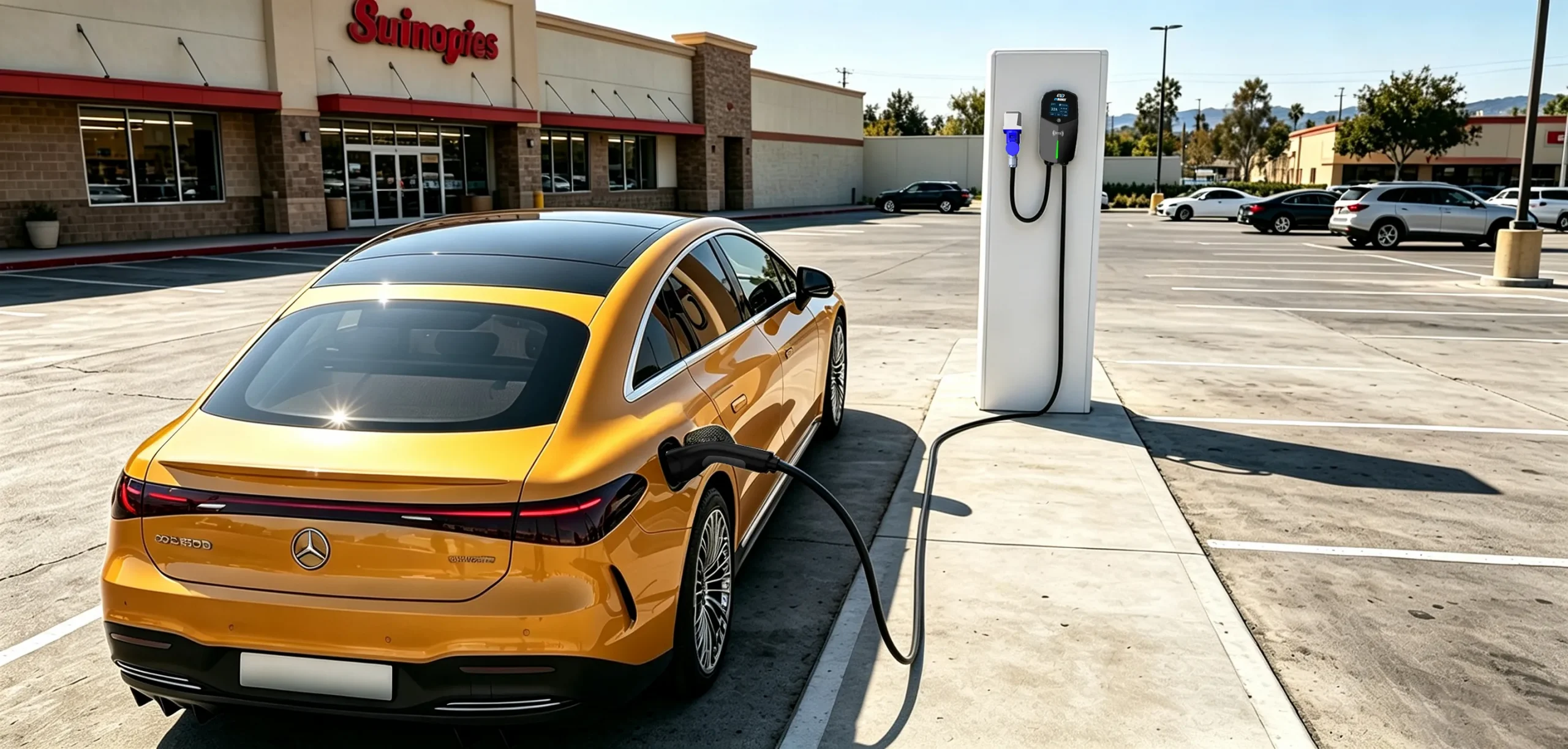
Energy Over a Day vs Power in a Session
Two different quantities are being compared:
| The canopy | A DC fast-charging session | |
|---|---|---|
| What it is measured in | Energy over time — kilowatt-hours accumulated across the day | Power now — kilowatts drawn while the car is plugged in |
| Its shape | Follows the sun: nothing at night, less in cloud and winter, most at midday | A short, high draw: U.S. DOT puts DC fast charging at 50–350 kW, adding roughly 180–240 miles of range per hour |
| What sets its size | The array’s area and the PV designer’s study of this site | The charger’s rating and the car’s acceptance — the rated speed is expected on arrival, at any hour |
| Where it lands | On the site’s meter, offsetting whatever the site is using then | On the site’s service, which must deliver it whether the sun shines or not |
So the two never meet directly. A canopy’s best hours are fixed by the sky; sessions arrive on the drivers’ schedule. The site’s supply is designed exactly as it would be without the canopy — the arrangement described in how commercial charging stations work — and the canopy’s contribution is settled on the meter, over the month, not at the plug.
What the Canopy Actually Does at a DC Site
- It offsets purchased energy. Every kilowatt-hour the array produces while the site is consuming is one the site does not buy. Against AC charging and the building’s daytime load — steady, hours-long draws that overlap the sun — the offset is at its most direct.
- It earns its keep as a structure. Shade and weather cover over the bays, and generation placed on land that was already a car park, as our guide to solar panels and EV chargers sets out.
- It does not shrink the grid side. The connection, service capacity and peak are still designed for chargers at full power on a dark, wet evening — because sooner or later, they will run that way. Surplus generation, when little is being used, supplies the building or is exported under the connection agreement.

Where DC and a Canopy Do Fit
The pairing works at long-stay venues — workplaces, retail, depots — where most charging is Level 2 across the day and one faster point handles turnover, so the canopy’s daylight output meets a daytime load. Sites that want solar energy to cover evening sessions are really asking about storage — a separate design element with its own supplier and study, not a property of the canopy.
The Chargers Under the Canopy
The chargers are standard grid-connected units; the canopy changes where part of the site’s energy comes from, not how they are powered. The EV-RHDC30K-L compact DC charger (22 kW DC, OCPP 1.6J, IP54) is the modest DC class such sites use, and the EV-AC03201T dual-connector AC station (up to 43 kW shared, OCPP 1.6J, RFID, IP54) covers the dwell bays. One honesty line: EVDANCE makes chargers only — no panels, no canopies — and no EVDANCE listing states a solar-surplus or diversion mode; surplus-following behaviour is an energy-management requirement to confirm in writing with whoever supplies it. Start via our commercial charging page.
Frequently Asked Questions
Could a big enough canopy run a DC charger alone at midday?
That is not how these stations are built. Chargers are supplied from the site’s service so rated power is available at any hour, in any weather; the array’s output is used by the site as a whole.
Does the canopy reduce a DC site’s demand charges?
It reduces purchased energy, which is a different line. A demand charge follows the site’s highest draw: if the busiest sessions land on a bright midday, generation may coincide; on a dark evening peak it cannot. Read the answer from the site’s interval data.
Who decides how large the array should be?
The PV designer, from a study of the site — its orientation and shading. The charging side is specified separately, against the site’s dwell pattern.
Related Reading
- Solar Panels and EV Chargers: How to Charge Your Car With Sunshine
- How Do Commercial EV Charging Stations Work?
- How Much Does It Cost to Install a Commercial EV Charging Station?

