
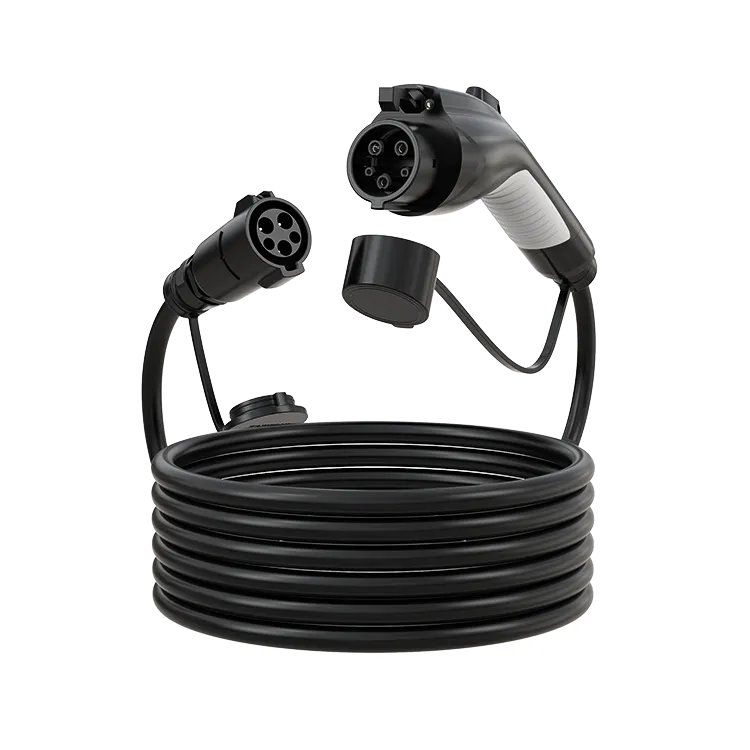
Yes — but one car at a time. The EV-AC04001U has a single J1772 connector, so it charges whichever car it is plugged into and never both at once. Sharing works because the unit is portable: instead of a fixed charger reaching two parked cars on one cable, you carry the charger to the car that needs it tonight.
Key Takeaways
- The EV-AC04001U charges one car at a time; sharing is sequential, never simultaneous.
- Both cars need J1772 inlets for a direct connection.
- A portable removes the cable-reach limit of a fixed wallbox and replaces it with a simple hand-off habit.
- Agree the priority rule once: longest drive tomorrow or lowest battery tonight takes the charger.
The Precondition: Both Cars Speak J1772
A shared charger only works if both cars can take its plug. The EV-AC04001U ends in a J1772 connector, so both cars need J1772 inlets, as our explainer on what J1772 is sets out. A car with a NACS inlet cannot take this plug directly; it would need the car maker’s own J1772-to-NACS adapter — a different part from the EVDANCE JT02, which adapts in the opposite direction, a NACS charger serving a J1772 car.
Sharing a Charger That Moves
Most two-car advice assumes a wallbox bolted between two parking spots. There, the charger never moves and the limit is cable reach: both cars must park within the cable’s run, in their real overnight positions. A portable inverts the problem. The outlet stays where it is; the charger travels, so reach stops mattering and a different friction takes its place — knowing who has the unit tonight.
| Fixed wallbox, two cars | One portable, two cars | |
|---|---|---|
| What moves | Only the connector, on its cable | The whole charger |
| The hard limit | Cable reach from the mounting point | A NEMA 14-50 outlet where the car parks |
| Typical friction | Parking both cars within reach, cable across walkways | The hand-off: who has the unit, and is it coiled and ready |
| Second location | Needs a second installed unit | The same unit travels with either car |
The weekly rotation maths for a fixed setup — alternate nights, priority rules, when a second unit earns its place — is covered in our guide to the charging duo problem. The portable version below keeps the same discipline but organises it around a unit that gets carried.
A Hand-Off Routine That Works
- Decide the owner of the night in advance. The car with the longer drive tomorrow, or the lower battery tonight, takes the charger. Agreeing the rule once beats negotiating nightly.
- The unit lives with the priority car. Coil it and keep it in or beside the car that charges tonight, so the hand-off is a thirty-second job, not a search.
- Charge on arrival, not at departure. At up to 9.6 kW a typical day’s driving is replaced in a few hours, so the first car can finish early in the evening and free the unit for a swap before bed.
- Set each car’s charge limit. A session that ends at tomorrow’s need, rather than running to full, hands the charger over sooner.
The energy side is forgiving. Level 2 charging adds about 10–20 miles of range per hour (U.S. DOT). Worked as an example: a car that drove 35 miles needs roughly two to three and a half hours to replace it, so two ordinary cars rarely want the charger for the whole of the same night.
The Portable in This Plan
The EVDANCE EV-AC04001U is a 40 A J1772 portable charger delivering 9.6 kW from a NEMA 14-50P plug, rated IP66, with a 25 ft cable. Sharing asks nothing more of it than a normal session: plug it into the outlet — our guide to what a NEMA 14-50 outlet is covers what to look for — connect the car that owns the night, and carry the unit across when its turn comes.

Frequently Asked Questions
Can the EV-AC04001U charge both cars at the same time?
No. It has one connector and runs one session at a time. The two cars share it in sequence — one charges, then the other — never in parallel.
Do both cars need to be J1772?
Yes, for a direct connection. A NACS-inlet car needs its car maker’s J1772-to-NACS adapter to use this charger; check the car maker’s instructions for the adapter it approves.
When does one shared portable stop being enough?
When both cars regularly come home nearly empty on the same nights with long drives the next day. That pattern, not the number of cars, is the point where a second unit — or a fixed wallbox for one car and the portable for the other — earns its cost.
Related Reading
- The Charging Duo Problem: How Two-EV Households Can Charge Smarter, Not Harder
- What Is J1772? The North American EV Plug Explained
- Are Portable EV Chargers Worth It? Pros, Cons and Who Should Buy One
- What Is a NEMA 14-50 Outlet? A Guide for EV Owners

