
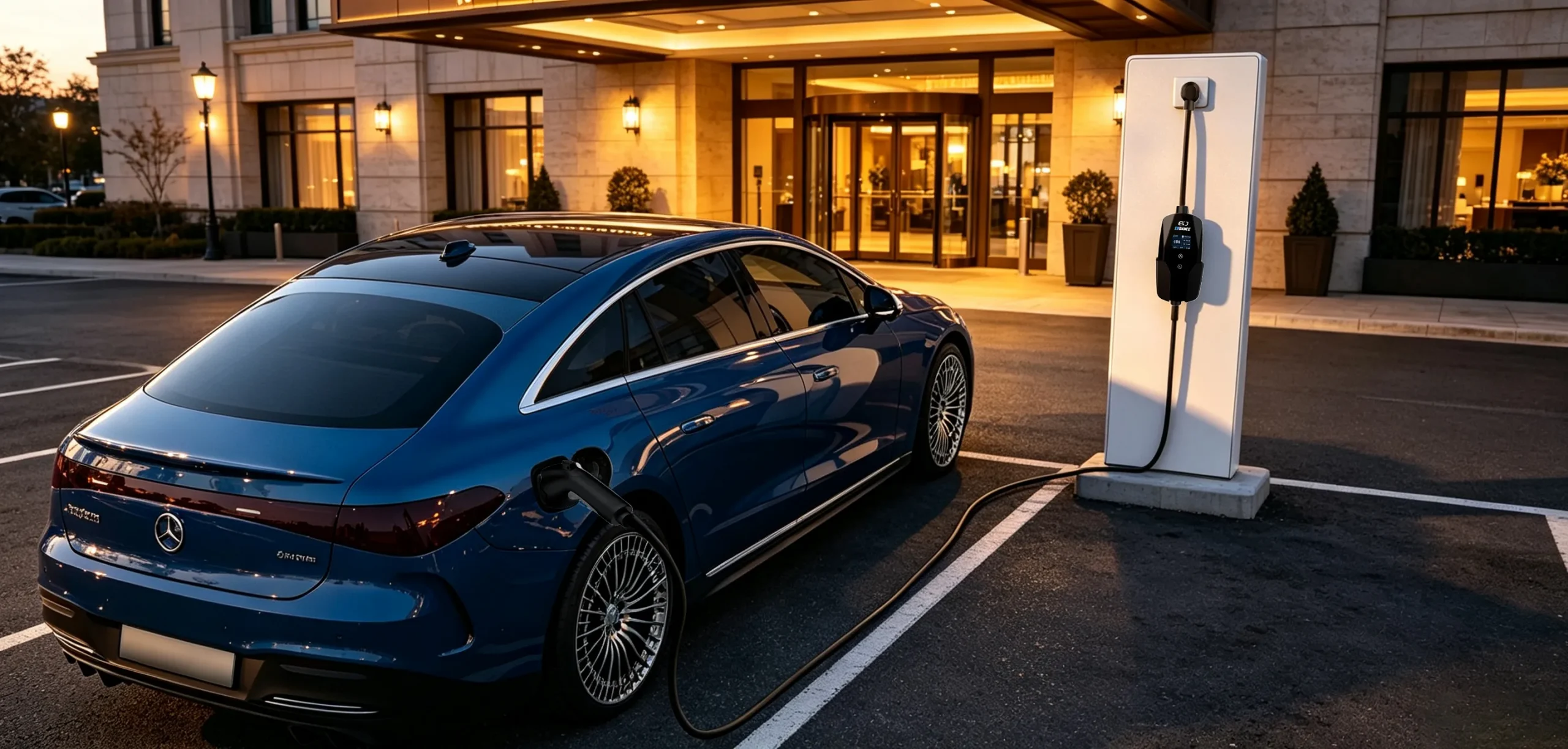
Sometimes, yes. Many hotel chargers are ordinary public chargers that happen to sit in a hotel car park, and anyone who pays can use them. Others are a guest amenity: switched on by the front desk, placed behind a parking barrier, or kept for valet use. Which kind you have found is the property’s decision, so the charger listing and a quick call settle it — not the hotel brand on the sign.
Key Takeaways
- Some hotel chargers are public chargers on hotel land; others are a guest amenity. The property decides, not the brand.
- A public listing with a public price is the strongest sign non-guests are welcome.
- Barriers, valet-only parking and desk activation mean guests only in practice.
- One call to the front desk — and a fallback charger — removes the guesswork.
Why Some Hotel Chargers Are Open to Everyone
A hotel that installs chargers on a public network usually leaves them open, because an open charger earns money from passing drivers as well as guests. These posts appear in the same station maps and apps as any other public charger, often with a per-kWh or per-hour price shown. The U.S. DOE’s AFDC Station Locator lists many hotel locations as public stations for exactly this reason. If a charger is listed publicly with a public price, that is a strong sign non-guests are expected. Hotels near highways do this deliberately: a charging stop can become a coffee or a meal.
Why Others Are Guests Only
The other kind of hotel charger is an amenity, installed so guests can charge overnight — as our guide to whether hotels have charging stations explains, most are Level 2 units meant for long stays. A property with two chargers and forty guests will protect them for the people paying for rooms. Amenity chargers are often activated by the front desk or a room key, sit inside barrier-controlled or valet-only parking, or carry signage saying guests only. None of that is visible from the road — a charger you can reach is not automatically one you may use.
Signs to Read Before You Rely on One
| What you find | What it usually means |
|---|---|
| Listed in a public station map, with a price per kWh or per hour | Open to paying drivers in practice — but parking charges may still apply on top |
| The listing, the hotel page or signage says “guests only” | An amenity charger. Do not plan a journey around it |
| Behind a parking barrier, in valet-only parking, or nowhere to be seen from the street | Effectively closed to non-guests unless the front desk says otherwise |
| No public listing anywhere, and the hotel cannot tell you the price | Treat it as guest-only and ask before you drive there |
How to Ask, and How to Behave if the Answer Is Yes
- Call the front desk first. Ask one direct question: “Can a driver who is not staying with you pay to use your EV charger, and is there a parking fee on top?”
- Expect two possible charges. The energy is one bill; parking is another. Our breakdown of whether hotel charging is free shows how properties split the two.
- Stay reachable and move when done. A non-guest blocking a finished charger is why the next driver gets refused.
- Have a fallback. Note the nearest public charger before you set off, in case the desk says no or both posts are taken.
For Hotels: Open or Guest-Only Is a Setting, Not a Build
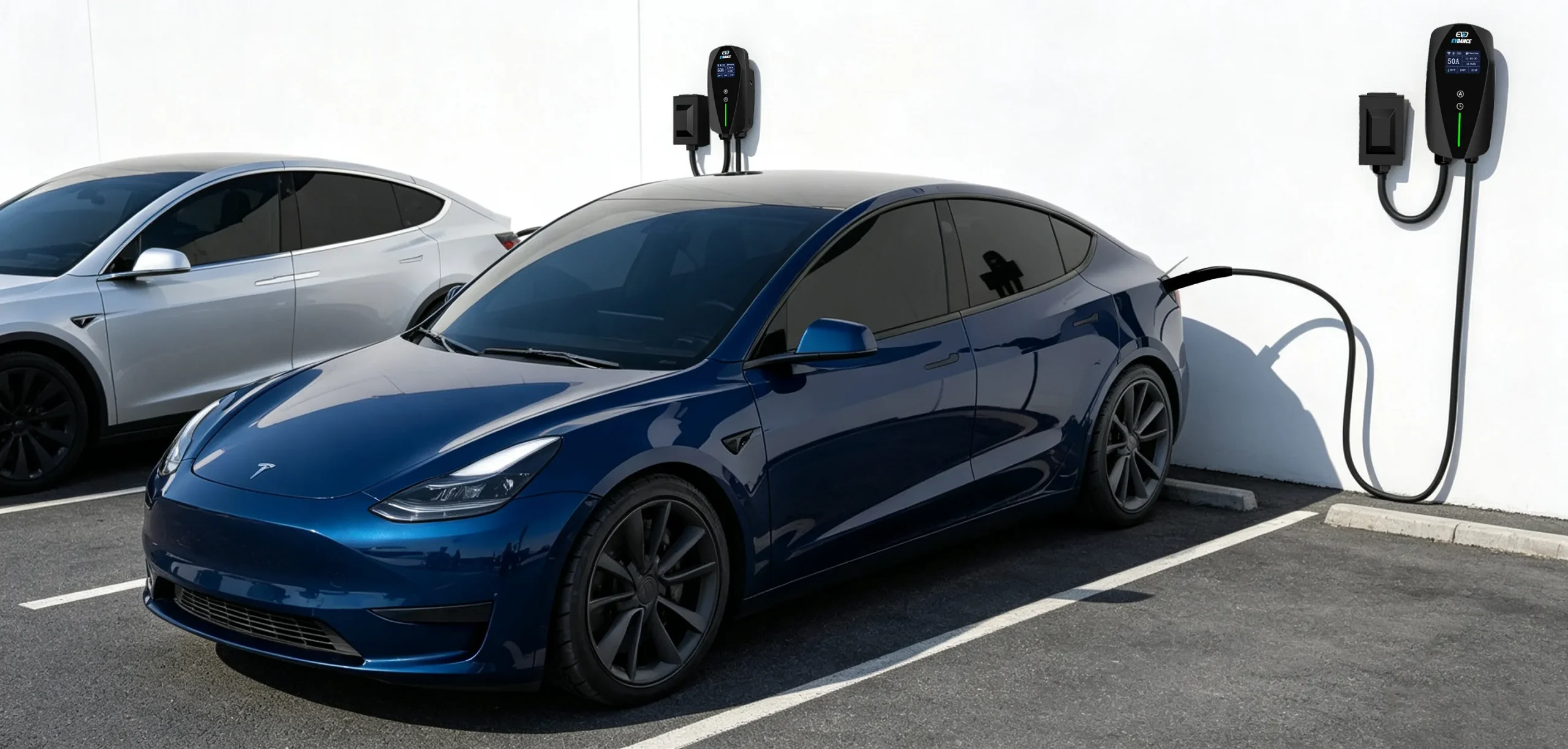
Properties choose the policy after the hardware goes in. A networked station such as the EV-AC03201T dual-connector AC station — two Type 2 connectors sharing up to 43 kW, with OCPP 1.6J and RFID — can run guest-only by access card or open to any paying driver through its network settings. Hotels weighing the choice can see both models in our commercial EV charging solutions.
Frequently Asked Questions
If the charger is reachable and idle, can I just plug in?
Reachability is not permission. If the post takes a public payment or appears in a public network, plugging in and paying is the intended use. If it is unlisted, unsigned or inside guest parking, ask at the desk first — the property’s answer governs.
Will I pay more than a guest would?
You might. Guests sometimes charge free or at a bundled rate, while a non-guest pays the public energy price plus any parking charge. There is no standard tariff, which is why the question to the desk matters.
The app shows the charger as available, but the desk says guests only. Who is right?
The desk. Listings lag behind policy changes, and the property controls its own car park. Thank them, use your fallback charger, and consider flagging the listing in the app so the next driver is not misled.
Related Reading
- Do Hotels Have Charging Stations for Electric Cars?
- Is EV Charging at Hotels Free?
- How to Use a Public EV Charger (and How to Stop It)
- Hotel EV Charging: How to Plan Guest Charging That Pays Off

