
Yes — the cable can set your charging speed. An AC session runs at the lowest-rated link in the chain, and the cable is one of those links: the charger reads the cable’s current rating and will not pass more. A 16 A or single-phase cable on a setup that could deliver more quietly caps the session, however powerful the charger and car are.
Key Takeaways
- An AC session runs at the lowest-rated link — and the cable is a link, with a rating the charger reads and obeys.
- Amps and phases both count: a 16 A or single-phase cable caps a faster setup, nothing broken.
- Adapters count as links too; use one rated above your charger’s setting.
- Length changes reach, not rating — and cables must never be joined end to end.
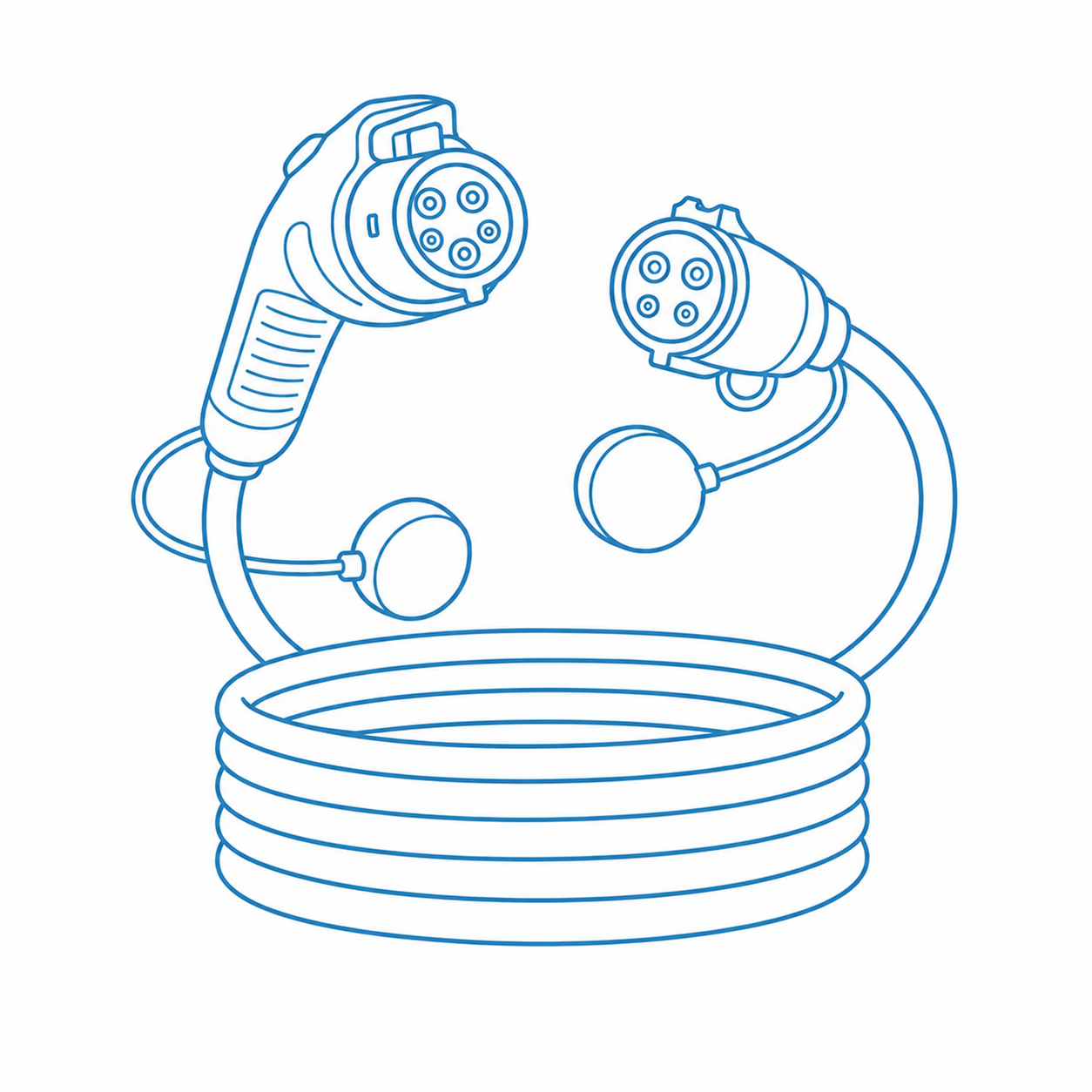
The Session Runs at the Weakest Link
Four things can limit an AC session: the supply and its breaker, the charger, the cable, and the car’s onboard charger. The session settles at whichever is lowest — which is why a driver can stand at a post labelled with a high power figure and watch the car take far less.
The cable’s limit is not a guess. In Type 2 charging, the cable tells the equipment its rating through coding in the connector, and a portable charger’s lead is rated as part of the unit. Fit a lower-rated cable and the equipment respects that rating — passing more current than a cable is built for is how cables overheat.
Cable Ratings, in Plain Numbers
| Cable or lead rating | Most it can pass | Where you meet it |
|---|---|---|
| 32 A, single-phase | About 7 kW | Standard home and public AC leads in Europe and Australia |
| 16 A, three-phase | 11 kW | Lighter three-phase portable chargers and leads |
| 32 A, three-phase | 22 kW | Full-speed three-phase leads for cars that accept 22 kW AC |
| 32 A, North American portable | About 7.7 kW | Portable chargers on a NEMA 14-50 outlet |
| 40 A, North American portable | 9.6 kW | Higher-output portable chargers on a NEMA 14-50 outlet |
Two traps follow. Phases matter as much as amps: a single-phase cable on a three-phase car and charger limits the session to the single-phase figure. And a 16 A cable is not faulty — it is doing what it is rated for — but it holds a 22 kW-capable setup to a fraction of its speed. Our selector for which EV charging cable you need matches cable, current and phases before you buy.
Tethered, Bring-Your-Own and Adapters
With a tethered home charger, the cable is part of the unit and rated to match it, so it is rarely the limit. The cable question appears where you supply your own: socketed public posts in Europe and the UK, where the lead in your boot decides what the post can give you, and portable chargers, whose leads are rated for the unit’s maximum.
Adapters are links too. The EVDANCE JT02 NACS-to-J1772 adapter is rated for AC charging up to 80 A, above typical home equipment, so it does not become the limit — but an adapter rated below your charger’s setting would. Cheap, uncertified cables and adapters are the real hazard: they may carry no honest rating at all, which is why not all EV charging cables are the same.
What Length Does — and Does Not — Do
Length by itself does not change a cable’s rating: a longer certified cable of the same rating passes the same current, just with more weight. Length matters in two other ways. Very long installed runs can lose voltage along the way — a wiring design question for the electrician, not something a thicker plug-in lead fixes. And reach tempts people into extensions: joining cables end to end hides the real rating from the charger and is not permitted, as our guide to extending an EV charging cable explains.
Cables Matched to Their Rating
EVDANCE portable chargers ship with leads rated for the full unit: the EV-ACS3210E 32A Type 2 portable charger delivers about 7 kW single-phase, and the ACS1605PE 11 kW three-phase portable charger covers cars that accept 11 kW AC.

Frequently Asked Questions
Can a better cable make my car charge faster?
Only if the cable is the current limit. A higher-rated cable removes a cap; it cannot push a session past what the charger offers or the car accepts.
Why is my public charge slower than the post’s label?
Check your own lead first at a socketed post: a 16 A or single-phase cable caps the session well below a 22 kW label. After that, the car’s own AC limit is the usual reason.
Does a longer cable charge more slowly?
Not by rating. What grows with length is weight, voltage-drop concerns on fixed wiring runs, and the temptation to join cables — which you should not do.
Related Reading
- Which EV Charging Cable Do I Need?
- Are All EV Charging Cables the Same?
- Can You Extend an EV Charging Cable?
- How Long Do EV Charging Cables Last, and Can They Be Repaired?

