
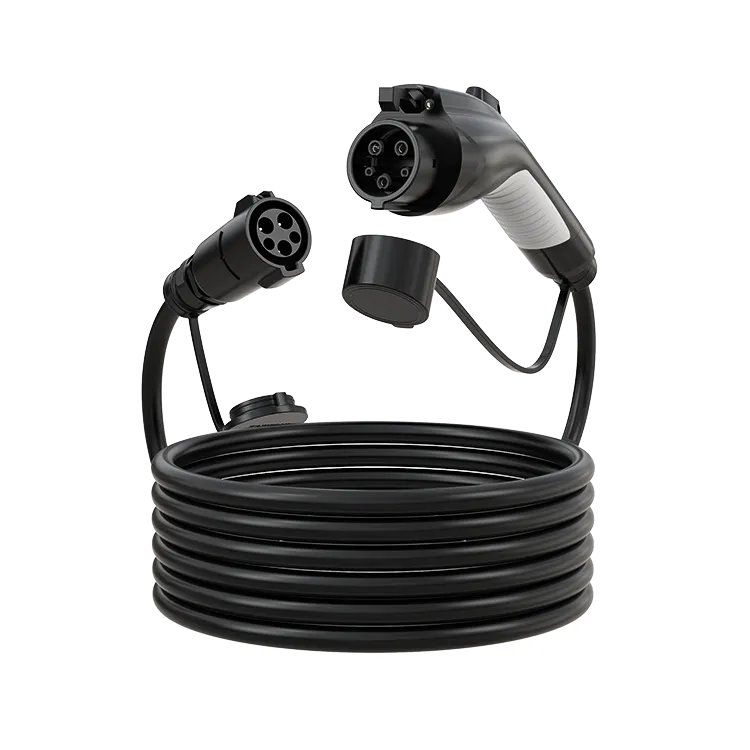
The EV-AC04001U charges any car with a J1772 inlet — which means every North American electric car and plug-in hybrid built with that standard inlet, battery-electric or hybrid. Compatibility here is a connector rule, not a model list: if the plug fits the inlet, the car and charger negotiate the session themselves. The cars it does not fit directly are the ones that have moved to a NACS inlet, and European cars with Type 2 inlets.
Key Takeaways
- Any car with a J1772 inlet — electric or plug-in hybrid — charges on the EV-AC04001U.
- A CCS1 inlet also works for AC, through its J1772 upper section.
- NACS-inlet cars need the adapter for the opposite direction, only where the car maker approves it; Type 2 cars cannot use it.
- Compatibility decides whether charging starts; the car’s onboard charger decides how fast.
The Rule: Match the Inlet, Not the Brand
J1772 is the standard AC connector for North America, as our explainer on what J1772 is sets out. A car maker fits the inlet; the charger follows the standard. That is why no compatibility list is published for a charger like this one: the list would simply be “every car with this inlet.” Work through your car by its inlet instead:
| Your car’s inlet | Works with the EV-AC04001U? | Notes |
|---|---|---|
| J1772 | Yes, directly | Battery-electric cars and plug-in hybrids alike; the car’s onboard charger sets the speed. |
| CCS1 combo inlet | Yes, for AC charging | The top part of a CCS1 inlet is a J1772 inlet; the two extra pins below serve DC fast charging only. Our piece on whether J1772 works with CCS explains the shared shape. |
| NACS | Not directly | A J1772-to-NACS AC adapter exists for this direction, to be used only where the car maker approves it. Do not confuse it with the JT02, which solves the mirror-image problem — a J1772 car at a NACS charger. |
| Type 2 | No | The European inlet is a different connector entirely, as the comparison of Type 2, J1772 and NACS shows. |
Compatible Does Not Mean Full Speed
The plug fitting settles whether charging starts. It does not settle how fast. The EV-AC04001U offers up to 9.6 kW (40 A at 240 V), and the car’s onboard charger accepts what it is built for:
- Cars that accept the full rate charge at up to 9.6 kW.
- Cars with a smaller onboard charger — many plug-in hybrids among them — charge at their own lower rate. The session works exactly the same; it simply runs at the car’s pace, which is still well matched to a hybrid’s smaller battery.
- No J1772 charger does DC fast charging. This is an AC unit; the DC pins on a CCS1 inlet belong to a different kind of station.

Three Checks Before You Rely on It
- Look at the inlet. A round J1772 inlet — or the top half of a CCS1 inlet — is a match. A slim NACS inlet is not.
- Read the car’s AC charging specification. It is printed in the owner’s manual and tells you the fastest rate any J1772 charger can deliver to that car.
- Check the reach. The unit’s 25 ft cable has to run from a NEMA 14-50 outlet to the car’s inlet where it parks, without stretching across a walkway.
Frequently Asked Questions
Can the EV-AC04001U charge a Tesla?
Not directly — Tesla cars use a NACS inlet. That route runs through an adapter in the J1772-to-NACS direction, used only where the car maker approves it; our article on whether a Tesla can use J1772 chargers covers how that works.
Does it work with plug-in hybrids?
Yes. Plug-in hybrids for this market carry J1772 inlets, and the charger serves them the same way. Expect the car’s lower acceptance rate rather than the full 9.6 kW — normal, and enough for a hybrid’s battery overnight.
My car has a CCS port. Is that a problem?
No. A CCS1 inlet includes a J1772 inlet as its upper section, and that is the part this charger uses. The DC pins below it stay idle during AC charging; they belong to DC fast-charging stations.
Related Reading
- What Is J1772? The North American EV Plug Explained
- Does J1772 Work With CCS? CCS Connectors Explained
- Can a Tesla Use J1772 Chargers?
- Type 2 vs J1772 vs NACS: Which EV Charger Connector Does Your Market Need?

