
Underneath, the EV-AC04001U and the EV-ACS4005T are the same class of charger: 40 A, 9.6 kW, a NEMA 14-50P plug and an IP66 housing, both running on a 50 A circuit. They differ at the car end — J1772 against NACS — and in one behaviour: the ACS4005T’s current can be stepped down, while the AC04001U delivers a fixed 40 A. So the choice is really two questions: which inlet will your next car have, and how certain is your circuit?
Key Takeaways
- Same power, same plug, same circuit: the pair differs in the car-end connector and in the ACS4005T’s current steps.
- Your next car’s inlet picks the model; an approved adapter is a bridge, not a substitute for the native fit.
- Only the ACS4005T forgives a smaller circuit — the AC04001U’s fixed 40 A needs a true 50 A circuit.
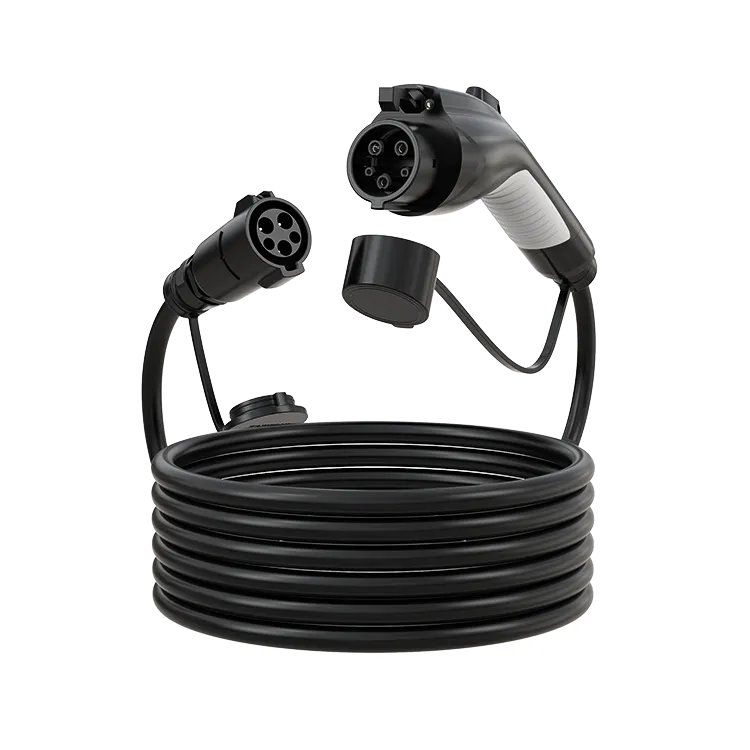
Side by Side
| EV-AC04001U | EV-ACS4005T | |
|---|---|---|
| Car connector | J1772 | NACS |
| Current | Fixed 40 A | Adjustable: 16 / 24 / 32 / 40 A |
| Output | 9.6 kW | 9.6 kW |
| Wall plug | NEMA 14-50P | NEMA 14-50P |
| Circuit at full rate | 50 A | 50 A |
| Cable | 25 ft | 25 or 28 ft |
| Housing | IP66 | IP66 |

The Difference That Matters at Home: Settings
EV charging is a continuous load, so the breaker is sized at 125% of the charger’s current — which is why both units want a 50 A circuit at full rate. The difference appears when the circuit is smaller or unverified. The ACS4005T can step down to meet it: 32 A on a 40 A circuit, 24 A on a 30 A circuit, by the same rule. The AC04001U cannot step down at all — on anything less than a true 50 A circuit, its answer is no. If your outlet’s circuit is proven 50 A, this difference disappears. If it is not, it decides the purchase on its own.
Adapters Blur the Line — With Conditions
Adapters exist in both directions, and they are not interchangeable. EVDANCE’s JT02 takes a NACS charger to a J1772 car: AC charging only, up to 80 A — and, like any third-party adapter, only where the car maker approves its use. The reverse trip, a NACS-inlet car charging from the J1772 AC04001U, runs on the car maker’s own J1772-to-NACS adapter, as our guide to whether a Tesla can use J1772 chargers explains; approval there is also the car maker’s call. An adapter is a good bridge for the occasional session. It is a poor reason to buy the wrong native connector for the car you charge every night — our look at whether EV charging adapters are safe sets out the checks that apply either way.
Choosing for the Car You Will Own Next
- Next car has a J1772 inlet: the AC04001U is the native fit — no adapter in the daily session.
- Next car has a NACS inlet: the ACS4005T is the native fit, with the same power and plug.
- The household will run both inlets for years: buy native for the car charged nightly, and bridge the other with an approved adapter.
- Uncertain circuit, certain car: connector picks the model family, but the circuit can overrule — only the ACS4005T forgives a smaller circuit.
For the wider picture of where each connector is used, see our comparison of Type 2, J1772 and NACS and our explainer on what J1772 is. Either way, you are buying the same 9.6 kW of charging; the inlet on your next car is what you are really choosing.
Frequently Asked Questions
Is one of them faster?
No. Both cap at 9.6 kW, and the car’s onboard charger decides the actual rate — a car that accepts less charges at less on either unit.
Can the AC04001U charge a NACS car with an adapter?
Yes, with the car maker’s J1772-to-NACS AC adapter, where the maker approves it. EVDANCE’s JT02 goes the other way — a NACS charger serving a J1772 car — and is AC-only.
My panel can only spare a 40 A circuit. Which one?
The ACS4005T, set to 32 A — the setting a 40 A circuit supports under the 125% rule. The AC04001U’s fixed 40 A needs a 50 A circuit.
Related Reading
- Type 2 vs J1772 vs NACS: Which EV Charger Connector Does Your Market Need?
- Can a Tesla Use J1772 Chargers?
- Are EV Charging Adapters Safe?
- What Is J1772? The North American EV Plug Explained

