
On an event site, the EV-ACS3205PE is the last link in a temporary power chain, not the chain itself. The site’s power team runs a three-phase feed to a 32 A CEE socket; this portable charger plugs into that socket and gives one car up to 22 kW. It brings no power of its own: one charger is one continuous 32 A load, and the event’s load plan has to carry it.
Key Takeaways
- The charger is the last link: the power team provides the feed and the 32 A CEE socket; the charger starts there.
- Plan on one continuous 32 A load — about 22 kW — per charger, for hours.
- Simultaneity decides the real cost: charging hours set against the event’s own peaks.
- Bring the load figures early, and leave the distribution to the electricians.
Where This Charger Sits in the Temporary Chain
Temporary event power is a chain: the venue’s supply or the site’s generation feeds temporary distribution, and the distribution ends in outlets. Everything up to the socket — distribution boards, protection, cable runs — is installed or checked by the event’s electricians. The charger’s job starts at the socket face.
That division is what makes a portable unit useful here. It is not wired in, so it can move between distribution points as the layout changes across a weekend, serve a different car park on day two, and go back into storage when the event ends. Choosing the right outlet matters: our guide to CEE plugs, 16 A or 32 A, explains the socket classes this charger family uses.
The One Number the Power Team Needs
Event power teams plan in loads, and a charger is an unusually honest load: it draws its full rate from plug-in to nearly full, for hours. EV charging is treated as a continuous load for exactly this reason. Give the power team the arithmetic below — planning figures at the unit’s full 22 kW rating — and let them place it against everything else the site runs.
| Chargers running at once | Combined draw (planning arithmetic) | Energy delivered per hour |
|---|---|---|
| 1 | 32 A three-phase, about 22 kW | About 22 kWh |
| 2 | About 44 kW | About 44 kWh |
| 4 | About 88 kW | About 88 kWh |
Two qualifiers keep the plan honest. First, a car takes only what its own onboard charger accepts, so many sessions draw less than 22 kW — planning at the full figure is the safe side, not a prediction. Second, simultaneity is the real question: four chargers running during the headline set compete with the show itself; the same four overnight compete with almost nothing.
Questions to Settle With the Event’s Power Team
- Where are the 32 A five-pin CEE outlets, and what else is fed from the same distribution? The charger needs the real 32 A three-phase article, not a shared afterthought.
- Which hours are charging hours? Agree them against the event’s own peaks before gates open, not during them.
- Who is the named contact if a breaker trips mid-event? At 22:00 the answer has to be a person, not a department.
- Who may plug in? Open parking, a stewarded rota, or crew vehicles only.
The power team owns these answers. The charger owner’s job is to arrive early with the load figures and accept the slot the plan gives them.
The EV-ACS3205PE on Site
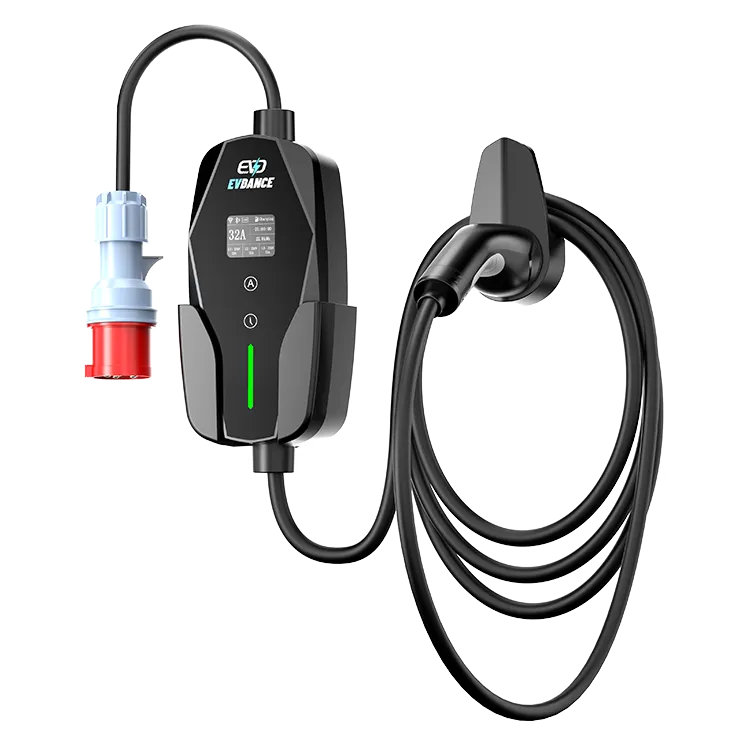
The EV-ACS3205PE is a 22 kW three-phase portable charger: 32 A on a 380–400 V supply, a CEE five-pin plug on the supply side, Type 2 to the car, a 1.77-inch display, and IP66 sealing for outdoor work. Its whole value on site is being a full-rate charger that arrives in a bag and leaves no installation behind. For permanent, managed charging instead, a fixed dual-connector station such as the EV-AC03201T is the step up; see our commercial charging page.
Frequently Asked Questions
Can this charger run from a generator?
Only as part of the site’s engineered supply: the generator feeds the distribution, and the charger plugs into a proper outlet on it like everything else. Sizing, fuel and noise are the operator’s engineering decisions — our article on charging an electric car with a generator covers what to check first.
How many cars can one charger serve during an event?
One at a time. The useful figure is parked time: a car sitting for four hours could take on the order of 80 kWh at the wall before losses, if its onboard charger accepted the full rate — far more than most visitors need. A simple rota usually serves more drivers than a second charger would.
Does the charger replace the event electrician?
No. It replaces only the last step, between a proper 32 A CEE socket and the car. Everything upstream remains qualified work, planned and checked by the event’s own electricians.
Related Reading
- Can I Charge an Electric Car With a Generator?
- CEE Plugs Explained: Choosing 16A or 32A for a Three-Phase Portable EV Charger
- What Is an EV Mobile Charger?
- Portable EV Charger Types Explained: 10A, 16A, 32A and Three-Phase Models

