
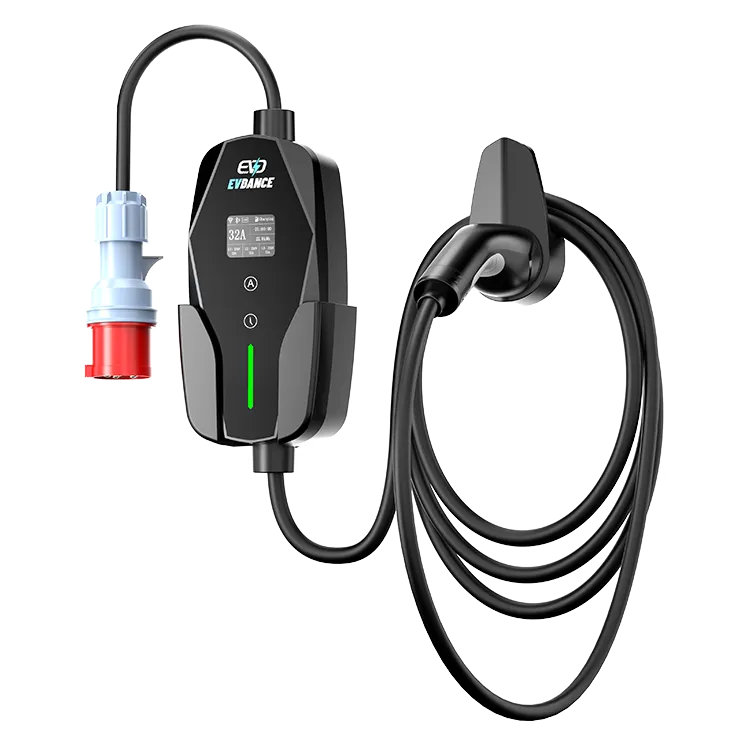
On a working construction site, the practical charger for electric vans is one that follows the site’s own three-phase power instead of being bolted to a wall. The EV-ACS3205PE is that shape: a 22 kW portable (32 A, CEE five-pin plug, Type 2, IP66) that plugs into a 32 A site socket and moves when the site does. The socket and its supply are the site electrical contractor’s scope — the charger’s job is to travel.
Key Takeaways
- A portable charger follows the site’s phases; a wallbox installed for phase one gets stranded.
- The 32 A CEE socket and everything behind it are the site electrical contractor’s scope and sign-off.
- The van’s onboard charger sets the real rate — 22 kW is a ceiling, not a promise.
- IP66 covers dust and weather; caps, cable routing and socket condition are daily care.
Why Portable Fits a Site That Keeps Changing
A construction site is a moving target: the compound relocates, parking shifts as phases hand over, and where the vans sleep in month one is a scaffold store by month four. A hardwired wallbox installed for the first phase ends up stranded in the wrong place — or worse, in the way. A portable has no position to strand: it lives in the site cabin or lead van, comes out where a suitable socket exists, and leaves with the crew at handover. The trade-off is honest: with no fixed point, the site’s own routine — who plugs in, when, who takes the unit home — is the control system.
The Socket Is the Site Contractor’s Decision
The charger needs one thing from the site: a 32 A five-pin CEE socket on a three-phase supply, in a place a van can park beside. Everything upstream of that socket — the distribution board, the circuit, the site supply’s total capacity while cranes, mixers and cabins run — belongs to the site’s electrical contractor: their assessment, their installation, their sign-off. Treat a socket they have provided for vehicle charging as the charge point, and any other as out of bounds. If none exists, having one fitted is their scope of work, not a crew job. Our guide to CEE plug classes for portable chargers shows the 32 A class against the smaller 16 A one on older site gear.
Vans, Dwell Time and Honest Rates
The ceiling is 22 kW, but a van only ever takes what its own onboard charger accepts. If a van’s AC limit is lower, the session runs at the van’s rate, not the charger’s — check the van’s specification first. Within that limit, dwell time does the planning:
| Site pattern | What the arithmetic gives |
|---|---|
| Overnight dwell at the compound | Even a van that accepts well under 22 kW refills across a long night |
| Two-hour midday turnaround at a sustained 22 kW | About 44 kWh drawn before losses, roughly 40 kWh stored (labelled example), if the van holds that rate |
| Short call between drops | Worth it for opportunity, not as a refill plan |
Rough Handling: Care on a Working Site
The unit is rated IP66 — sealed against dust and powerful water jets — the right starting point for site dust and weather. The rating covers the unit, not careless handling:
- Cap the Type 2 connector whenever it is out of a van; grit in the contacts is a stop sign.
- Keep the cable out of vehicle routes — a driven-over cable is removed from service, not tested by the next session.
- Wipe the CEE plug first, and never force it into a damaged or worn socket — that socket goes back to the contractor.
- Store the unit dry in the cabin between uses.
The EV-ACS3205PE in This Scene
The EV-ACS3205PE is EVDANCE’s 22 kW three-phase portable: 32 A on a 380–400 V supply, CEE five-pin plug, Type 2 to the vehicle, a 1.77-inch screen and an IP66 enclosure, in our commercial charging range. Where a site’s sockets are the 16 A class instead, the 11 kW ACS1605PE is the portable built for them.

Frequently Asked Questions
Can any site socket be used for charging vans?
No — use a 32 A five-pin CEE socket on a three-phase supply that the site’s electrical contractor has provided and confirmed for this load. An unassessed socket is not a charge point, however well the plug fits.
Will every electric van charge at 22 kW?
No — the van’s onboard charger sets the rate. A van that accepts 22 kW AC uses the full output; a van with a lower limit charges at its own rate for the same dwell.
Can it charge two vans at once?
No — the unit has one Type 2 connector and serves one vehicle per session. Several vans are a rotation, or several units where the contractor confirms the supply allows it.
Related Reading
- CEE Plugs Explained: Choosing 16A or 32A for a Three-Phase Portable EV Charger
- Single-Phase vs Three-Phase EV Charging: 7kW, 11kW and 22kW Explained
- Portable EV Charger Types Explained: 10A, 16A, 32A and Three-Phase Models

