
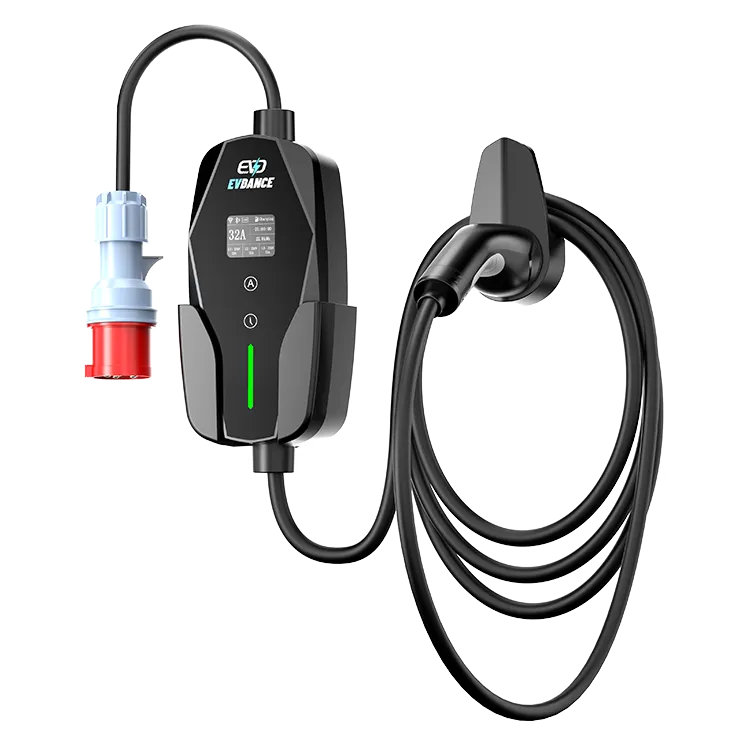
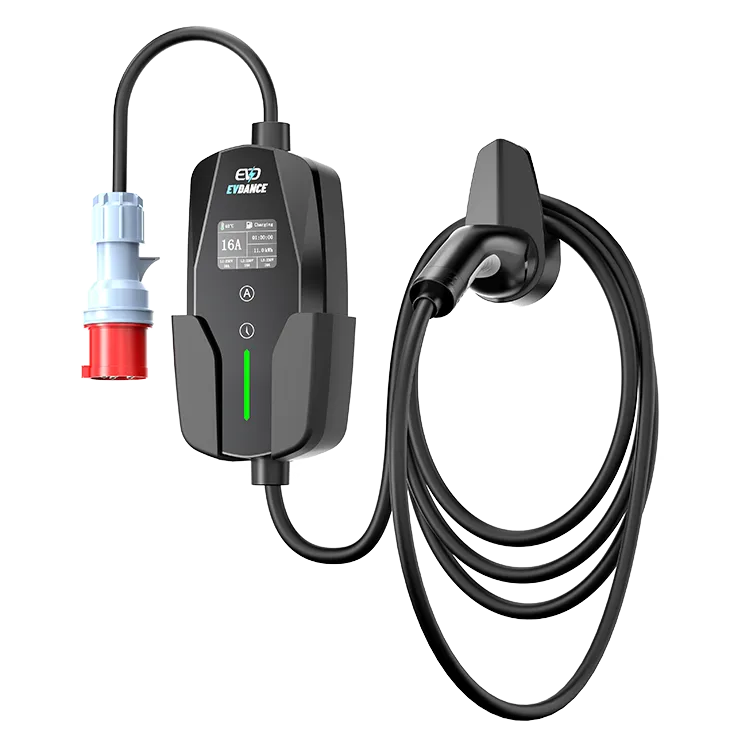
These two portables are built the same way — three-phase, Type 2 to the car, a CEE five-pin plug to the wall, IP66 — and differ in one thing: the socket class each one needs. The EV-ACS3205PE draws 32 A per phase for 22 kW; the ACS1605PE draws 16 A per phase for 11 kW. The bigger number only reaches the battery if three gates all pass it through: the socket class, the car’s own charger, and a session long enough to use it.
Key Takeaways
- The two portables differ by socket class: 32A for 22 kW, 16A for 11 kW.
- The extra 11 kW needs a 32A socket, a car that accepts 22 kW, and a session long enough to use it.
- An 11 kW car charges identically on both units.
- Check which socket class your buildings have before choosing — the wall decides first.
Two Socket Classes, Two Ceilings
| EV-ACS3205PE | ACS1605PE | |
|---|---|---|
| Power | 22 kW three-phase | 11 kW three-phase |
| Current | 32 A per phase | 16 A per phase |
| Plug and socket | CEE five-pin, 32A class | CEE five-pin, 16A class |
| To the car | Type 2 | Type 2 |
| Screen | 1.77-inch | 1.77-inch |
| Cable | Not stated in the listing — confirm before ordering | 7.6 m |
| Rating | IP66 | IP66 |
The plug must match the socket natively — the 32A plug does not fit the 16A socket, and that is by design. So the first question is not which charger you prefer, but which sockets your buildings actually have. Our guide to choosing 16A or 32A CEE plugs works through identifying them.
The Three Gates Between 11 and 22 kW
- Gate 1 — the socket. A 32A five-pin socket on a three-phase supply, with a circuit able to carry 32 A per phase continuously. With only the 16A class available, the 22 kW unit cannot plug in at all — the 11 kW unit is the one that fits your walls.
- Gate 2 — the car. Many cars accept at most 11 kW of AC power. Such a car charges at 11 kW on both units, and the bigger charger’s headroom is never used. The 22 kW case rests on cars whose onboard charger accepts the full rate.
- Gate 3 — the session. With about 10% allowed for losses, an hour stores roughly 20 kWh at 22 kW and roughly 10 kWh at 11 kW. For a 10 kWh top-up, both finish inside the hour and the gate never matters; for a 40 kWh refill, it is the difference between about two hours and about four.
Which One Fits Your Sockets
If your sites have the 16A class of CEE socket, the ACS1605PE is the charger that uses them today, and for cars that accept 11 kW it gives up nothing. If 32A sockets exist — or an electrician is fitting sockets anyway — and your cars can accept 22 kW, the EV-ACS3205PE halves the long sessions. Mixed sites argue for honesty about the mix: the 11 kW unit works everywhere the smaller sockets are, while the 22 kW unit works only where its own class is fitted. The explainer on single-phase vs three-phase charging covers where both ratings come from.
Frequently Asked Questions
Can I plug the 22 kW unit into a 16A socket with an adapter?
No. The plug has to match the socket class natively — that match is what keeps the current within what the socket and its circuit were built for. If the socket is the 16A class, that is the 11 kW unit’s ground; fitting a 32A socket is an electrician’s job.
My car accepts 11 kW. Is the bigger unit wasted on it?
For that car, yes — it charges at 11 kW on both. The headroom only pays when a car that accepts 22 kW uses it, which is a question about your next car as much as your current one.
Can both be used outdoors?
Both listings rate the units IP66 — sealed against dust and powerful water jets. The socket they plug into has its own rating and condition to check, which is part of the site check either way.
Related Reading
- CEE Plugs Explained: Choosing 16A or 32A for a Three-Phase Portable EV Charger
- Single-Phase vs Three-Phase EV Charging: 7kW, 11kW and 22kW Explained
- Portable EV Charger Types Explained: 10A, 16A, 32A and Three-Phase Models

