
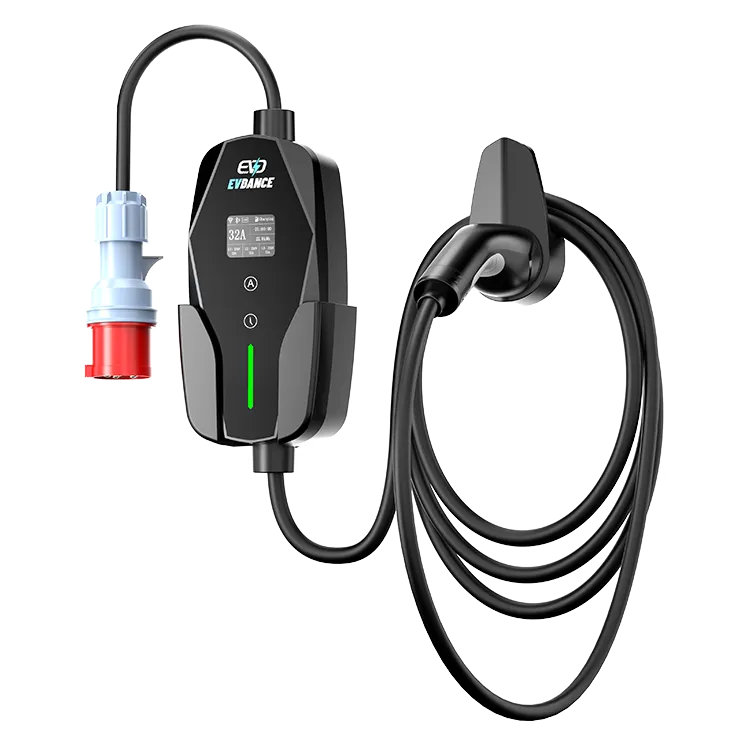
For event charging there are two answers to “there is no fixed charger here”. A mobile battery charger carries its energy with it: a finite store that delivers anywhere, then has to be refilled. A CEE-fed portable like the EV-ACS3205PE carries nothing: it draws up to 22 kW from the site’s three-phase supply for as long as a suitable 32 A socket is available. One question decides between them — does the site have power to spare, or must the power arrive in the vehicle?
Key Takeaways
- The choice is about where the energy lives: in a finite store the unit carries, or in the site’s supply the portable draws from.
- The arithmetic flips with scale: two cars and no supply favour the battery; ten cars and a feed favour the portable.
- Confirm socket class and spare capacity with the power team before choosing socket-fed equipment.
- No battery-unit capacities, weights or prices are quoted — the comparison is class-level and the illustration numbers are labelled.
Two Machines, Two Energy Sources
A battery-buffered mobile unit is a store on wheels: charged beforehand, taken to the car, discharged into it. Its strength is independence — no socket, no supply, no site electrician. Its limit is arithmetic: once spent, the store needs charging time before the unit can serve again. Our explainer on what an EV mobile charger is covers the class in full.
A socket-fed portable is the opposite trade: light because it holds no energy. Plug it into a 32 A five-pin CEE socket and it passes three-phase power to the car at up to 22 kW, session after session. Its limit is location — it works only where that socket class exists, as our guide to CEE plugs sets out. Between them sits the organiser’s real question: how much energy does the day need?
The Event-Day Energy Question, Worked
Use invented round numbers to see the shape of the decision — illustrations, not product figures. Suppose an event day needs about 200 kWh of top-ups: ten cars taking roughly 20 kWh each. A battery unit with an illustrative 40 kWh store covers two cars, then stops to recharge; ten means refill cycles or several units. The socket-fed portable delivers about 20 kWh per car per hour — the same ten cars across a working day, no refill cycle, provided the site supply can carry the load alongside everything else the event runs. Shrink the day to two cars and no supply, and the battery unit wins by existing where the cars are.
| Question | Mobile battery charger | CEE-fed portable (EV-ACS3205PE) |
|---|---|---|
| Where does the energy come from? | A finite on-board store, filled beforehand | The site’s three-phase supply, drawn live |
| What ends the working day? | The store running down; refill time between jobs | The event ending, or the supply being needed elsewhere |
| Best fit | Short jobs, no usable supply, rescue-style top-ups | Long event days on sites that already run three-phase power |
When Each Class Wins
- Choose the battery unit when there is no suitable socket, the job is a single stranded car, or cars are scattered where no power reaches. That is the roadside pattern our look at roadside charging options describes.
- Choose the socket-fed portable when the event runs a three-phase temporary supply — stages, catering, cabins — and cars queue in one place for hours. The energy is already on site; the charger is the last link.
The EV-ACS3205PE in This Choice
The EV-ACS3205PE is a 22 kW three-phase portable: 32 A at 380–400 V, CEE five-pin plug, Type 2 connector, 1.77-inch display, IP66 enclosure. Its specification lists no battery and no network features, because it is neither a store nor a platform — it is a feed. The buying question is about the site, not the unit: confirm socket class and spare capacity with the power team first. Where that comes back positive, one portable covers car after car all day. EVDANCE is a Shenzhen manufacturer founded in 2011, and the model carries its 3-year standard warranty.

Frequently Asked Questions
Can a battery charger match 22 kW all day?
Only while its store lasts. Rate and total are different questions: a battery unit may deliver quickly, but its day is capped by what it carries plus refill time; the portable’s, by the event day itself.
Can I charge an EV from a portable battery at all?
Yes — that is what the class is for, and our article on charging an EV with a portable battery explains the limits: a top-up, not a full-charge service.
What if the event site has only single-phase power?
Then this three-phase portable is not the tool — it needs its 32 A socket. Single-phase sites belong to the smaller portable classes, or to the battery units. Confirm the supply before choosing equipment.
Related Reading
- What Is an EV Mobile Charger?
- Can You Charge an EV With a Portable Battery or Power Bank?
- CEE Plugs Explained: Choosing 16A or 32A for a Three-Phase Portable EV Charger

