
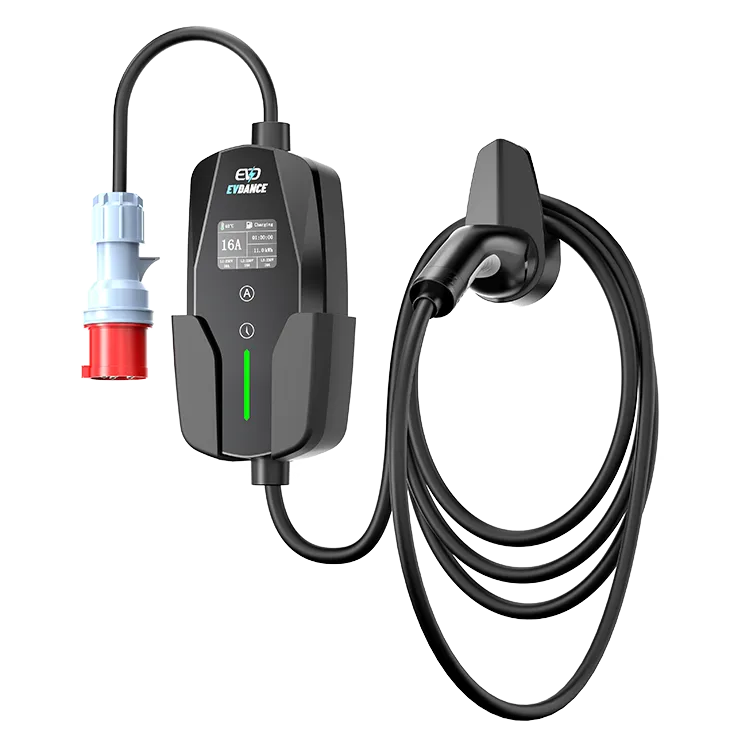
Decide by the supply at your parking space, not by the bigger number. On a single-phase supply, the EV-ACS3210E delivers up to about 7 kW, drawing 32 A on one phase. Where a three-phase supply and a five-pin CEE socket are within reach, the ACS1605PE draws a gentler 16 A per phase and delivers about 11 kW. Both plug into the car with a Type 2 connector — the wall side is what differs.
Key Takeaways
- Your property’s supply type decides this choice before the products are compared.
- The EV-ACS3210E gives about 7 kW on single-phase; the ACS1605PE gives about 11 kW across three phases at 16 A each.
- For ordinary nightly top-ups both finish in time; the gap shows with big batteries and short windows.
- The car must also accept three-phase AC for the 11 kW to arrive — check its specification.
Start at the Fuse Box, Not the Product Page
Your supply type is a fact about your property, and it settles this choice before any product comparison starts. Check it one of three ways:
- Look for the socket. A blue or red five-pin CEE socket near where you park means three-phase power is already there.
- Read the consumer unit or meter. The supply is usually labelled; if the labelling is unclear, do not guess from the number of breakers.
- Ask an electrician. Confirming the supply is a short visit, and the same visit can confirm the socket is fit for continuous charging.
The concept behind the two options is covered in our explainer on single-phase vs three-phase EV charging. This article stays on the decision between these two units.

The Two Units Side by Side
| EV-ACS3210E | ACS1605PE | |
|---|---|---|
| Supply it needs | Single-phase | Three-phase |
| Current | 10–32 A adjustable, on one phase | 16 A on each of three phases |
| Charging power | About 7 kW (32 A × 230 V ≈ 7.4 kW, labelled arithmetic) | About 11 kW (16 A × 230 V × 3 phases, labelled arithmetic) |
| Wall plug | Version to match your socket — confirm when ordering | CEE five-pin |
| Car connector | Type 2 | Type 2 |
| Cable | 7.5 m | 7.6 m |
| App and energy monitoring | Yes, with OCPP-ready connectivity | Not listed for this model |
| Weather sealing | IP66 | IP66 |
Our guide to CEE plugs for three-phase portable chargers covers the plug shapes.
What the Extra Phases Actually Buy
Run the overnight arithmetic, with roughly 10% allowed for losses: at about 7 kW an eight-hour night adds roughly 50 kWh; at about 11 kW, roughly 79 kWh. For a daily top-up of 10–20 kWh, both units finish long before morning, and the difference never shows. The gap appears with a large battery, a short parking window, or two cars taking turns on one socket.
The load shape differs too: the single-phase unit puts its whole 32 A on one phase, the three-phase unit spreads 16 A across three. Which your supply handles more comfortably is part of the electrician’s check, not a product claim.
One warning in the other direction: a three-phase unit bought for a single-phase property buys nothing. There is no reduced mode that turns it into the other product — the supply decides which unit can work at all.
The Car Has a Vote
The charger offers; the car’s onboard charger decides how much it accepts. An 11 kW session only happens if the car can take 11 kW of three-phase AC. A car limited to single-phase AC charging will charge at its own ceiling on either unit, and then the EV-ACS3210E’s adjustability and app matter more than the phase count. Check your car’s AC charging specification before you pay for phases your car cannot use.
So the order of decisions is: confirm the supply, confirm the car, then pick the unit that matches both. The EV-ACS3210E is the single-phase answer, with current adjustable from 10 A to 32 A, an app with energy monitoring, and a 7.5 m cable. The ACS1605PE is the three-phase answer where that supply already exists. Both are in the wider range of portable EV charger types the site explains.
Frequently Asked Questions
Can I run the ACS1605PE on a single-phase supply?
No. It is a three-phase unit: 16 A per phase through a CEE five-pin plug. On a single-phase property, the EV-ACS3210E is the matching product.
Will the 11 kW unit always charge my car faster?
Only if your car accepts 11 kW of three-phase AC. If the car’s onboard charger is single-phase or capped lower, it sets the pace on both units, and the sessions take the same time.
How do I find out which supply my home has?
Look for a five-pin CEE socket, read the supply label on your meter or consumer unit, or ask an electrician to confirm. Do not infer it from the age or size of the house.
Related Reading
- Single-Phase vs Three-Phase EV Charging: 7 kW, 11 kW and 22 kW Explained
- CEE Plugs Explained: Choosing 16 A or 32 A for a Three-Phase Portable EV Charger
- Portable EV Charger Types Explained: 10 A, 16 A, 32 A and Three-Phase Models

