
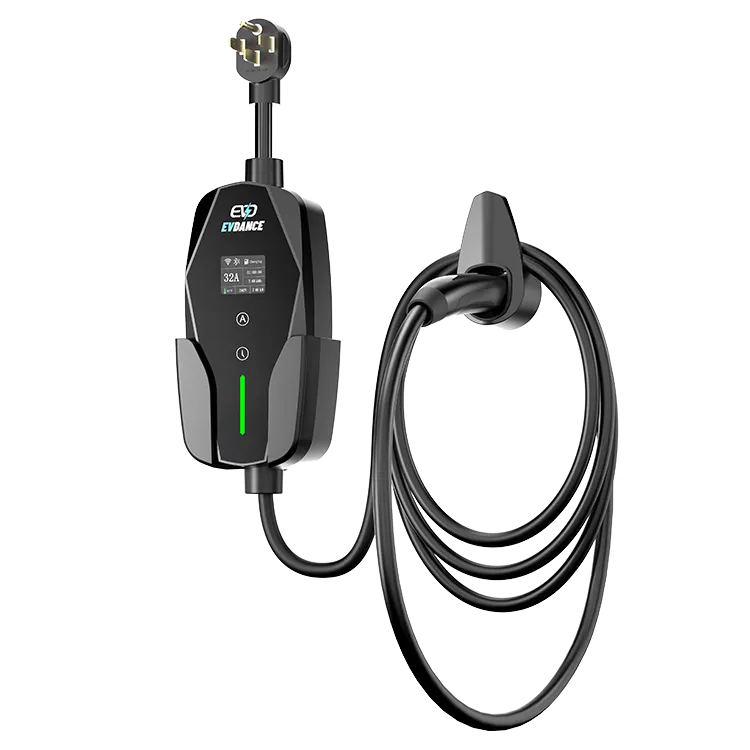
An adjustable charger is hard to sell from a sealed box, because its selling point is a choice: six current steps that fit many different home circuits. A good in-store display makes that choice physical — the unit out of its box, the step selector and screen in reach, and one chart mapping each step to its breaker. The display does not need a live charge to make its point, and it should never be wired up improvisationally.
Key Takeaways
- Display the choice, not just the charger: unit in hand, step selector reachable, step-to-breaker chart beside it.
- The display needs no live power — handling plus the chart carries the whole argument.
- A powered demo is an electrician-installed circuit decision, never an improvised one.
- Staff need one question — the customer’s breaker size — and one boundary: wiring advice belongs to the customer’s electrician.
What the Display Has to Explain
The customer’s real question is not “is it a good charger?” but “will it work at my house, and how fast?” An adjustable charger answers it with a small table — and the table is the display’s centrepiece, because it turns the customer’s own breaker size into a charging speed:
| Step on the unit | Breaker it needs | Power at 240 V |
|---|---|---|
| 10 A or 12 A | 15 A | About 2.4–2.9 kW |
| 16 A | 20 A | About 3.8 kW |
| 20 A | 25 A | About 4.8 kW |
| 24 A | 30 A | About 5.8 kW |
| 32 A | 40 A | About 7.7 kW |
The breaker column exists because charging is a continuous load, sized at 125% of the current — the rule behind our guide to what size breaker an EV charger needs. With that chart on the shelf edge, one SKU serves the customer whose garage circuit is 20 A and the customer whose is 40 A. That is the retail argument for adjustability, and it fits on a card.
The Demo Problem: Power
A portable charger’s natural demonstration — plug it into a car and watch it charge — needs a 240 V circuit and a car; most shop floors have neither at the shelf. The display works without them:
- Handling is the demo. Weight in the hand, the cable’s flexibility, the connector, the screen and the step selector are all assessable unpowered — the relevant test for a product carried and coiled weekly.
- A live demo is a facilities decision. A genuinely powered display means a properly installed circuit, put in by a licensed electrician — never improvised from a shelf socket.
The One Question Staff Should Ask
“What size breaker feeds the outlet you would use?” turns a browser into the right recommendation: read across the chart to the step their circuit supports, and the customer leaves knowing their first setting. Two boundaries keep that conversation safe. Staff are matching a setting to a circuit, not advising on wiring — any question about adding or changing a circuit belongs to the customer’s electrician. And the connector question comes first: this unit is NACS, native for cars with a NACS inlet; a J1772-inlet car charges from it only through the adapter the car maker supplies or approves for AC charging. Background: our Type 2 vs J1772 vs NACS comparison.
The Retailer Side
The EV-ACS3210T is a 32 A NACS portable charger: six steps from 10 to 32 A, a NEMA 14-50P plug, a 1.77-inch screen and an IP66 housing, backed by EVDANCE’s 3-year standard warranty. Retailers source it through the reseller and distributor program. EVDANCE, a Shenzhen manufacturer founded in 2011, exports to 30+ countries, with private label from 100 units. Selling online carries its own listing and compliance work — see our checklist for selling portable EV chargers online. In store, the display above is the whole job: unit in hand, chart beside it, one question asked well.

Frequently Asked Questions
Does the display unit need to be plugged in?
No. The selling points — steps, screen, connector, build — are all assessable unpowered, and the chart does the technical explaining. A powered display is worth doing only as a properly installed circuit: a facilities decision.
What should the shelf card say?
The facts that decide the purchase: the six current steps, the breaker each step needs, the connector type, the IP66 rating and the warranty. Everything on the card should match the box and the rating label — the customer will compare them.
How much electrical knowledge do staff need?
Enough to use the chart and know its boundary. Matching a step to a breaker is a lookup; advising on wiring is not a retail job. The right answer to a wiring question is a direction — their electrician — not a guess across the counter.
Related Reading
- Selling Portable EV Chargers Online: Listing and Compliance Checklist
- EV Charger MOQ Explained: What Sets Minimum Order Quantities
- Type 2 vs J1772 vs NACS: Which EV Charger Connector Does Your Market Need?
- What Size Breaker Do I Need for an EV Charger?

