
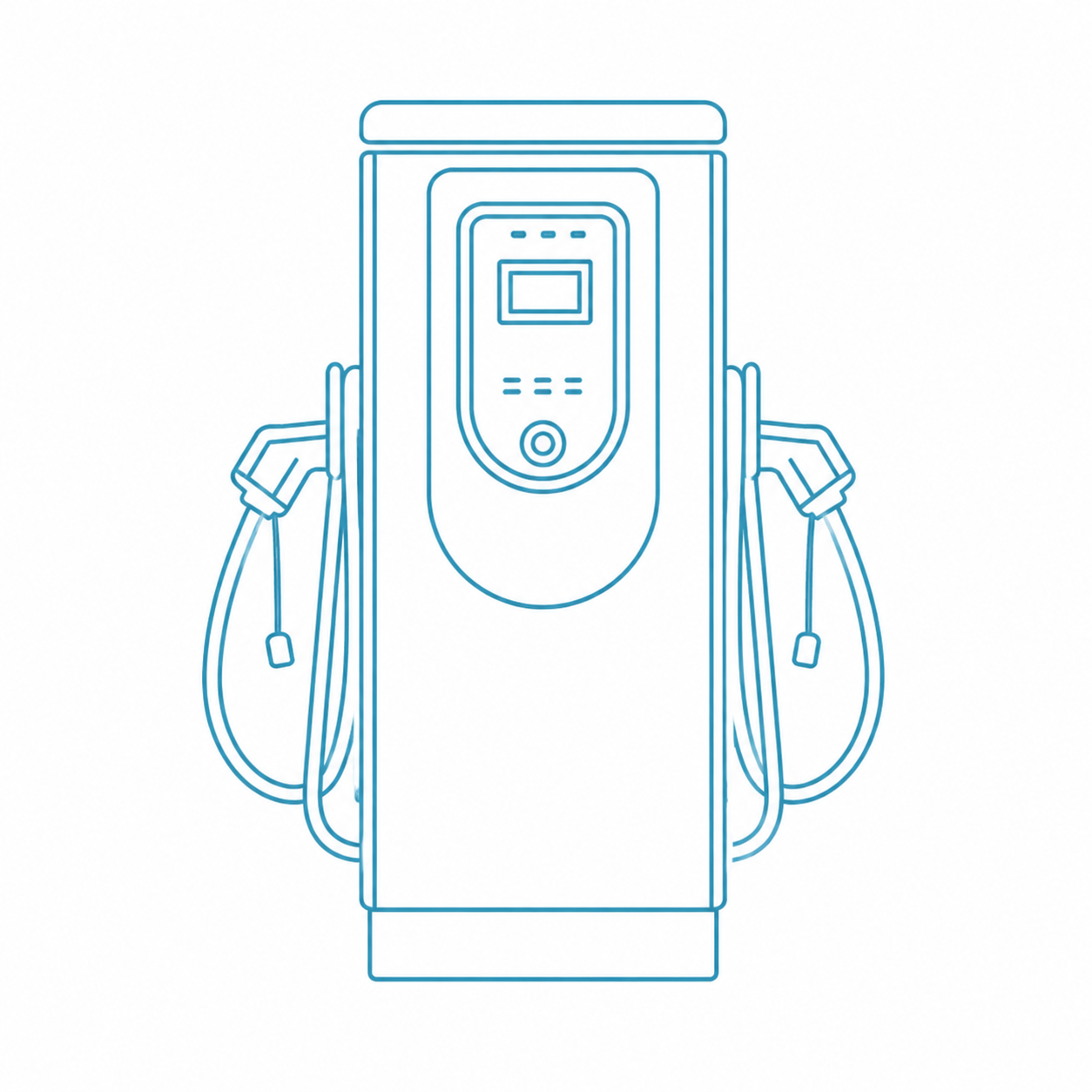
A spare parts plan for a DC charger is the operator’s own document. It lists the parts that get handled and wear, what the operator holds on site, what only a qualified service visit should touch, and the questions the supplier must answer in writing. For the EV-RHDC30K-L, the plan starts from what the listing states — a floor-standing, single-connector 22 kW DC unit with an LCD and OCPP 1.6J — and treats everything beyond that as a confirmation to obtain, not a shelf to guess at.
Key Takeaways
- The plan is the operator’s document: handled parts on the operator’s shelf, cabinet internals booked as service.
- Stocking decisions come from the manual and the written answers — this listing names no filters or fans, so the plan stocks none.
- The daily visual walk decides what the shelf must answer; the failure log decides what it holds next year.
- Warranty coverage, parts classification and lead times are written confirmations, never assumptions.

Two Shelves: What You Hold and What You Never Touch
| Part area | Whose shelf | Why |
|---|---|---|
| Connector (connector) and its cable | The operator’s stocking decision | Gripped, coiled and holstered at every session — the first place damage shows |
| Holster and exterior fittings the manual names as replaceable | The operator’s stocking decision, per the manual | Outside the cabinet, exposed to weather and use |
| Power electronics and everything inside the cabinet | Qualified service only | The cabinet is a service workspace, not an operator parts shelf — the plan books a visit; it does not stock boards |
Deliberately absent: this model’s listing states no cooling hardware — no filters, no fans — so the plan lists none as spares. If the supplied manual names serviceable items, they enter the plan from the manual. A plan written from a listing’s silence would be inventing a parts catalogue.
The Daily Check Decides What You Stock
The stocking list earns its items from the operator’s own routine: the visual walk of the connector and cable — the connector face and pins as observables, the cable jacket along its run, the holster fit. A finding on that walk takes the unit out of service, and the plan then says what happens next: a shelf part the operator is authorised to swap, or a service call. Our guide to spare parts and the RMA process for distributors covers the pipeline a failed part enters; this plan covers what happens before anything enters a pipeline.
Questions the Supplier Answers in Writing
- Which parts does the manufacturer classify as wear parts for this model, and which of them may the operator replace?
- What documentation is supplied — a parts list, exploded views, service manual access — and in what form?
- What lead times apply to the wear-facing parts? Asked and recorded, never assumed from another model.
- What does the 3-year standard warranty cover on a DC unit, and what evidence does a claim need?
- Is the connector-and-cable assembly a complete swap unit, or a service repair?
The Log Is Part of the Plan
Every failure goes in the operator’s log: what was found, when, how long the unit was down, and which shelf answered it. A year of that log turns the next stocking decision from a guess into arithmetic. On a single-connector site — one connector down is the whole site down — it also prices the continuity question, for or against holding a spare assembly.
The EV-RHDC30K-L in the Plan
The EV-RHDC30K-L is a compact DC unit — 22 kW on its product page, in the class described as 22 kW DC — and its OCPP 1.6J link is how session and status data reaches the operator’s platform — the raw material of the log above. EVDANCE, a Shenzhen manufacturer founded in 2011, offers a 3-year standard warranty; the plan makes that warranty, and the stocking around it, administrable from day one. Operators structuring a wider purchase can use our distributor program page as the commercial starting point.
Frequently Asked Questions
Should the plan include a complete spare charger?
That is a continuity decision, priced from your own log: how often the site can be down. For a single-connector site a spare unit is the simplest answer; the plan makes the trade-off explicit — it does not prescribe it.
Can our own electrician fit internal parts?
Treat the cabinet as qualified-service territory. Who counts as qualified for warranty purposes is one of the written questions above — get the answer before anyone opens the unit, not after a claim is questioned.
How is this different from the distributor RMA process?
The RMA process is the pipeline a faulty part travels through the distributor; this plan is the operator’s side — what you hold, check and record before anything enters that pipeline.
Related Reading
- EV Charger Spare Parts and RMA Process for Distributors
- How Do DC Fast Chargers Work?
- Why Is DC Fast Charging So Expensive?
- How Much Does It Cost to Install a Commercial EV Charging Station?

