
Neither size is “better” — the right DC charger is the one whose power matches how long cars actually stay. A 60 kW+ unit earns its capacity where stops are short and drivers are waiting. A compact 22 kW DC unit like the EV-RHDC30K-L earns its place at one-to-three-hour dwells, where the bigger unit’s extra power mostly idles. Match the power to the dwell time, not to the headline number.
Key Takeaways
- Compare energy delivered inside the stay, not nameplate power: at 30 minutes the 60 kW class wins outright; at 2–3 hours, taper erases most of its lead.
- The bigger class owns turnaround duty, stranger traffic and queues; compact DC owns the one-to-three-hour dwell.
- Power class is installation class — corridor-class supply work costs corridor-class money, at the U.S.-cited figures.
- Audit your own site’s dwell times first; the stay you measure should choose the charger.

The Energy a Stop Actually Delivers
The only honest comparison is energy delivered inside the stop — labelled arithmetic at full rate, before losses and before the taper every DC session follows:
| Stop length | At 22 kW DC | At 60 kW DC | What the gap means |
|---|---|---|---|
| 30 minutes | About 11 kWh | About 30 kWh | Nearly three times the energy — decisive if the driver is waiting |
| 60 minutes | About 22 kWh | About 60 kWh, before taper | A wide gap on paper; many cars begin tapering inside this window |
| 2–3 hours | About 44–66 kWh | Nameplate says 120 kWh+; a real session rarely holds it | Most cars have taken what they need and tapered — the extra capacity idles |
The taper row is the argument. DC charging slows as the battery fills, so a unit’s advantage lives in the first part of a session. Where a car stays long enough for a 22 kW unit to finish the job, the extra power buys minutes nobody needed. Our explainer on how fast a DC fast charger is covers the rate curves behind this.
Where the Bigger Unit Wins Outright
- Turnaround duty. Cars that must leave within the half hour — a fleet between shifts, a rental being turned — cannot wait for arithmetic to catch up. Short dwell is the big unit’s home ground.
- Unknown drivers, unknown stays. A public stop serving strangers must assume the shortest dwell in the queue — capacity is insurance against the twenty-minute driver.
- Throughput queues. Where cars queue for the charger, energy per hour is the site’s output — the bigger unit clears it faster per bay.
None of this criticises the smaller unit; it describes a different job. By the U.S. DOT’s bands, DC fast charging runs 50–350 kW — the 60 kW+ class sits inside that band, built for corridor work.
The Supply Side of the Choice
Power class is also an installation class. U.S. DOE-cited figures put corridor-class DC fast charging at about $38,000–$90,000 equipment plus $20,000–$60,000 installation per unit — U.S. figures for the big-charger class, quoted for scale, never as any unit’s price. A 22 kW-class draw is a smaller supply conversation — less capacity to find on the site’s board, a lighter installation around it — and your installer prices the actual site. Where cars stay for hours, paying for infrastructure that delivers power they cannot use is the expensive way to be wrong.
The Compact Option
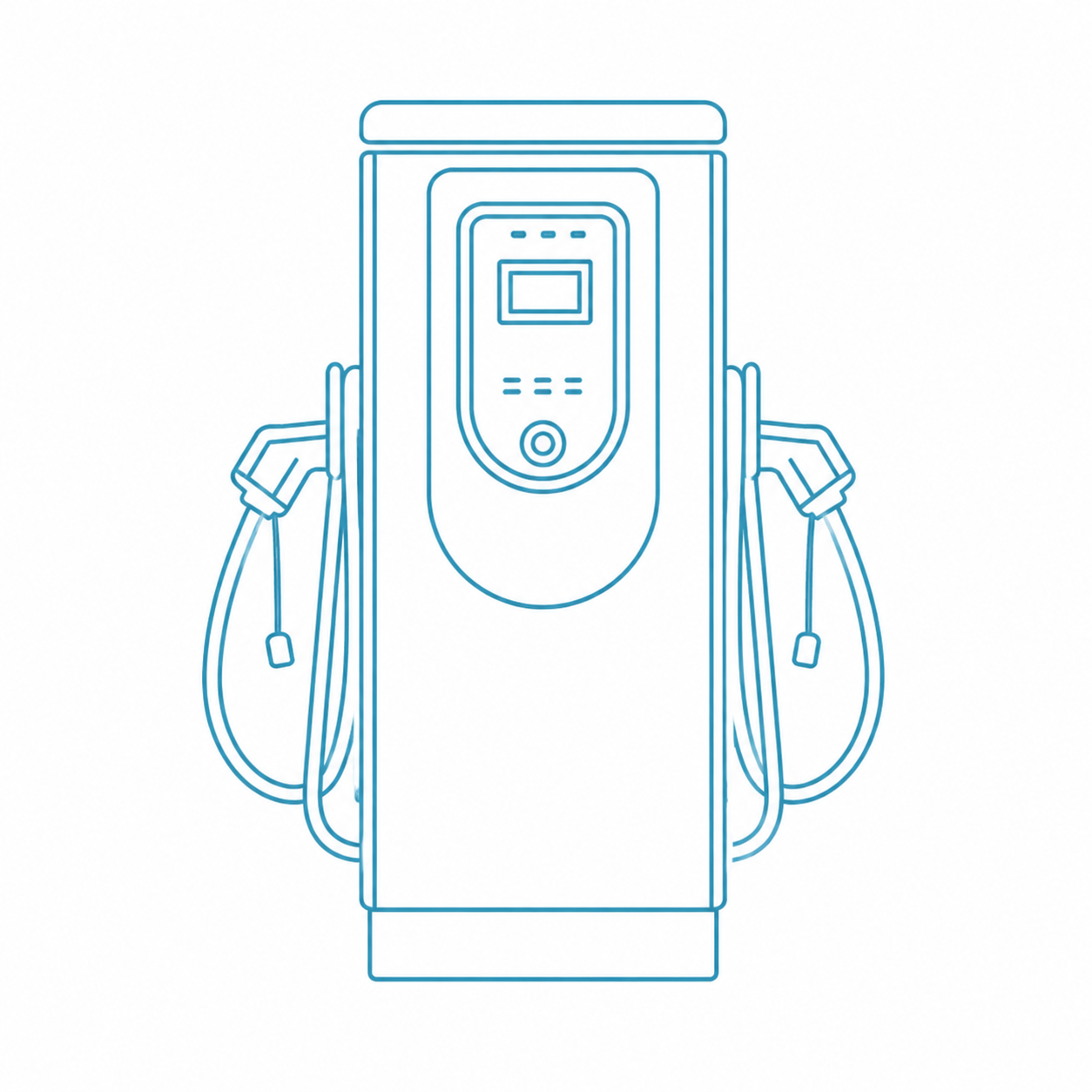
The EV-RHDC30K-L is EVDANCE’s compact DC charger: 22 kW as the product page states it, floor-standing, single connector, IP54, with an LCD for the driver and OCPP 1.6J for the operator’s platform. It sits deliberately below the DOT fast-charging band: faster than AC for the many cars whose onboard chargers cap AC well under 22 kW, and honest about not being a motorway unit. EVDANCE is a Shenzhen manufacturer founded in 2011; the unit carries its 3-year standard warranty. For all-night dwell, AC is the cheaper answer — the commercial charging range covers both.
Frequently Asked Questions
Is 22 kW DC “fast charging”?
It is DC charging at a compact size. The U.S. DOT puts the DC fast band at 50–350 kW, and this unit sits below it — which is why it suits dwell sites, not corridor stops. Call it what it is: a top-up charger for one-to-three-hour stays.
Will a 60 kW charger charge our cars twice as fast on a two-hour park?
Only if the cars accept that rate that long — most do not. Sessions taper as the battery fills, so over a long stay the delivered energies converge well below the nameplate ratio. The gap is real at 30 minutes, mostly theoretical at three hours.
How do I decide which class a site needs?
Audit the dwell from your own site’s observation: under about half an hour points to the bigger class, one to three hours to compact DC, overnight to AC.
Related Reading
- Level 1 vs Level 2 vs DC Fast Charging: A Practical Comparison
- How Fast Is a DC Fast Charger?
- How Do DC Fast Chargers Work?
- Why Is DC Fast Charging So Expensive?

