
There is no standard weight for an EV charging cable, and any single figure would mislead. The weight is set by four build choices — the cable’s length, its current rating, its phase count and its connector pair — so a short single-phase lead and a long three-phase one are different objects in the hand. The only weight that counts for a purchase is the one printed on the exact cable’s own specification.
Key Takeaways
- There is no standard cable weight; rating, phase count, length and connectors set it together.
- Copper for the rating is the biggest driver; three-phase builds add cores and can outweigh higher-amp single-phase leads.
- Weight matters through repetition, cold-stiffened jackets and coil size — not in a single lift.
- EVDANCE states no cable weight for any model; treat the exact figure as a written-confirmation item.
Four Things Set the Weight
| Driver | Why it adds weight | What you feel |
|---|---|---|
| Current rating | A higher-rated cable carries more copper in each core; copper is most of a cable’s mass | The single biggest step: a 32 A class cable is noticeably heavier and stiffer than a 16 A class one |
| Phase count | A three-phase cable carries more power cores than a single-phase cable at the same rating | A three-phase lead can outweigh a slimmer single-phase one of a higher amp class |
| Length | Every metre adds the same copper, insulation and jacket again | The steady multiplier: the long version of the same cable is heavier in direct proportion |
| Connector pair | Two moulded connectors with their latching hardware ride at the ends | A fixed share of the total that does not shrink on a short cable |
This is why the question has no honest universal answer. Read the printing on the jacket and plugs for the rating and phase build before judging by thickness — looks mislead in both directions, as our guide to whether all EV charging cables are the same sets out.

Where the Weight Actually Matters
A charging cable’s weight is carried in two hands for a few seconds at each end of a session, so for most drivers it is a minor fact. It starts to matter in three situations:
- Daily repetition. A heavy three-phase lead coiled and carried twice a day is a different proposition from the same lead used weekly. Weight is an ergonomic cost that compounds.
- Cold weather. Cable jackets stiffen in the cold, so a cable that coils willingly in summer resists in winter — the effect our cold-weather charging guide describes. The mass has not changed; the handling has.
- Storage. The heavier the cable, the larger and stiffer its coil, and the more boot space its loop honestly needs.
The Spec-Sheet Route
Weight is a field a serious listing states, next to length and rating. If the figure matters to you — limited grip strength, a cable that must live in a small frunk — read it off the exact model’s page or ask the maker for it in writing. A listing that omits the weight is itself information, and no review’s estimate can substitute for the figure on the unit you will actually lift.
The EVDANCE Range, on Stated Facts
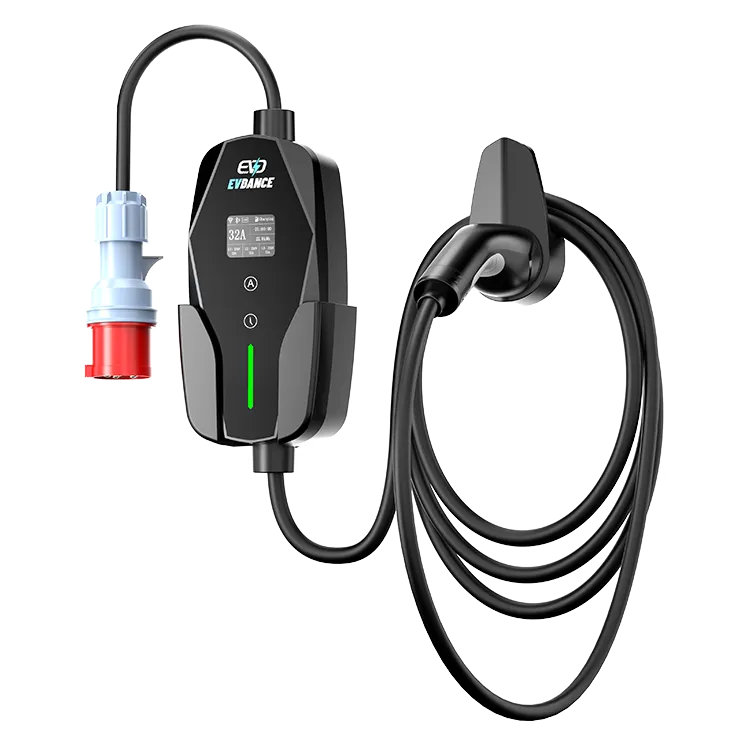
EVDANCE states ratings and protection figures for its portable chargers, and — stated plainly — no cable weight for any of them. The EV-ACS3210E is a 32 A Type 2 portable charger, single-phase at about 7 kW, IP66; the EV-ACS3205PE is a 22 kW three-phase portable charger on a CEE 32A plug, Type 2, IP66. By the drivers above, the three-phase unit’s cable is the heavier build of the two — but the exact figure is a written-confirmation item through our contact page, not a number to infer. DC cables are a separate handling world again: at the top of the DC range some are liquid-cooled, a category of its own and no guide to an AC lead.
Frequently Asked Questions
Is a heavier cable a better cable?
Not by itself. Weight mostly reports how much copper the rating and phase build required; a light cable of the right stated class is not a worse cable. Judge by the stated rating, build and certification, not by the lift.
Why is my 32 A cable so much harder to coil than my old 16 A one?
More copper per core makes the higher class both heavier and stiffer, and stiffness is what fights the coil. A three-phase version adds cores on top of that. It is the expected behaviour of the class, not a defect.
How do I find the weight of a cable I already own?
Check the maker’s page or manual for that exact model first. Failing that, a bathroom scale under the coiled cable answers it for your own unit.
Related Reading
- Are All EV Charging Cables the Same?
- Which EV Charging Cable Do I Need?
- Cold-Weather EV Charging: What Happens to Chargers and Cables Below Freezing
- How Long Do EV Charging Cables Last, and Can They Be Repaired?

