
There is no single figure, because the question hides two different projects. Developing your own charger design puts most of the money into fixed costs paid before the first sale. Branding an existing, already certified charger removes most of those blocks and leaves branding, documentation and commercial setup. Which route you are pricing decides the shape of the budget.
Key Takeaways
- “Develop a brand” prices two different projects: owning a design, or branding an existing certified one.
- Route A’s budget is fixed and front-loaded; Route B’s is led by the per-unit price.
- Certification recurs per market and design change on Route A; on Route B it is an existing file plus paperwork.
- Decide by where your advantage lives — inside the product, or in channel, service and brand.
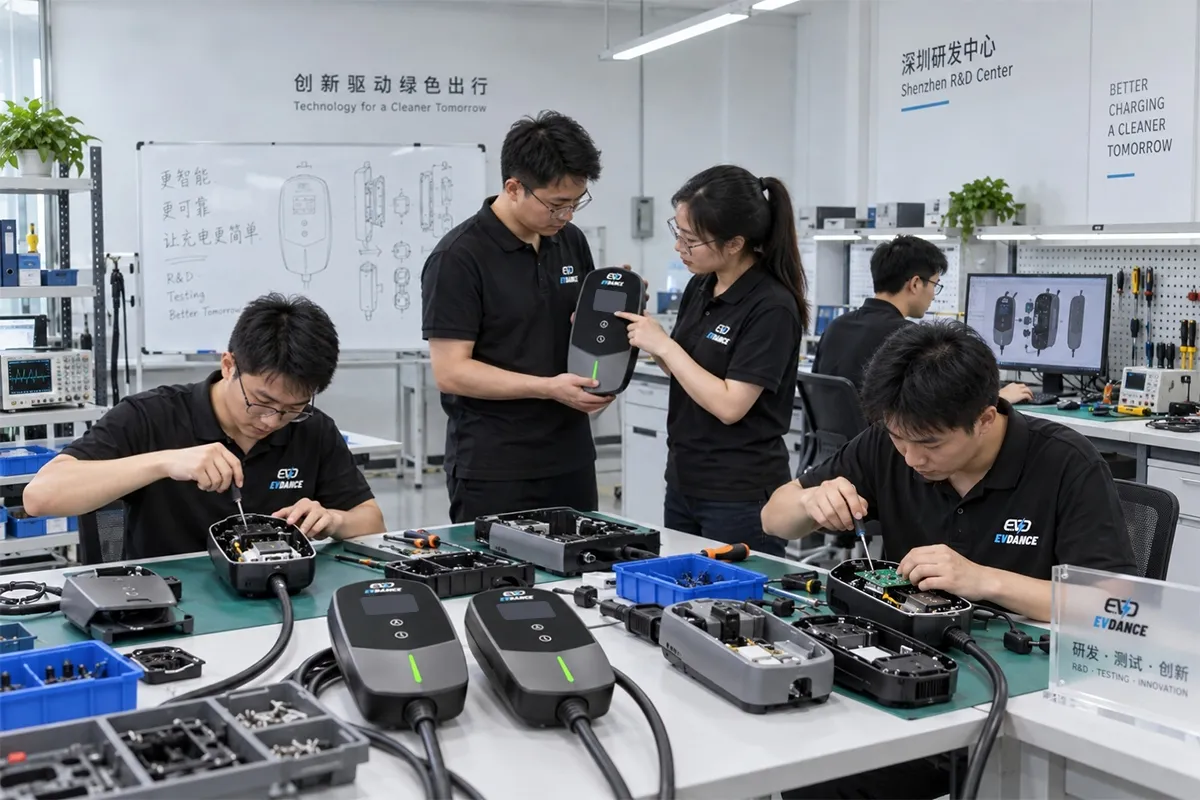
One Question, Two Cost Structures
Put the two routes side by side and the difference is structural: one budget is front-loaded and fixed, the other is led by the per-unit price of the chargers themselves.
| Cost layer | Route A: your own design | Route B: brand an existing design |
|---|---|---|
| Design and engineering | A full block: enclosure, electronics, protection design | None — the design already exists |
| Tooling | Yours to fund: moulds and fixtures for your enclosure | The factory’s, already paid for across its production |
| Prototypes and revisions | Repeated build-test-fix rounds before production | Samples of a finished product, approved once |
| Certification | Per market and per design, repeated when the design or the markets change | An existing file for the exact model; your work is the paperwork around it |
| Software and app | Built by you, then maintained for the product’s life | Only the connected options the model already offers |
| Brand and commercial setup | Present — the same layer as Route B | Present — and nearly the whole budget |
The certification row is the one buyers most often underweight. A design is evaluated market by market — in the United States through an OSHA-recognised Nationally Recognized Testing Laboratory — and a later design change can reopen the file. On Route B, the factory paid that cost before you arrived.
The Layer Both Routes Share
Whichever route you take, you are the seller of record, and carrying a brand has its own costs: the trademark in your launch markets, packaging and manuals in each market’s language, a support process, and a reserve for warranty handling. Our breakdown of what it costs to start an EV charger brand itemises that launch layer; this article is about the decision above it.

What Owning the Design Actually Buys
Route A buys three things Route B cannot:
- Control. You can change the product itself — rating, enclosure, features — not just the label and the box.
- Differentiation. Your charger is not the same unit a competitor can order from the same shelf next week.
- Ownership. Tooling and design files can be yours, under the contract you negotiate.
Against that, price the non-money costs: the months a development cycle adds before the first sale, certification that recurs per market as you expand, and the lifetime maintenance a connected product demands. The deciding question is where your advantage lives. If it lives in your channel, service and brand, Route B buys the same shelf presence at a fraction of the fixed cost. If it must live inside the product, only Route A can own it — and then the fixed blocks are the purchase price of that control, to be quoted block by block in writing.
The Branding Route at EVDANCE
EVDANCE is a Shenzhen manufacturer founded in 2011, with its own factory and exports to more than 30 countries. Its OEM and private-label program offers private label from 100 units, with a 3-year standard warranty — the design, tooling and certification blocks above are already paid for on models such as the EV-ACT5006T 48 A wall charger (ETL, FCC and CE as stated on its page). Bring your market and model to the contact page and ask which branding changes keep the existing certification file valid.
Frequently Asked Questions
Is developing your own design always more expensive?
In fixed, pre-sale cost, yes — by structure: Route A pays for design, tooling and certification that Route B never invoices. Whether it is more expensive overall depends on your volumes and how long you sell the design — a calculation to run on written quotes.
Can I start with private label and develop my own design later?
Yes, and it is a common sequence. The brand assets — trademark, channels, support process — carry over. The hardware file does not: a new design starts its own certification from the beginning.
Which single cost should I pin down first?
Certification for your exact design and launch markets, quoted by the laboratory as well as the factory. It is the block most likely to recur.
Related Reading
- How Much Does It Cost to Start an EV Charger Brand?
- OEM and Private-Label EV Chargers: A Complete Guide for Brands
- Private Label vs Reselling a Branded EV Charger: Pros and Cons
- How an OEM EV Charger Project Works, Step by Step

