
Importing EV chargers into the UK is mostly a paperwork exercise that should finish before the freight starts. As of October 2026, an importer bringing chargers into Great Britain closes four confirmations for each model: the conformity-marking route, whether the smart charge points regulations reach that product type, who carries the importer’s duties (and what changes if the brand is yours), and the customs entry, priced by your broker. Northern Ireland follows different arrangements and is checked separately.
Key Takeaways
- Importing into Great Britain is a sequence of confirmations that close before freight, not at the border.
- The marking route follows current GOV.UK guidance, backed by its declaration and technical file.
- Smart charge points scope is read from the regulations themselves — never from a supplier’s summary.
- Placing a charger on the market under your brand makes the importer’s duties yours; allocate them in writing.

First Gate: The Marking Route for Great Britain
Great Britain has its own UKCA marking, and under the position set out in GOV.UK guidance it continues to recognise CE marking for most products — including the electrical equipment EV chargers fall under — with UKCA available alongside. Which route a charger takes is a per-model, per-launch decision, and whichever mark is used must be backed by its matching declaration of conformity and technical documentation — a mark on the artwork is not evidence. Our guide to UKCA vs CE for EV chargers sold in Great Britain works through the position; recheck official guidance at each launch.
Second Gate: The Smart Charge Points Regulations
Marking is not the only GB gate. The Electric Vehicles (Smart Charge Points) Regulations 2021 govern relevant charge points sold in Great Britain, setting functional and security requirements for those in scope. Whether your product type is in scope is answered from the regulations’ own text — not from a supplier’s summary or a feature list: having smart functions says nothing, by itself, about meeting those requirements. Treat the scope answer as a written item in each model’s launch file.
Third Gate: Whose Name Is on the Product
Whoever places the charger on the GB market carries the importer’s duties: holding or accessing the declaration and technical file; their name and postal address on the product; English instructions and safety information; and complaint records, with action on safety problems. Placing the product under your own brand deepens those duties into manufacturer responsibilities — the normal private-label position. None of it is delegated by a purchase order.
| Confirmation | Closed by | Evidence it happened |
|---|---|---|
| Marking route for the exact model | You, against current GOV.UK guidance | The declaration and technical file for that model |
| Smart charge points scope | You, from the regulations’ text, with an adviser if needed | A written scope note per model |
| Classification, duty and the entry itself | Your customs broker, from your documents | The broker’s written confirmation |
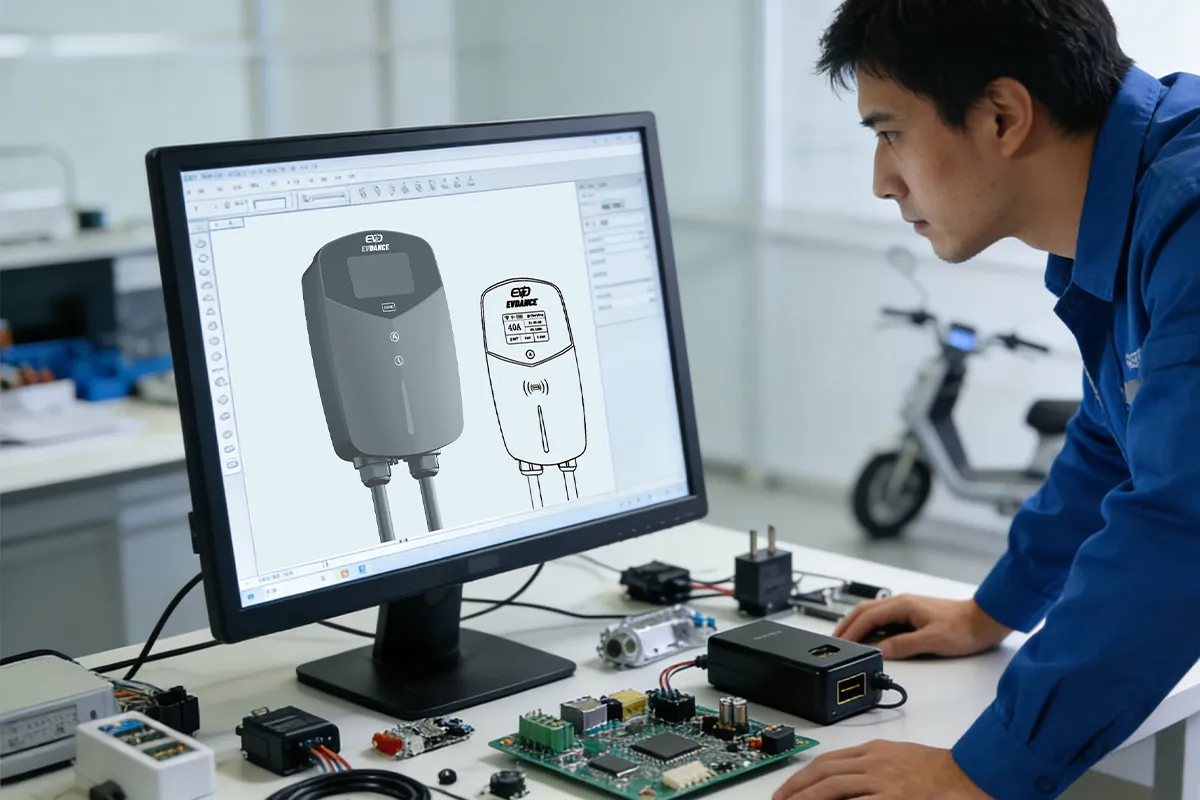
The UK Shelf From EVDANCE
EVDANCE is a Shenzhen EV charger manufacturer founded in 2011, exporting to more than 30 countries, with private-label production from 100 units and a 3-year standard warranty.
For GB programmes the relevant shelf is Type 2: the EV-ACT3204PE, a 22 kW three-phase wallbox with tethered Type 2 cable, RFID and app, IP66 and CE per its listing, and the EV-ACS3210E, a 32 A Type 2 portable charger of about 7 kW, IP66. The GB market version and documentation pack are confirmed in writing before an order — including the smart-regulations scope reading. Start via the distributor program.
Frequently Asked Questions
Does a CE mark settle everything for Great Britain?
No. The marking route is one gate; the smart charge points scope question, the importer’s duties and the customs entry all remain, and each closes separately. A correctly marked charger can still be wrong for a GB launch if its type sits inside those regulations unaddressed.
Do the smart charge points regulations apply to portable chargers?
The regulations define their scope by product type and intended use. Read your exact product against that text — or have a UK compliance adviser do it — rather than relying on any supplier’s general statement. The answer belongs in writing in your launch file.
Can the factory handle the UK side under delivered terms?
A seller can arrange carriage and even the entry under some trade terms, but the duties attach to the party placing the product on the GB market — under your brand, that is you. Confirm in the supply agreement who holds the file, whose name goes on the product and who answers an inspector.
Related Reading
- UKCA vs CE for EV Chargers Sold in Great Britain
- EV Charger Factory Audit Checklist for Importers
- OEM and Private-Label EV Chargers: A Complete Guide for Brands
