
You cannot make a public charger vandal-proof, and any product sold that way should be doubted. What an operator can do is work in layers: put chargers where people already are, keep them lit and overlooked, place the hardware so its fragile parts are protected, and detect and repair damage fast. Each layer prevents some incidents and makes the rest cheaper — none of them prevents all of it.
Key Takeaways
- Prevention is layered: siting and visibility, light and oversight, protected hardware, and fast detection and repair.
- Vehicle impact prevention — kerbs, bollards, bay layout — stops the commonest hardware damage of all.
- IP ratings are weather ratings, never vandal ratings; access control stops unauthorised use, not damage.
- Damage found fast and repaired fast protects uptime, evidence and the next incident’s odds.
Layer 1: Siting and Visibility
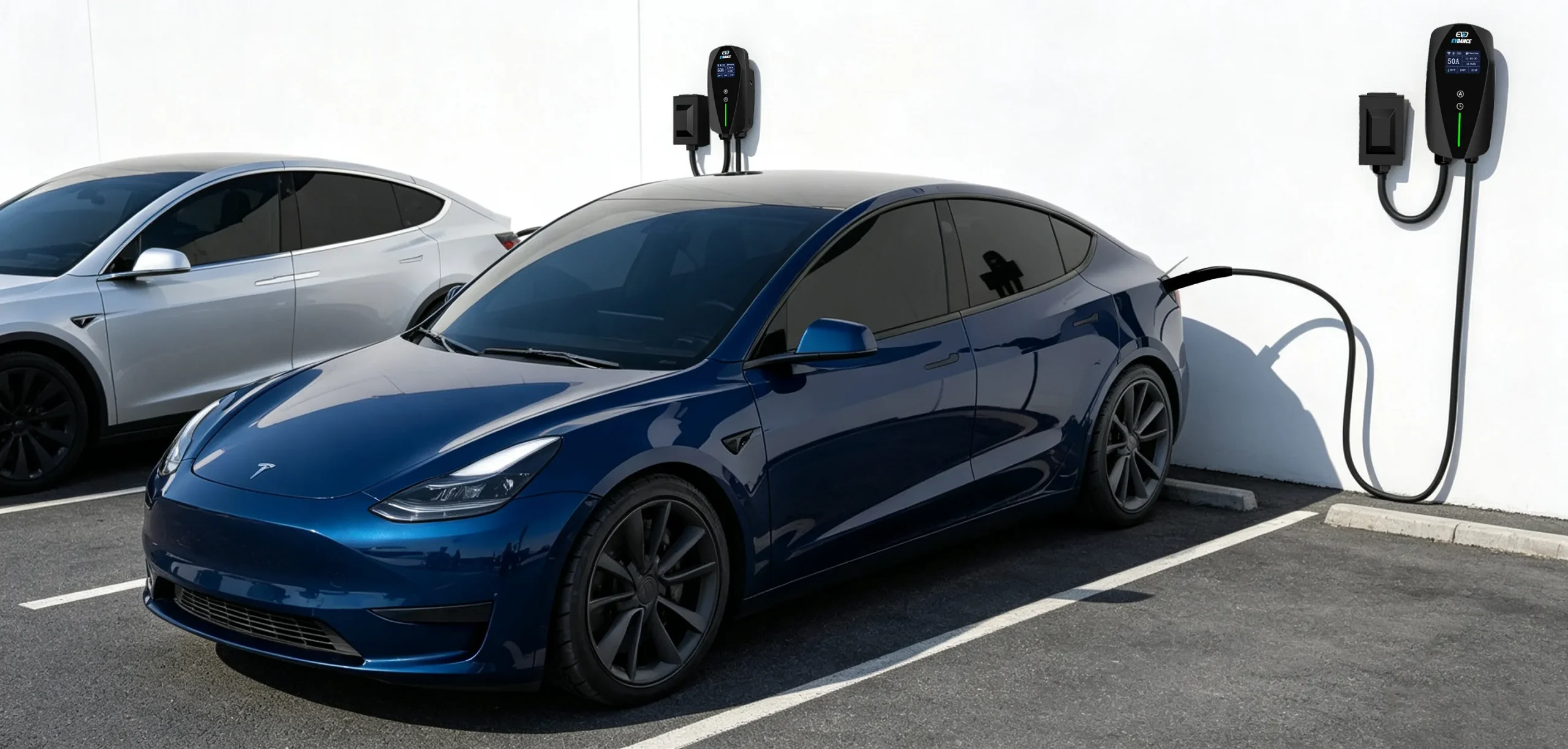
Most interference is opportunistic, and opportunity shrinks in busy places. Chargers placed in active, overlooked bays — near entrances, staffed areas and passing foot traffic — are simply harder to damage unobserved than chargers in an isolated rear corner. Vehicle impact belongs in the same layer: a charger a car can clip will eventually be clipped, so kerbs, bollards or bay layout that keep vehicles off the hardware prevent the commonest “vandalism” of all, which is not vandalism but a bumper.
Layer 2: Light and Oversight
Lighting does double duty — drivers handle connectors more carefully in a lit bay, and interference prefers darkness. Cameras belong in this layer as a category: a deterrent to casual damage and, more reliably, evidence afterwards for the police and your insurer. Neither is a guarantee. Sites usually scope lighting and camera coverage in the original project, because retrofitting oversight into a finished car park costs more than designing it in.
Layer 3: The Hardware Itself — and Honest Ratings
| Measure | What it protects | Its limit |
|---|---|---|
| Solid mounting and fixings | The unit itself, against being forced or pulled at | Only as good as the installation — every fixing point used, into a solid base |
| Holstered connectors and managed cables | The connector and cable, the parts most often damaged | Cable protection is its own topic — see the guide in Related Reading |
| Access control (RFID, app) | Your electricity and your session data | It stops unauthorised use, not damage to the box |
| Enclosures, where a site suits them | The unit, behind a second barrier | Public charging is open by design; a cage fights the access the site exists to give |
One rating point needs stating plainly, because it is often mis-sold: an IP rating — IP54 or IP66 — measures protection against dust and water. It says nothing about impact. Impact resistance is a separate scale, and no charger should be presented as vandal-resistant on the strength of an IP number.
The hardware examples follow that honesty. The EV-AC03201T is a floor-standing dual-connector AC station (two Type 2 connectors sharing up to 43 kW, OCPP 1.6J, IP54) whose stated rating is a weather rating; the EV-ACT3204PE wallbox (22 kW, Type 2, IP66, CE) adds RFID and app access control — the use-prevention layer above. The wider range is on our commercial EV charging page.

Layer 4: Detect Fast, Repair Fast
- Monitoring and fault alerts, so a damaged or dead unit is known about in hours, not discovered by a driver weeks later.
- A repair route agreed in advance — who attends, with what spare parts, on what response terms.
- Damage made safe immediately: a breached housing or cut cable is an electrical hazard before it is a repair ticket, so it is isolated and taken out of service first.
- Records for every incident — photographs, dates, the repair file — which feed the insurance claim and show whether one site keeps being targeted.
Frequently Asked Questions
Will CCTV stop vandalism?
No camera guarantees that. Cameras and lighting deter casual interference and provide evidence afterwards; siting, mounting and fast repair do the rest of the work. Treat a camera as one layer, never the plan.
Is an IP66 charger vandal-proof?
No. IP66 is a dust and water rating — it certifies sealing against weather, not resistance to impact or tools. A charger presented as vandal-proof on an IP number is being misdescribed.
Should public chargers be locked in cages?
Usually that trades away the thing the site is for: open access. Enclosures suit some private or semi-public sites, and our guide to whether you need an EV charger enclosure works through the choice. On genuinely public sites the layered approach above is the standard answer.
Related Reading
- Can EV Charging Cables Be Stolen? How to Lock and Protect Yours
- Do You Need an EV Charger Enclosure?
- How to Open an EV Charging Station: Step by Step
- How Do Commercial EV Charging Stations Work?

