
An IC-CPD designed for Europe follows three rules. The whole cord set — wall plug, control box, cable and Type 2 connector — is type-tested as one product. Its earth-fault detection is designed for the DC residual currents EV charging can produce. And its current settings respect the domestic plug it ships with. National wiring rules then decide what the installation must add. The rules below are the checklist; the accredited test report is the proof.
Key Takeaways
- The IC-CPD cord set is tested as one product, per plug variant — post-test part changes break the evidence.
- Fault detection must be designed for DC residual currents, with the in-box or upstream split stated in the manual.
- Current settings are rated for the shipped wall plug — usually the weakest link.
- National rules differ: confirm each market, dated, before production.
Rule One: The Cord Set Is the Product
Mode 2 charging — the framework our guide to Mode 2 vs Mode 3 charging and IEC 61851 explains — puts the control and protection on the cable, in the IC-CPD. The parts work as one system and are tested as one: change the plug, box or connector after testing and the evidence no longer describes the product you ship. For Europe the vehicle end is Type 2, while the wall end changes by country (see our Type 2, J1772 and NACS comparison). A European range is therefore a family of tested variants, not one SKU with swappable plugs.

Rule Two: Design the Fault Detection for DC
An EV session can push smooth DC residual current through a fault, blinding a detector built only for AC fault shapes. European design practice answers in one of two ways: detection covering the DC case inside the box, or a stated requirement for a matching device upstream. Our RCD protection explainer covers the terms. The rule is not which answer you pick, but that it is chosen, tested and written in the manual the installer works to. One boundary: requirements for fixed charge points, including the UK’s own rules for installed units, are a separate case from a portable on a socket. Never present a portable design as meeting fixed-installation rules; confirm each market’s position with the local authority or your test house.
Rule Three: Rate the Set for the Plug It Ships With
A single-phase European portable sits in the roughly 7 kW class, but the wall plug is often the weakest link. A plug end running warm for hours is a design failure, not user error. Adjustable current steps exist for this reason: the box can be set to what the shipped plug and socket can carry continuously, and the plug end’s temperature is a design watch-point. Three-phase designs move the same problem to industrial sockets, with their own ratings.
| Design rule | What it fixes | Evidence to request |
|---|---|---|
| Test the cord set as one product | Plug, box, cable and connector proven together, per variant | Type-test report naming the exact model and variant |
| Design fault detection for DC residual current | The detector is not blinded by smooth DC faults | The detection method stated in the manual, backed by the test report |
| Rate the set for its shipped plug | Current settings the wall plug can carry continuously | Ratings and setting steps as tested, not as marketed |
| Check national deviations per market | Plugs, wiring rules and installation duties differ by country | A per-market confirmation from the test house, dated |
EVDANCE Portables for European Buyers
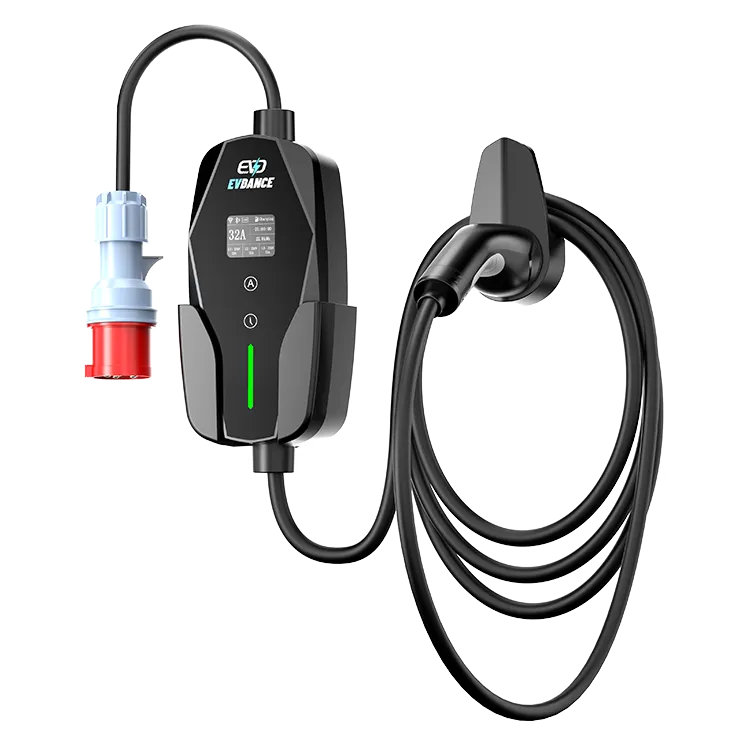
The EV-ACS3210E 32A Type 2 portable charger is a single-phase unit of about 7 kW with an IP66 rating. The EV-ACS3205PE 22 kW three-phase portable charger uses a CEE 32A plug and a Type 2 connector, also IP66, for sites with three-phase sockets. The pages state ratings and sealing; market-specific compliance documents are confirmed per model, in writing, through the contact page. Requirements change — the position noted here is as of October 2026 — so confirm the current position with your test house before a production run, especially for private-label volumes.
Frequently Asked Questions
Does a CE-marked IC-CPD sell legally in every European country automatically?
CE marking is the manufacturer’s declaration under the EU framework, supported by test evidence. National wiring rules, plug standards and installation duties still differ by country, so confirm each target market separately.
Does the box’s fault detection replace the RCD in the home?
Only where the design and its manual say so; many designs still rely on protection in the installation. If the manual does not state it, ask the manufacturer in writing.
Can one IC-CPD design serve both the EU and the UK?
The connector and Mode 2 framework overlap, but the UK applies its own rules. Treat it as a separate confirmation, and never claim compliance the documentation does not state.
Related Reading
- Mode 2 vs Mode 3 Charging: What IEC 61851 Means for Portable EV Chargers
- RCD Protection for EV Chargers: Type A, Type B and 6 mA DC Detection Explained
- EV Charger Certifications Explained: CE, UKCA, UL, ETL, CB and What Buyers Should Ask For

