
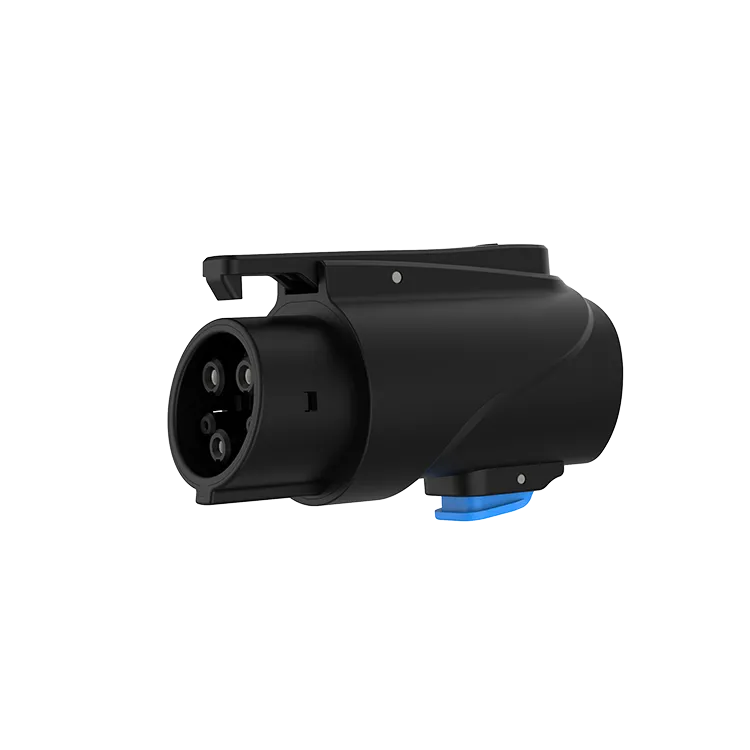
Start with what the product is: the JT02’s listing names no lock, latch or anti-theft feature. It is a loose item by design — it sits between the charger’s plug and your car, held only by the connectors at each end. So prevention is not a feature you switch on. It is where you charge, whether you stay within reach of the session, and whether the adapter leaves the connector when you do.
Key Takeaways
- The JT02 listing names no lock or anti-theft feature — it is a loose item, and prevention is behaviour.
- The strongest habit is the simplest: when the session ends, the adapter goes in the car, never left in a public connector.
- A car’s inlet lock, where fitted, is the car’s feature — a useful second layer during a session, not a guarantee.
- Choose attended, lit sites for long unattended windows, and match the session to your stay.
The Habit That Does Most of the Work
An adapter is only exposed while it sits in a public connector, and the driver controls both ends of that window. The habit that answers most of the risk is unglamorous: when the session ends, unplug it and put it in the car — every time, as part of the unplugging routine. The corollary matters as much: never leave it sitting in a shared charger’s plug “ready for next time” — unattended indefinitely in the connector, unexposed in your glovebox. While a session runs, the window is the session itself — plan public sessions you can stay near the end of, rather than leaving the car for the day.
The Car’s Side: A Lock That Isn’t the Adapter’s
Many J1772 cars lock the connector into the inlet while a session runs — and where yours does, that lock also holds the adapter’s car-side end. Two honest limits. First, the behaviour is the car’s feature and it varies: check your car’s manual for whether it locks, and when it releases. Second, a locking inlet protects one joint during one session — nothing for an adapter left behind afterwards — and a lock is a delay, not a guarantee. Treat it as a welcome second layer, not a reason to leave the adapter exposed.
Choosing the Site and the Moment
- Prefer attended, lit, busy sites where you have the choice. This is prudence, not a rating of neighbourhoods — more people around means fewer unobserved minutes.
- Match the session to your stay. A top-up while you are nearby is a short window; a workday or overnight is a long one, arguing for the more attended site.
- At hotels and hosts, ask. A destination charger is the host’s equipment on the host’s premises — where guests charge, and what the host expects, is the host’s call.
- If a site feels wrong, change sites, not gadgets. No accessory converts an uncomfortable location into a supervised one.
| Situation | The exposure | The habit that answers it |
|---|---|---|
| Charging while you stay nearby | The session window itself | Stay within reach of the session’s end; take the adapter with you after |
| Car left for hours — workday, overnight | A long unattended window | Choose the attended site; know whether your car locks the connector |
| Adapter left in the charger’s plug “for later” | Exposed indefinitely, for anyone | Never — unplug it and store it in the car |

The Adapter Itself
The EVDANCE JT02 is a NACS-to-J1772 AC adapter rated up to 80 A, with silver-plated copper contacts and an IP65 rating. None of that spec is an anti-theft provision, and none is claimed here — the protection is the driver’s routine and the site, applied to an item small enough to pocket. That cuts both ways: easy to take, and just as easy to take with you. For the wider picture of using other networks’ chargers, see can I use a Tesla charger for other cars.
Frequently Asked Questions
Does the JT02 lock to my car?
No lock is named in its listing. If your car locks the J1772 connector into its inlet during a session, that lock also holds the adapter’s car-side end — but the lock is the car’s feature, so its behaviour is a question for your car’s manual, not for the adapter.
Do cable locks or tethers help?
An aftermarket tether is your own accessory choice. It can slow a casual grab, but it is not a security guarantee — and anything you add must never strain or twist the connector during a session.
Is it fine to leave it charging unattended at a hotel?
That is a judgement about the site, not the adapter: the charger is the host’s equipment on the host’s premises, and drivers charge unattended at hosts they trust nightly. The adapter adds no protection, so let the site — attended, lit, host-managed — carry the decision.
Related Reading
- Are EV Charging Adapters Safe?
- Can I Use a Tesla Charger for Other Cars?
- Can a Tesla Use J1772 Chargers?
- What Is J1772? The North American EV Plug Explained

