
Yes — a mixed site works when each technology is given the job it suits. The dual-connector AC station serves cars that stay for hours; the compact DC unit serves cars that stop for under an hour. Plan them as one site from the start: one zoning decision, one load picture, one platform conversation, even if the DC unit is installed a season later.
Key Takeaways
- Zone by dwell: AC connectors where cars stay, the DC connector where cars stop.
- Design one load picture — 43 kW of AC ceiling plus a 22 kW-class DC draw — and let the electrician and utility size it.
- Both units list OCPP 1.6J; confirm both models with your platform provider in writing.
- Confirm the DC unit’s connector variant in writing before ordering — its listing does not name one.
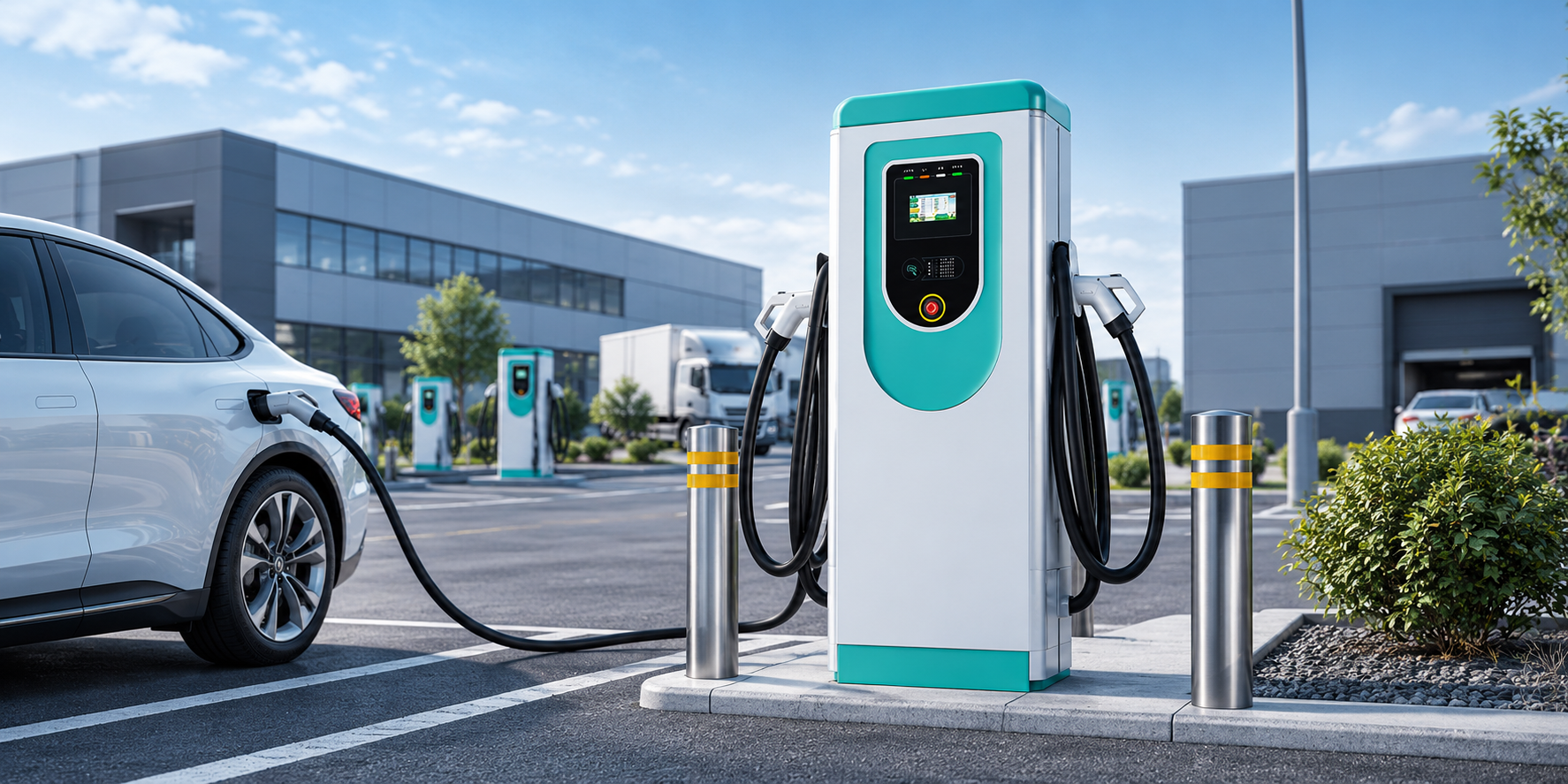
Zone the Bays by Dwell, Not by Hardware
The design rule is the dwell split: put each technology where its pattern already happens in your car park.
| Bay role | Hardware | Session shape | Site rule that makes it work |
|---|---|---|---|
| Stay bays (staff, residents, all-day visitors) | EV-AC03201T AC connectors | Hours plugged in; a large charge, capped by each car’s onboard charger | Bays signed for long stays, so a settled car is never blocking a queue |
| Stop bays (customers, short visits, turnarounds) | EV-RHDC30K-L DC connector | A top-up sized to a short stop, then the bay frees | The DC bay is a stop, not a parking space — signage and time expectations are the operator’s policy |
Zoning is also communication: a driver who settles into the DC bay for three hours has not broken the charger — the site has failed to say where each service lives. Our site selection guide covers placement.
One Load Picture, Not Two
Electrically, the mix is one sum. Labelled ceiling arithmetic: the AC station adds up to 43 kW at full output, and the DC unit is one further draw in the 22 kW class — 65 kW of combined nameplate ceiling, before the rest of the building’s load. Real sessions sit below ceilings, but the supply is designed against the picture, not the average.
- One load calculation covers both. Your electrician sizes the whole site — existing load, both chargers, and any future units — in a single assessment.
- Capacity answers come from the utility, in writing. What the feeder can carry, and whether it needs work, is the utility’s assessment, not a figure a charger listing can give you.
- Groundworks are cheapest in one pass. If the DC unit is a later phase, raise the route and foundation with your installer before the AC groundwork closes — reserving a route costs less than retrofitting one.

One Operating Picture
Both units are listed with OCPP 1.6J, the protocol a platform uses to run sessions, access and records. A single platform for the mixed site is therefore a reasonable specification to take to providers — but the choice, and confirmation that it supports both models, is your procurement check. No platform compatibility is claimed here.
Access differs by hardware. The AC station lists RFID, so staff and regulars can be issued cards. The DC unit’s listing names no access hardware of its own, so how drivers start its sessions is set by the platform arrangement you put behind it. Pricing, idle rules and bay enforcement are the operator’s policies on either technology — the hardware does not set them.
The EVDANCE Pair
The EV-AC03201T is a floor-standing dual-connector AC station: two Type 2 connectors sharing up to 43 kW (22 kW per connector), OCPP 1.6J, RFID and a 7-inch touchscreen, at IP54. The EV-RHDC30K-L is a compact floor-standing DC charger, listed at 22 kW DC, single connector, with an LCD screen, OCPP 1.6J and IP54. One point to settle in writing before ordering: the DC unit’s listing does not name its connector standard, so confirm the connector variant for your market’s cars with EVDANCE first. Both carry the 3-year standard warranty. The wider commercial charging range covers the rest.
Frequently Asked Questions
Do the AC and DC units need separate electrical supplies?
Normally they share one site supply picture and one load calculation. Whether circuits or metering are split is your electrician’s design decision against the utility’s written terms.
Can one platform really run both?
Both models list OCPP 1.6J, which is the link a platform uses. Ask the platform provider to confirm both models in writing before you commit; support for the protocol is listed, certification with any named platform is not claimed.
Which should I install first?
The AC station, where long dwell is already proven — staff and overnight patterns exist today. Add the DC unit when short-stay demand is visible in your own car park, and raise the DC route with your installer during the first groundworks.
Related Reading
- Where to Install an EV Charging Station: Site Selection Guide
- How Do Commercial EV Charging Stations Work?
- Level 1 vs Level 2 vs DC Fast Charging: A Practical Comparison

