
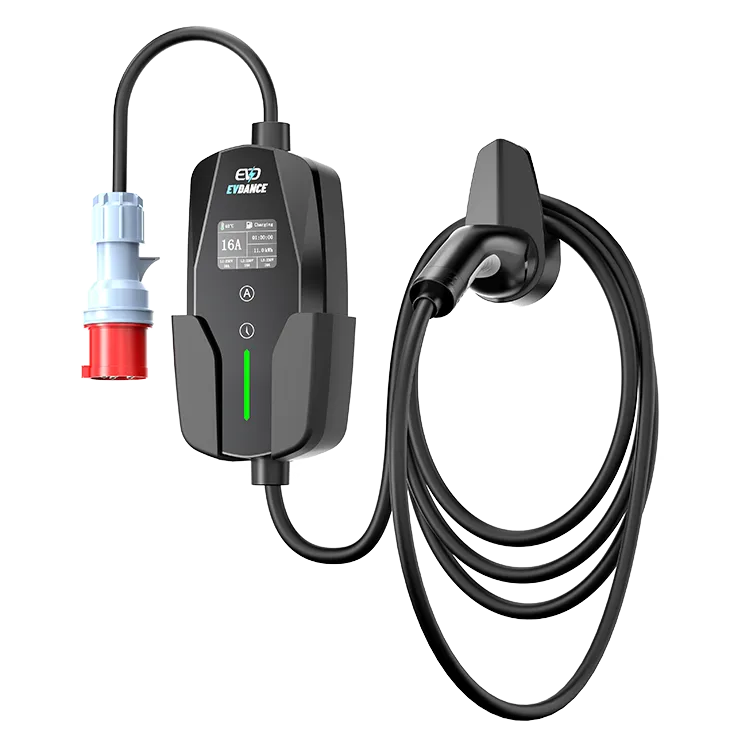
Upgrading from the EV-ACS3210E to the ACS1605PE pays only when two things line up: your property has a three-phase supply with a 16 A CEE socket, and your car can accept 11 kW of three-phase AC. If either answer is no, the swap buys nothing — the single-phase unit you already own is not the bottleneck. If both are yes, the ceiling rises from about 7 kW to 11 kW, but the upgrade also takes things away.
Key Takeaways
- The upgrade pays only when the property has three-phase supply and the car accepts 11 kW three-phase AC.
- A single-phase-only car charges slower on the three-phase unit than on the EV-ACS3210E.
- You gain ceiling and a gentler per-phase draw; you give up the current steps and the app.
- The old unit keeps a second life anywhere single-phase power is what the parking spot offers.

Two Gates Decide Before Any Product Does
The first gate is the supply. Three-phase power is a fact about your property, not a charger setting. A five-pin CEE socket near where you park is the visible sign; the meter or consumer unit is usually labelled; if neither is clear, an electrician confirms it in a short visit. If your property is single-phase today, adding three-phase supply is an electrical project of its own — the swap is its last step. Our explainer on single-phase vs three-phase EV charging covers how the supplies differ.
The second gate is the car, and it is the one upgraders miss. The ACS1605PE offers 11 kW across three phases; the car’s onboard charger decides what it accepts. A car whose AC charging is single-phase only draws on one phase of that supply — at 16 A, roughly 3.7 kW by simple arithmetic — slower than your current unit running at 32 A. For that car, this “upgrade” is a downgrade. Check the car’s AC specification before anything else.
What You Gain, What You Give Up
| EV-ACS3210E (today) | ACS1605PE (after the swap) | |
|---|---|---|
| Supply it uses | Single-phase | Three-phase, through a CEE five-pin plug |
| Charging ceiling | About 7 kW | 11 kW |
| Current draw | Up to 32 A on one phase | 16 A on each of three phases |
| Current settings | Adjustable: 10 / 13 / 16 / 20 / 24 / 32 A | None listed — the socket class is the setting |
| App and energy monitoring | Yes, with OCPP-ready connectivity | Not listed for this model |
| Cable | 7.5 m | 7.6 m |
| Car connector | Type 2 | Type 2 |
Two gains are real. The ceiling rises by about half, and the load spreads: 16 A per phase is a gentler draw on each conductor than 32 A on one, which can matter where phase balance is tight — your electrician’s call, not the product page’s. The losses are real too. The step settings go away, so on a marginal circuit you can no longer turn the charger down. The app and its energy monitoring go with them: the ACS1605PE’s listing states a display and IP66 sealing, and no app, RFID or platform features.
The Overnight Difference, in Labelled Numbers
Worked example, with roughly 10% allowed for losses: replacing 40 kWh takes about six hours at the single-phase rate (about 6.6 kWh stored per hour) and about four hours at the three-phase rate (about 10 kWh stored per hour). The gap only matters when the parking window is short or the battery is large; a 10–20 kWh top-up finishes early on either unit. Our charging time comparison puts the same arithmetic in a wider frame.
What Happens to the Old Unit
The EV-ACS3210E does not become scrap. It still works anywhere a single-phase supply and its socket exist — the supply class the ACS1605PE cannot use at all — so it remains the travel unit, the second car’s charger, or the spare. Many two-car owners end up running both — one unit per car’s acceptance. Choosing between the two from scratch is covered in our guide to portable EV charger types; this article is only about the swap.
Frequently Asked Questions
Can I run the ACS1605PE on my existing single-phase supply until the upgrade?
No. It is a three-phase unit with a CEE five-pin plug; no reduced mode runs it from a single-phase supply. Until the three-phase supply exists, the EV-ACS3210E remains your charger.
Will the upgrade definitely charge my car faster?
Only if the car accepts 11 kW of three-phase AC. A car capped at 7.4 kW charges at 7.4 kW on either unit, and a single-phase-only car is slower on the three-phase unit than on your current one.
Do I lose my charging records when I swap?
The ACS1605PE’s listing includes no app or energy monitoring, so its sessions are not recorded in an app. If the records matter, keep the single-phase unit in service for the cars it suits.
Related Reading
- Single-Phase vs Three-Phase EV Charging: 7kW, 11kW and 22kW Explained
- CEE Plugs Explained: Choosing 16A or 32A for a Three-Phase Portable EV Charger
- Portable EV Charger Types Explained: 10A, 16A, 32A and Three-Phase Models
- How Long Does It Take to Charge an EV at 7 kW, 11 kW and 22 kW?

