
There is no single policy called charging station insurance. A public charging site is usually covered by a combination: public liability cover, property cover for the equipment itself, and business interruption cover for the income lost while a site is down. In practice, the demand for proof often comes from contracts — a site host, a landlord, a lender or a public tender — rather than from one law that names chargers.
Key Takeaways
- Site cover is a combination: public liability, property and equipment, and business interruption.
- The demand for proof usually comes from host agreements, leases, tenders and lenders — not a charger-specific law.
- Product liability, motor insurance and the product warranty are separate things; none of them replaces site cover.
- Decide whose policy covers the hardware before installation, and put it in the site paperwork.
The three covers a site is usually asked about
| Cover | What it responds to | Why a charging site needs it |
|---|---|---|
| Public liability | A driver or passer-by is injured, or their property is damaged, in connection with the site | Charging happens in shared space: car parks, forecourts and pavements, with cables on the ground |
| Property and equipment | The chargers themselves are stolen, vandalised, hit by a vehicle, or damaged by weather or fire | The hardware is valuable, outdoors and unattended for most of the day |
| Business interruption | Sessions stop after an insured event — a fire, a flood, a damaged supply — while the site is repaired | A site earns only while it dispenses; a closed site still carries its costs |
Who asks to see the certificate
Most operators first meet insurance as a clause in somebody else’s paperwork. A site host letting an operator install on its land commonly requires the operator to carry liability cover and to name the host in it — that allocation is one of the points a host agreement settles before any hardware arrives. Public tenders for charging sites usually set minimum cover as a condition of bidding. Lenders financing a site ask the same question as lenders anywhere: what pays if the asset is destroyed mid-loan? None of this requires a charger-specific statute; it is ordinary commercial practice applied to a new kind of asset.
One boundary is worth drawing early. The installer who builds the site carries their own insurance for the works — that is the contractor’s policy, not the operator’s, and it ends with the job. The operator’s cover starts where the installer’s stops: with the running site.
What site insurance does not replace
Three neighbouring risks are often confused with site cover. Product liability — a defect in the charger itself harming someone — sits with the brand or manufacturer, which is why product liability for private-label charger brands is its own topic. A driver’s own motor insurance stays with the driver; the site’s liability cover responds to the site’s responsibilities, not to the car’s. And a warranty is not insurance: EVDANCE chargers carry a 3-year standard warranty against defects, which says nothing about theft, impact or a flooded car park. A site needs the warranty conversation and the insurance conversation separately.
Certified hardware is part of the risk picture
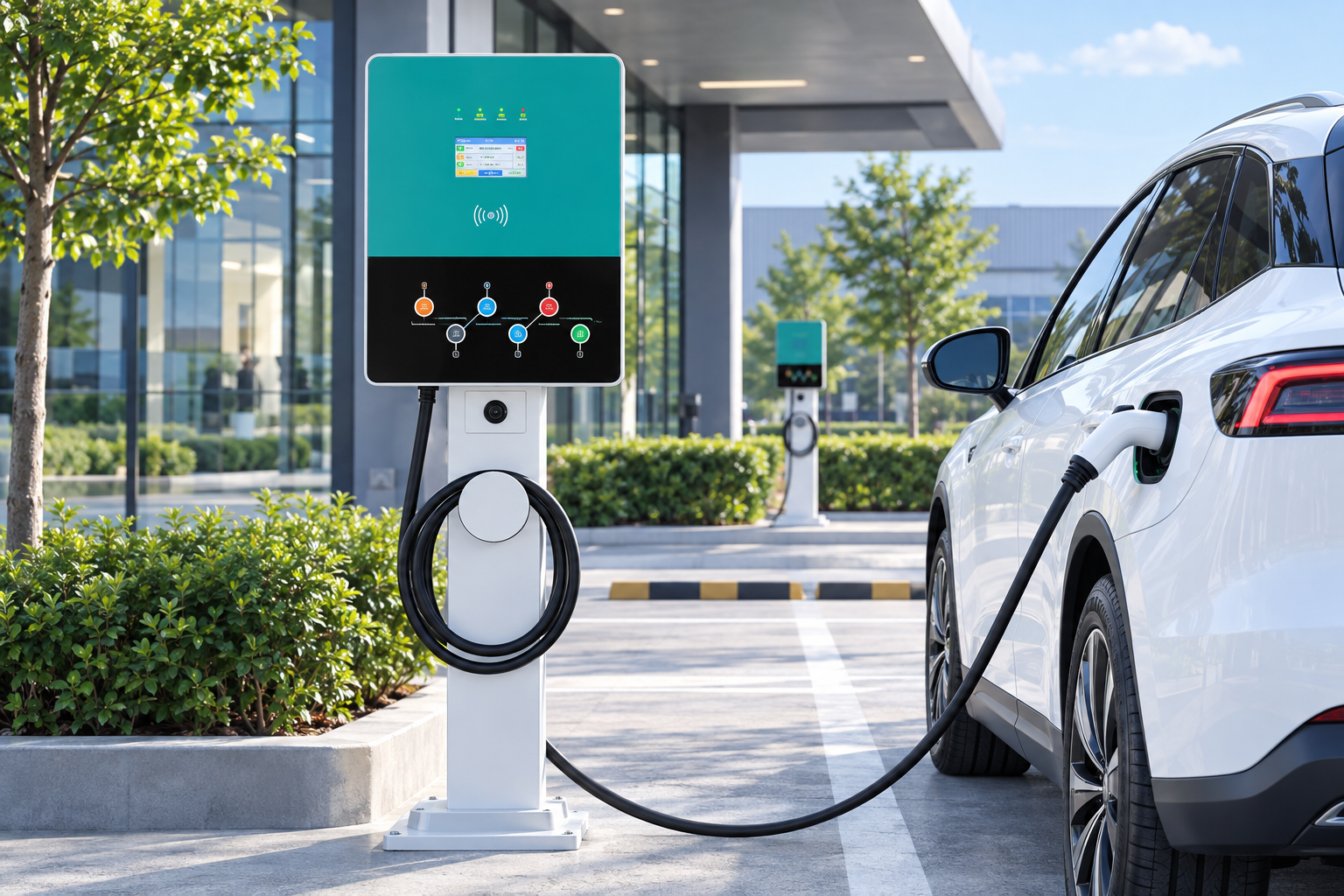
Insurers and hosts both look at what is actually being installed. Independently listed, certified equipment with a published ingress rating is easier to underwrite than unbranded hardware with no test history. The EVDANCE EV-AC03201T dual-connector AC station, for example, is an IP54 unit with OCPP 1.6J and RFID access — the kind of specification a host’s or insurer’s reviewer asks to see. Our commercial EV charging page sets out the hardware range. None of that removes the need for cover; it makes the cover conversation shorter.
Frequently Asked Questions
Is insurance for a charging site legally required?
There is no single charger-insurance law to point to. Requirements usually arrive through contracts — a host agreement, a lease, a tender or a loan — and through the general liability rules that apply to any business open to the public. What is compulsory varies by place, so treat it as a question for a local broker before you sign a site deal, not after.
Does the host’s existing business policy cover the chargers?
Not automatically. Chargers are new, high-value electrical assets in a car park, and a policy written before they existed may not describe them. The safe assumption is that the host and the operator each tell their own insurer what is being installed, and agree in the site paperwork whose cover responds to what.
Who insures a charger on leased land?
Whoever the agreement says — which is why it should say it before installation. Ownership of the hardware, responsibility for insuring it, and what happens at the end of the term are standard clauses to settle up front, alongside the liability cover each side carries.
Related Reading
- How to Open an EV Charging Station: Step by Step
- How to Get an EV Charging Station Franchise (and What to Check)
- Product Liability for Private-Label EV Charger Brands
- Is an EV Charging Station Business Profitable?

