
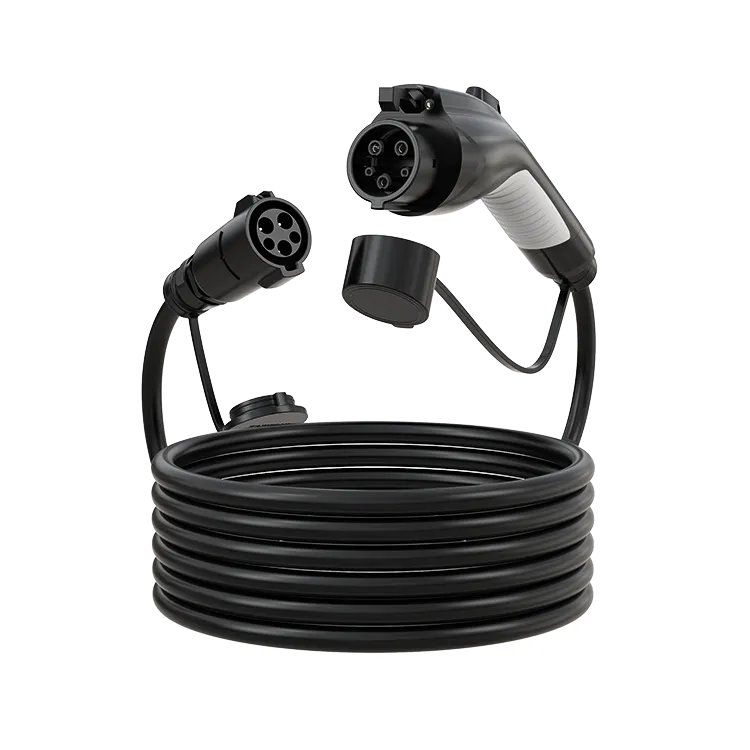
A Type 2 to Type 1 cable is a detachable charging cable with a Type 2 plug on one end and a Type 1 connector on the other. Its one job: let a car with a Type 1 inlet charge on AC at an untethered Type 2 socket charger — the socket posts and wallboxes common across Europe, where the driver supplies the cable. It does nothing at tethered posts, and nothing for DC fast charging.
Key Takeaways
- A Type 2 to Type 1 cable connects a Type 1 (J1772) car to untethered Type 2 socket chargers, for AC.
- It works in one direction, at socket posts only, never for DC fast charging.
- Rate the cable for the post’s output; the session runs at the chain’s lowest rating.
- At home, Type 1 cars charge on Type 1 equipment — the cable is for the socket-post world.
The Two Ends, and Why Each Is What It Is
Type 1 is the IEC name for the connector standardised by SAE as J1772 — the same plug under two names, as our J1772 explainer sets out. The cable exists because its ends answer to different authorities: the charger end is Type 2 because the post’s socket is; the car end is Type 1 because the car’s inlet is. Neither side can be swapped — the cable is the one place the two regional systems meet, on AC.
Where It Earns Its Keep
- An imported car living in a Type 2 region. A US- or Japanese-market car keeps its Type 1 inlet after the move; this cable connects it to local socket posts.
- A two-standard household. A Type 2 socket wallbox fitted for one car can serve a Type 1 car too, with this cable as the second lead.
- Touring with the car. A driver taking a Type 1 car into Type 2 territory carries one, as Type 2 drivers carry theirs.
In each case the pattern is the one the U.S. DOE’s public charging guide describes: at a socket-style post, the cable is the driver’s equipment, matched at both ends.
The Rules That Come With It
| Rule | What it means in practice |
|---|---|
| AC only | It carries AC for Level 1 and Level 2 charging. DC fast charging uses separate pins on both systems — no part for this cable. |
| One direction | Built for a Type 2 source and a Type 1 car. It does not let a Type 2 car use a Type 1 charger — a different product question. |
| Ratings must match | The session runs at the lowest rating in the chain — post, cable, car — so the cable’s rating must cover the post’s. |
| Socket posts only | It needs a socket. At a tethered post the fixed cable already ends in Type 2 — no outlet for it. |
| The car maker’s guidance comes first | Cable use sits under the checks in our guide to whether EV charging adapters are safe: stated ratings, sound condition, no improvised joins. |
What It Is Not For
It is not a fast-charging accessory: a Type 1 car’s DC route is CCS1, a CCS2 post is a separate system, and no cable of this kind crosses over — our explainer on how J1772 works with CCS shows why the DC pins settle it. It is not a charger: the cable is a passive link; the post sets the power and runs the session. And it is not an extension lead: never join it to another cable for reach.
The Type 1 Car at Home
Most Type 1 drivers charge at home on equipment built for the inlet, and keep a cable like this for the socket-post world. The EV-AC04001U is a 40A J1772 portable charger — 9.6 kW, NEMA 14-50P plug, IP66, 25 ft cable — whose tethered lead is a Type 1 cable in fixed form. The EV-ACS3210E 32A Type 2 portable serves Type 2 cars the same way. The conversion cable sits between those two worlds, only at socket chargers.

Frequently Asked Questions
Is a Type 2 to Type 1 cable the same as an adapter?
It does the same matching job in cable form: a connector at each end of a lead, for socket chargers. Plug-style adapters exist for other pairings; the checks are the same — stated rating, sound condition, the car maker’s position.
Will it make my Type 1 car charge faster?
No. It carries what the post offers and the car accepts; it adds nothing. If it is the lowest-rated link, the session runs at its rating — hence the rating check before first use.
Can I use it at a CCS2 fast charger?
No. DC fast charging on a Type 1-family car runs through the CCS1 inlet’s extra DC pins, and a CCS2 post is built for the CCS2 inlet. An AC cable cannot stand in for either.
Related Reading
- What Is J1772? The North American EV Plug Explained
- Are EV Charging Adapters Safe?
- Type 2 vs J1772 vs NACS: Which EV Charger Connector Does Your Market Need?
- Does J1772 Work With CCS? CCS Connectors Explained

