
DIN 70121 is the communication protocol that most CCS DC fast charging sessions still run on. Before any high-power current flows, the car and the charger hold a digital conversation over the charging cable to agree voltage and current limits, and they keep talking for the whole session. DIN 70121 defines that conversation. The newer ISO 15118 standard defines it too — and adds features such as Plug & Charge on top.
Key Takeaways
- DIN 70121 is the digital conversation that sets up and supervises a CCS DC fast charge.
- ISO 15118 covers the same ground and adds Plug & Charge and smarter services.
- If Plug & Charge does not start, the fallback is a card or app — the charge is the same.
- The protocol is software; charger hardware supplies the power the conversation agrees.
Why Fast Charging Needs a Conversation
Slow AC charging can be arranged with a simple pilot signal: the charger advertises how much current is available and the car takes it. DC fast charging is different. The charger itself converts grid power and feeds the battery directly, in the U.S. DOT’s typical 50–350 kW band, so both sides must agree numbers continuously: the battery’s voltage, the current it is asking for, temperature limits, and exactly when to stop. That takes a data link, not just a signal tone.
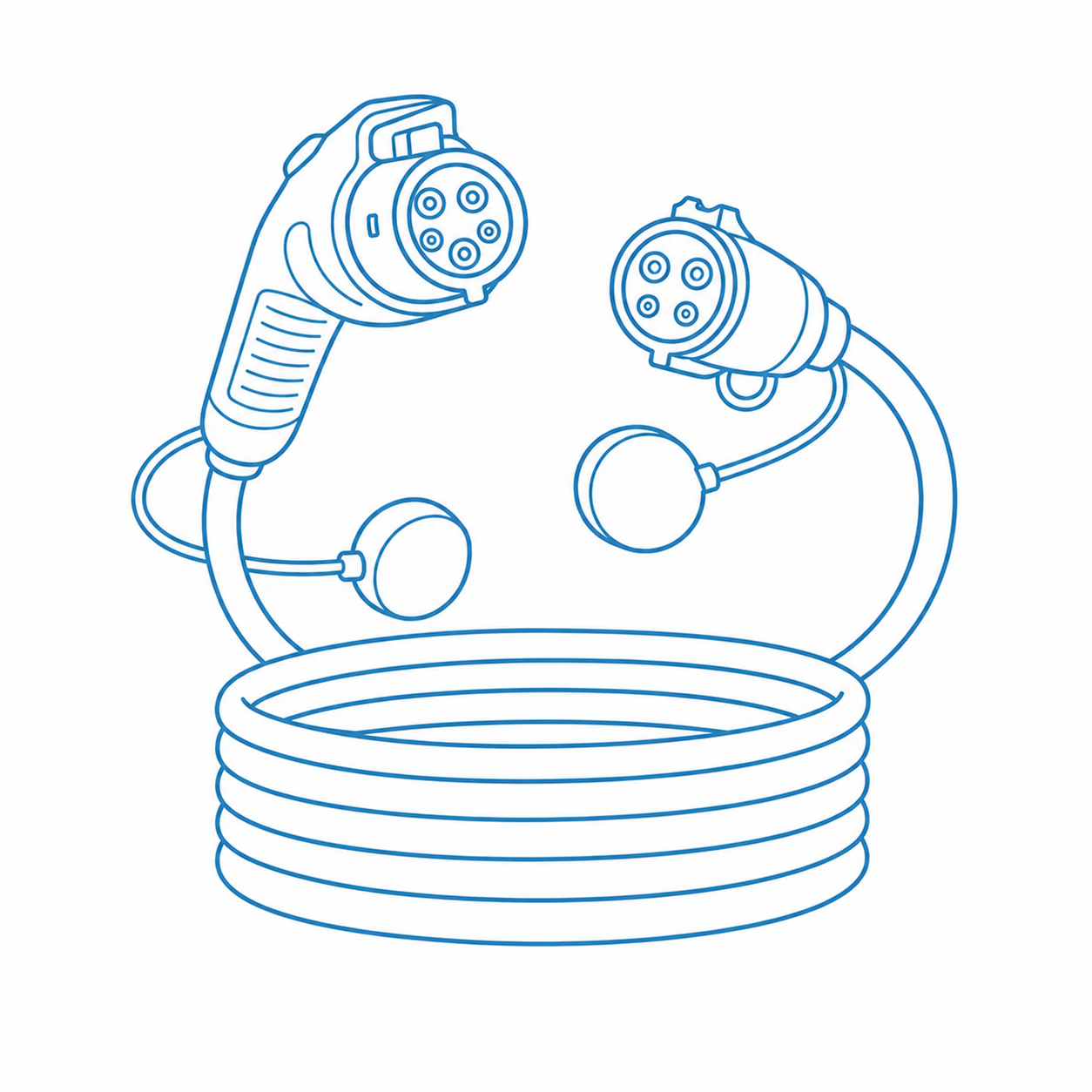
The messages travel as powerline communication over the control pilot wire inside the connector. The session begins with the two sides identifying each other and exchanging limits; from then on the car sends requests and the charger answers with what it is delivering, many times a second, until either side calls a stop. If the conversation breaks down, the power stops — by design, not by failure.

DIN 70121 vs ISO 15118
| DIN 70121 | ISO 15118 | |
|---|---|---|
| Job | Digital communication for DC charging sessions | The same job, for AC and DC, with extra services |
| Origin | A German DIN specification, published in 2012 | An international standard, first published in 2014 |
| Plug & Charge (the car identifies and bills itself) | Not included — you pay by card, app or RFID | Included, where car and charger both support it |
| Smart and bidirectional charging messages | Not included | Included in later parts, notably ISO 15118-20 |
| Status today | The common baseline most CCS sessions use | Spreading, and required for Plug & Charge |
What This Means When You Plug In
Most days, nothing: if the session starts after a card tap, the protocol has done its job invisibly. It surfaces in two situations. First, Plug & Charge: automatic identification needs ISO 15118 at both ends, so if the car or the charger speaks only DIN 70121, you fall back to a card or app — the charge itself is unaffected. Second, a session that fails in its first seconds, before power flows, has often failed in the conversation rather than in the power hardware. The full sequence of a session, from authorisation to billing, is set out in our guide to how EV charging stations work.
The Hardware Side
The protocol is a matter of car and charger software; the power still has to come from somewhere. Compact units such as the EVDANCE EV-RHDC30K-L DC fast charger deliver 22 kW of DC power, with OCPP 1.6J handling a separate conversation — between charger and operator — explained in our OCPP guide. The wider hardware range is on our products page.
Frequently Asked Questions
Is DIN 70121 outdated or unsafe?
Neither. It remains the baseline language of CCS fast charging, and the safety monitoring of the session — agreed limits, continuous checks, a controlled stop — is part of it. ISO 15118 adds services around the session rather than replacing its safety core.
Does my car use DIN 70121 or ISO 15118?
For ordinary fast charging, assume DIN 70121 is involved: nearly every CCS car and charger supports it. The visible sign of ISO 15118 support is Plug & Charge appearing in the car’s charging menu or manual.
Will DIN 70121 be switched off?
There is no switch-off date. Chargers are built to speak both languages, and the older one remains the fallback that guarantees any CCS car can charge anywhere.
Related Reading
- How Do EV Charging Stations Work?
- OCPP Explained: What Charge Point Operators Need From EV Charger Hardware
- What Is J1772? The North American EV Plug Explained
- Does J1772 Work With CCS? CCS Connectors Explained

