
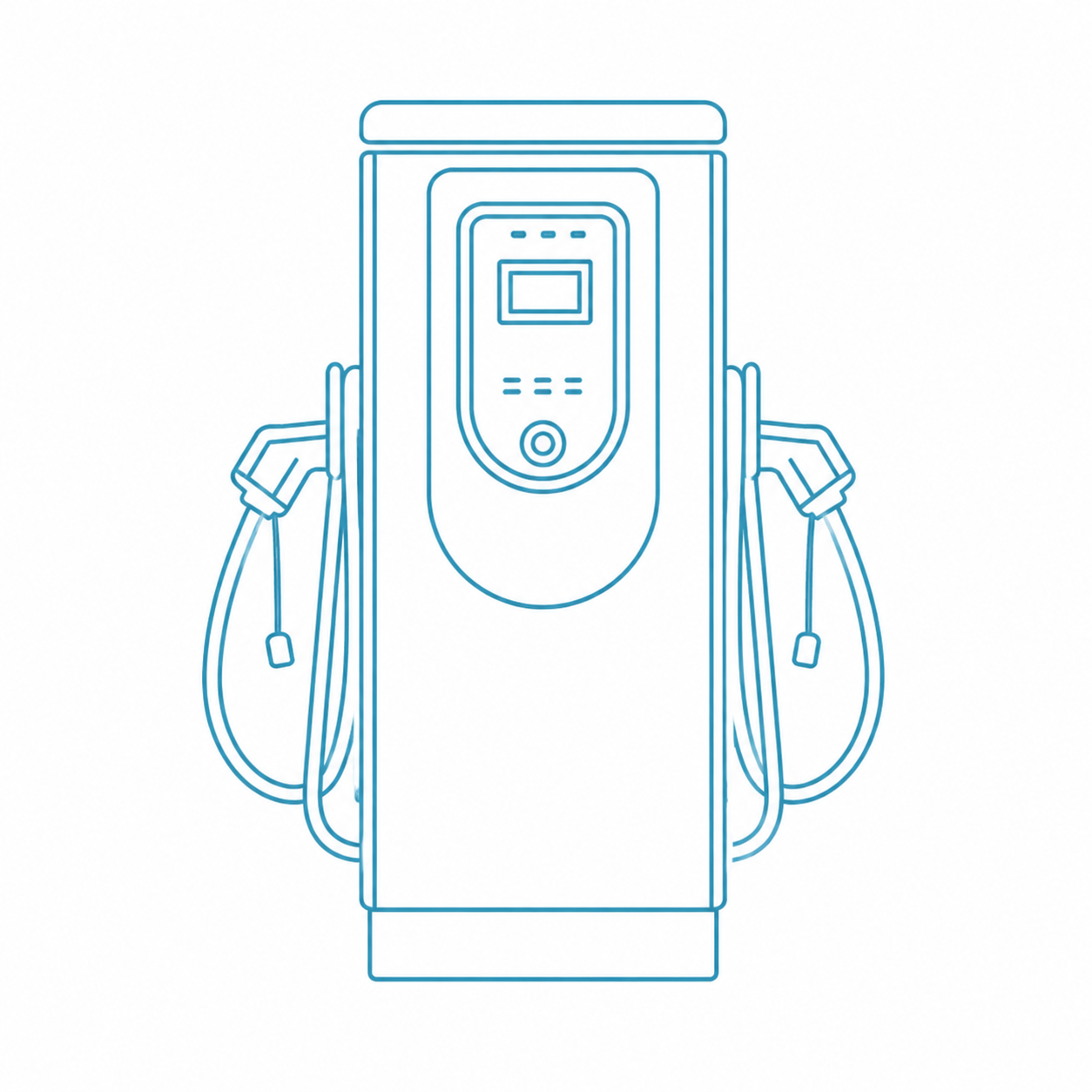
Mode 4 is the name the IEC 61851 system gives to DC fast charging: the equipment that converts AC power to DC sits in the charging station, not in the car. That one fact separates it from every AC mode. It is why Mode 4 equipment is a large, grid-fed cabinet with its own tethered cable, and why it delivers power in the U.S. DOT’s 50–350 kW band instead of the 7–19 kW of Level 2 AC charging.
Key Takeaways
- Mode 4 is DC fast charging: the AC-to-DC conversion sits in the station, not the car.
- That single difference explains the cabinet size, the tethered cable and the DOT’s 50–350 kW band.
- A Mode 4 site is an electrical project — equipment, installation and grid capacity all price at DC scale.
- The mode names the architecture, not the power: compact depot DC is Mode 4 too, well below corridor power.

Where the Conversion Happens Decides Everything
In Modes 1, 2 and 3, the station supplies AC and the car’s onboard charger converts it to the DC the battery stores. The car’s converter is small, so AC charging power stays modest — that ceiling is a property of the car, not the wallbox. In Mode 4 the conversion moves off the vehicle: the station houses the power electronics, feeds DC straight to the battery, and the car’s limit becomes how much DC its battery system will accept. Moving the converter is what makes fast charging fast, and it is also what makes the equipment big, heavy and expensive.
The four modes as a set are compared in our guide to Mode 2 vs Mode 3 charging, and the AC-or-DC question is untangled in Are EV Chargers AC or DC? This article stays with Mode 4 itself: what follows, on a real site, from putting the converter in the station.
Mode 3 and Mode 4, Side by Side
| Mode 3 (AC) | Mode 4 (DC) | |
|---|---|---|
| Conversion happens | In the car, via its onboard charger | In the station, via off-board power electronics |
| Typical power (U.S. DOT) | 7–19 kW, Level 2 | 50–350 kW, DC fast charging |
| Equipment form | Wallbox or AC station on a dedicated circuit | Free-standing power cabinet with a tethered cable |
| Connector carries | AC pins plus control signalling | DC pins — CCS1 on North American DC ports under the NEVI rules — plus signalling |
| Where you meet it | Homes, workplaces, destinations | Highway corridors and public fast-charging sites |
What Mode 4 Means for a Site
Because the station does the heavy work, a Mode 4 site is an electrical project first and a charger purchase second. The DOE’s cited figures put DC fast charging equipment at about $38,000–$90,000 per unit with installation at $20,000–$60,000 — an order of magnitude above AC. The supply has to match: corridor stations built under the NEVI programme must offer at least 150 kW per DC port, stay open 24/7, take contactless payment and average above 97% annual uptime. Grid capacity, not the charger catalogue, is usually the constraint that sets the timetable. How the stations themselves work is covered in How Do DC Fast Chargers Work?
Compact DC: The Exception That Proves the Category
Mode 4 names the architecture, not a minimum power. Compact DC chargers use the same off-board conversion at depot scale: the EVDANCE EV-RHDC30K-L delivers 22 kW DC with OCPP 1.6J and an IP54 rating, for fleets turning vehicles around faster than AC allows. It sits deliberately below the corridor band — it is not highway fast-charging hardware, and it does not pretend to be. The mode label tells you where the conversion happens; the power line on the spec sheet, as always, has to be read separately.
Frequently Asked Questions
Is Mode 4 the same as “Level 3”?
“Level 3” is an informal name you will see in the press. Standards and U.S. government sources say DC fast charging instead; in the IEC vocabulary, that is Mode 4. If a document matters — a permit, a tender — use the formal terms.
Is every DC charger Mode 4?
As a category in the IEC system, yes: DC delivered by off-board charging equipment is Mode 4, whether the unit is a corridor cabinet or a compact depot charger.
Can a home have Mode 4 charging?
Compact DC units exist, so it is not impossible — but the supply capacity and installation scale make AC the normal home pattern. A licensed electrician and the utility’s process decide what a given service can support.
Related Reading
- How Do DC Fast Chargers Work?
- Level 1 vs Level 2 vs DC Fast Charging: A Practical Comparison
- Are EV Chargers AC or DC?
- Mode 2 vs Mode 3 Charging: What IEC 61851 Means for Portable EV Chargers

