
OCPI — the Open Charge Point Interface — is the open protocol that charging networks and app providers use to exchange charger data with each other. It is not an app, a company or a charger feature you switch on. It is the shared language that carries locations, live status, prices and session records between businesses, which is why one app on your phone can show, start and bill for posts run by networks you never signed up with.
Key Takeaways
- OCPI is the open protocol networks and app providers use to exchange locations, status, tariffs and session records.
- It is what makes roaming feel simple: one account, many networks, one bill.
- OCPP links a charger to its operator; OCPI links operators and apps to each other. A roaming session uses both.
- The protocol moves data but cannot verify it — a shown status is only as fresh as the operator’s feed.

What OCPI Carries Between Networks
Drivers experience the result as roaming: arrive at an unfamiliar network’s post, start it with the account you already have, and get one bill from your own provider. Roaming only works if the two businesses can swap four kinds of data reliably, and that exchange is OCPI’s whole job.
| Data exchanged | What it contains | What you see as a driver |
|---|---|---|
| Locations | Where each post is, its connectors and access details | Pins for other networks appearing in your app’s map |
| Status | Whether a post is free, in use or out of order, updated as it changes | The availability shown before you drive there |
| Tariffs | The price structure that applies at that post | A price displayed before you start the session |
| Sessions | Start and stop records with the metered energy | One itemised bill from your own provider afterwards |
OCPI Is Not OCPP
The two acronyms differ by one letter and work at different layers, which is why they are so often confused. OCPP connects a charger to its own operator’s backend: start and stop commands, meter values, fault messages. OCPI connects businesses to each other: operator to operator, and operator to the app and map providers drivers use. A roaming session typically uses both — OCPP inside the network that owns the post, OCPI between that network and yours.
Why Aggregation Matters Beyond Apps
The same standardised data feeds public tools, not just commercial apps. The U.S. Department of Energy’s Station Locator gathers station information so drivers can search across networks in one place, as described in our guide to where to find charging stations. Whether the pipe is a roaming platform or a national database, the principle matches: a charger is only findable if its operator publishes clean, current data about it.
Where EVDANCE Hardware Fits
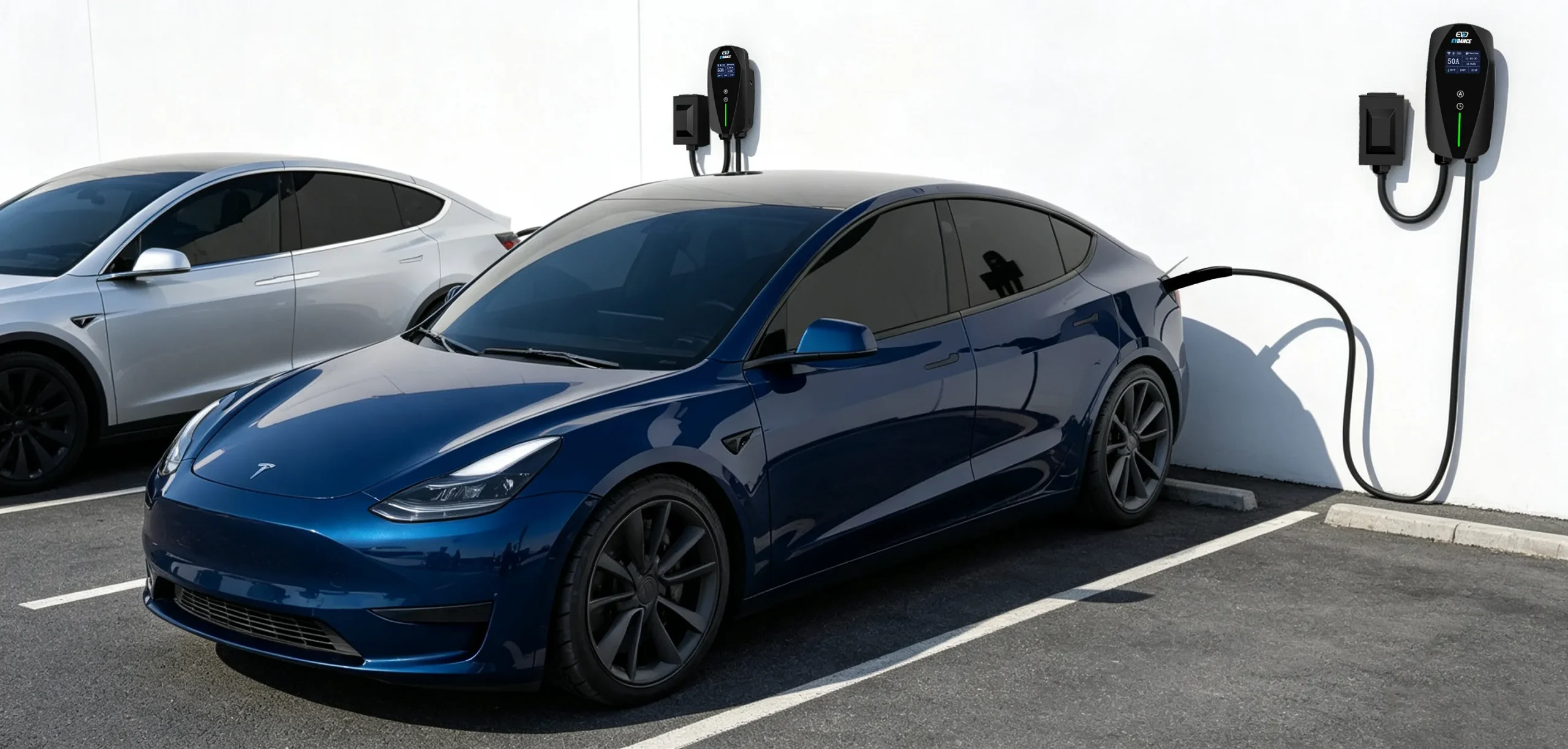
A post joins this data world through its backend connection. EVDANCE networked posts — the EV-AC03201T dual-connector AC station and the EV-RHDC30K-L compact DC fast charger among them — speak OCPP 1.6J to their operator’s platform, which is the layer that then exchanges locations, status and tariffs onward to apps and other networks. For operators building a site, our commercial EV charging page sets out the range.
Frequently Asked Questions
Do I need to install or enable OCPI?
No. OCPI runs between companies, in their server systems. As a driver you only choose an app or card provider; if that provider has roaming agreements and the data links to support them, the posts of other networks simply appear and work.
Does OCPI set the price I pay?
No. Each operator sets its own tariff, and OCPI only carries that tariff data to your provider. Your own provider’s terms decide the final price you are billed, which is why the same post can show different prices in different apps — always check the price in the app you are about to use.
If a network uses OCPI, why did the app show a broken charger as available?
Because OCPI moves data; it cannot make the data true. A status is only as fresh as the operator’s own feed — if the post has not reported its fault yet, every downstream app repeats the last known state. A listing in an app is a report, not a guarantee.
Related Reading
- Where to Find EV Charging Stations: Maps, Apps and Tips
- Can You Use Any EV Charging Station?
- How Do Commercial EV Charging Stations Work?
- How Much Do EV Charging Stations Charge? Pricing Models Explained

