
The control pilot is a low-voltage signal carried on one small pin of every AC charging connector. Before any power flows — and for the whole session — the charger uses it to tell the car the maximum current it may draw, and the car uses it to say it is connected and ready. Until that conversation checks out, the main contacts stay open and the plug in your hand is not live.
Key Takeaways
- The control pilot is a low-voltage signal pin that lets the charger state a current ceiling and the car confirm it is connected and ready.
- The connector is not live until the handshake completes, and power stops the instant the signal breaks.
- Every session runs at the lowest of the charger’s offer, the car’s limit and the circuit behind them.
- On CCS fast chargers, a digital conversation runs over the same pilot line.

Where the Pilot Lives
Both the North American Type 1 plug described in our J1772 explainer and the European Type 2 plug carry a dedicated pilot pin next to the power pins. The signal belongs to the same standards family that defines the charging modes — background in Mode 2 vs Mode 3 charging — and does two jobs: it advertises a current limit, and it reports the connection state.
How the Agreement Works
The charger sends a fast, repeating square-wave signal down the pilot line. The pattern of that wave — how much of each cycle it spends high — encodes the current the car is allowed to take. The car reads the pattern, sets its own charger to that ceiling or below, and answers by changing the load it presents on the line: connected, ready to charge, or fault. Only when the state says ready does the charger close its contacts and let power flow. If the signal breaks — plug pulled, latch pressed, a fault — the contacts open at once.
| Step | What happens | Why it matters |
|---|---|---|
| You plug in | The pilot detects the car; the main contacts stay open | A connector lying loose or half-plugged is never live |
| The charger advertises | The pilot pattern states the maximum current on offer | The ceiling comes from the charger and its circuit, not from hope |
| The car answers | The car signals “ready” and draws at or under the ceiling | The car, not the charger, controls the actual draw |
| Charging runs | Both sides keep watching the pilot | Either side can end the session instantly and safely |
| You press the latch | The pilot breaks before the power pins separate | Power is already off as the plug comes out — no arc |
Why Your Charging Current Is a Negotiation
A session runs at the lowest of three numbers. The first is the ceiling the pilot advertises, which follows your equipment and its settings: an adjustable unit like the EVDANCE EV-ACS4005T 40A NACS portable charger, set to 32 A, advertises 32 A — the setting exists so the advertisement can match a smaller circuit. The second is the car’s own limit, set by its onboard charger. The third is the wiring: EV charging is a continuous load under the National Electrical Code, so the breaker is sized at 125% of the charger current (40 A of charging needs a 50 A breaker). A 48 A wallbox such as the EV-ACT5006T therefore never forces 48 A into a car that accepts less; it offers, the pilot states the offer, and the car decides.
On DC Fast Chargers, the Same Wire Talks Digital
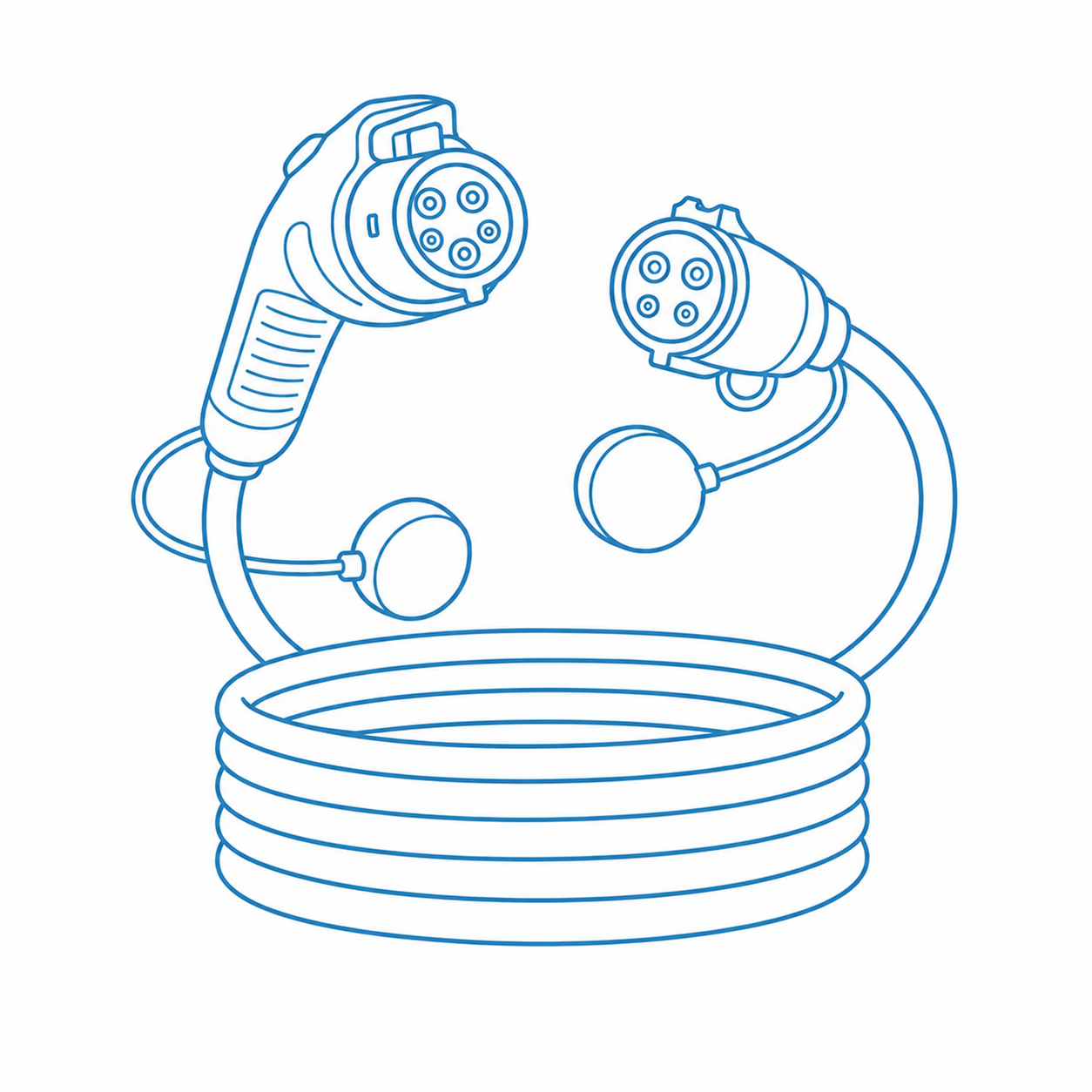
AC charging needs only the simple current advertisement. DC fast charging needs a richer conversation — voltage requests, battery state, insulation checks — so on a CCS inlet a digital data link runs over the pilot line itself, which is how CCS builds on the J1772 foundation. The pilot’s safety jobs still apply underneath: connection detection and an instant stop on any fault.
Frequently Asked Questions
Is a charging plug live before the car starts charging?
No. The main contacts stay open until the pilot handshake completes, so a connector that is unplugged, dropped or half-inserted carries no charging power. The pilot itself is a low-voltage signal, not a power supply.
Can a car draw more current than the pilot allows?
No. The advertised ceiling is a hard instruction: the car must draw at or under it, and the charger watches the session and can stop it. This is what lets one wallbox serve cars with very different onboard chargers safely.
Why does charging stop the moment I press the plug’s release button?
By design. The latch and pilot arrangement breaks the signal before the power pins separate, so power is cut while the plug is still fully mated. The click from the wallbox is the contacts opening.
Related Reading
- What Is J1772? The North American EV Plug Explained
- Mode 2 vs Mode 3 Charging: What IEC 61851 Means for Portable EV Chargers
- Does J1772 Work With CCS? CCS Connectors Explained
- Can a Tesla Use J1772 Chargers?

