
The chargers that suit Thailand are sorted first by the supply at each site, not by the catalogue. Confirm in writing, site by site, whether each feed is single-phase or three-phase and which voltage window the nameplate must cover; that answer removes part of any range before connectors are discussed. Connector family comes second, matched to the cars your customers run, and the stated enclosure rating third, matched to each bay’s exposure. As of October 2026, the configuration Thailand requires for your models is a written-confirmation item — take it from the responsible authorities and your importer of record.
Key Takeaways
- Sort by phase first: a site-by-site survey decides which half of any range is a candidate.
- Read the nameplate window against the confirmed supply, not the headline kW.
- Connector follows the cars you serve; the stated IP rating follows the bay’s exposure.
- Thailand’s required configuration, as of October 2026, is a written-confirmation item for your model.
Sort One: The Phase Written on Each Site’s Supply
Phase is a gate, not a preference. A charger built for a three-phase input does not run at reduced output on a single-phase feed — it does not run — and a single-phase unit cannot take the output a three-phase bay could deliver. So the first sort is mechanical: mark each site’s supply as confirmed single-phase or confirmed three-phase, in writing, before any model is compared — by a licensed local installer who surveys the board, or the utility where an upgrade is part of the plan. Do not let one site class speak for another: a depot’s feed says nothing about a customer’s home. Our explainer on single-phase vs three-phase charging sets out what each supply supports.
Sort Two: The Nameplate Window Against the Confirmed Supply
With the phase known, read the nameplate. The unit’s stated input window — the voltage range and phase configuration on its rating label — must cover the supply your survey confirmed. Compare the window, not the headline power: a kW figure assumes a supply, and the window is what the hardware accepts. Where a model offers adjustable current steps, treat them as a hedge across sites whose supply differs — set per site, recorded per site. Circuit sizing follows local rules and the installer’s judgement.
| Sort | The question | Who confirms it | What it decides |
|---|---|---|---|
| One — phase | Is each site’s feed single-phase or three-phase? | Licensed installer survey; the utility for upgrades | Which half of the range is a candidate at all |
| Two — nameplate | Does the stated input window cover the confirmed supply? | The rating label and technical file, checked against the survey | Which models on the surviving half can be ordered |
| Three — connector and rating | Does the connector fit the cars, and the stated IP rating the bay’s exposure? | Your parc survey; the stated rating | The final model and variant per site |
Sort Three: Connector Family and the Stated IP Rating
Connector follows the cars, not the charger: survey the inlets of the vehicles your customers run and let the count fix the family — our comparison of Type 2, J1772 and NACS walks through the families. Then match the stated enclosure rating to the siting: the dust-tight end suits open, dusty sites, while a lower-rated station belongs under a roof. Our guide to IP ratings for EV chargers works through both digits.
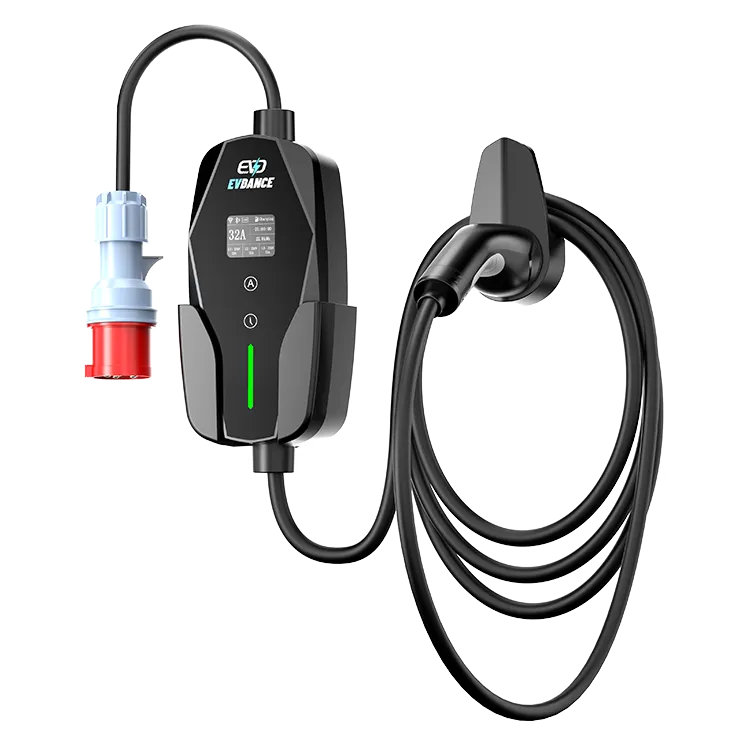
The EVDANCE Range, Sorted by Phase
On the single-phase side, the EV-ACS3210E is the stated single-phase portable: about 7 kW, Type 2, IP66. On the three-phase side sit the ACS1605PE (11 kW, CEE 5-pin, Type 2, 7.6 m cable, IP66), the EV-ACS3205PE above, and the EV-ACT3204PE wallbox (22 kW, tethered Type 2 cable, RFID and app, IP66, CE). For shared sites, the EV-AC03201T dual-connector station (up to 43 kW shared, OCPP 1.6J, RFID, IP54) belongs in covered bays, and the EV-RHDC30K-L adds compact DC at 22 kW — its listing names no DC connector variant, so confirm it in writing. Importers can start via the reseller and distributor program or contact us.

Frequently Asked Questions
Can a three-phase charger run on a single-phase supply?
Only if its listing states single-phase operation — the EVDANCE listings state the phase build per model, and none of the three-phase models above claims it. Confirm the site’s supply and order the build that matches it.
Which connector do chargers for Thailand need?
The one your customers’ cars carry, confirmed in writing before production. Survey the inlets you will serve, and have the required configuration confirmed for your exact model rather than assumed from a neighbouring market.
Do all my sites need the same charger?
No — a mixed range is the normal outcome of the phase sort. Each site gets the model its own survey supports.
Related Reading
- Single-Phase vs Three-Phase EV Charging: 7kW, 11kW and 22kW Explained
- Type 2 vs J1772 vs NACS: Which EV Charger Connector Does Your Market Need?
- IP Ratings for EV Chargers: IP54, IP65 and IP66 Compared

