
Usually, a specialist charger factory — not the car company. The wallbox or portable charger bundled with a new EV is typically an OEM product: designed and built by a specialist charging-hardware manufacturer, made to the car brand’s specification, and sold with the car brand’s name on it. “OEM” — original equipment manufacturer — names the factory behind the badge. The car brand specifies, brands and supports the charger; the OEM is who actually engineered and produced it.
Key Takeaways
- The charger bundled with a new EV is usually an OEM product: built by a specialist factory, branded and supported by the car brand.
- Carmakers contract chargers out for engineering depth, per-market certification and flexible volumes.
- For warranty you deal with the name on the product; for the real specification, read the rating label and certificate.
- A replacement charger need not carry the car brand — it must match the car’s connector and your supply.
Why Carmakers Buy Chargers Instead of Building Them
Charging hardware is a specialist product sitting next to a car programme, and three practical reasons push carmakers towards OEM supply:
- Engineering depth. A charger is power electronics, thermal design and safety certification in one enclosure. Specialist factories do nothing else.
- Certification per market. A charger sold in several countries must be tested and certified for each. A factory already holding those files is faster than a carmaker starting from zero.
- Volumes. A bundled charger is an accessory line next to vehicle production. Contracting it out matches supply to car sales without building a charger plant.
The result is that the same basic hardware can appear under several car brands, each with its own casing, badge and support channel. The arrangements behind the badges — and how OEM differs from ODM and private label — are set out in our OEM vs ODM explainer.

What the OEM Arrangement Means for You as the Owner
| Situation | Who you deal with | Why |
|---|---|---|
| The charger fails under warranty | The car brand or its dealer — the name on the product | The brand sold it to you and carries the customer-facing warranty, whatever factory built it |
| You want the real specification | The rating label and manual supplied with the unit | Stated current, connector and ratings are printed there; the maker’s name often appears on the label or certificate |
| You replace or upgrade it | Any charger brand you choose | Charging follows open connector standards, so a replacement must match your car and supply — it does not have to carry the car brand |
| You are comparing two bundled chargers | The stated facts, not the badges | Similar hardware is sold under many names; compare current, cable length and certification as printed |
How to Tell Who Made Yours
- Read the rating label. Chargers carry a label with the model, ratings and often the manufacturer’s name — which may differ from the brand in large letters on the case.
- Check the certificate. Safety certificates name a holder and an exact model. Under OEM supply that holder is commonly the factory, as the U.S. OSHA NRTL programme listings show for the U.S. market.
- Look at the manual’s publisher details. The fine print frequently identifies the company that produced the unit and its documentation.
None of this changes daily use. It matters when something fails, when you replace the unit, or when you ask whether a cheaper identical-looking charger is genuinely the same hardware — a question our complete guide to OEM and private-label chargers works through from the brand’s side.
The Factory Side: EVDANCE
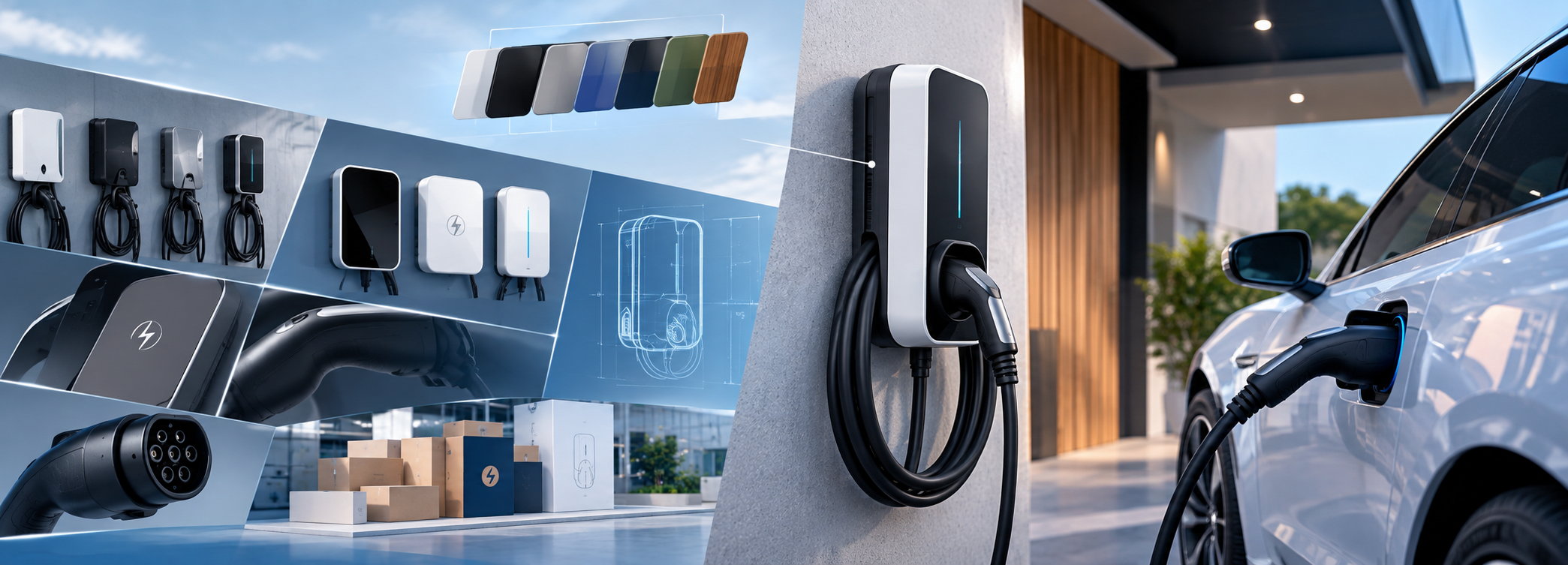
EVDANCE is the kind of factory this arrangement runs on: a Shenzhen manufacturer founded in 2011, with its own factory, exports to more than 30 countries and a 3-year standard warranty. It supplies chargers under other companies’ brands — private label from 100 units — and works with car companies through its OEM and auto-companies programme. The same models sold under the EVDANCE name are on the products page — the simplest way to see an OEM factory’s own shelf before the badges go on.
Frequently Asked Questions
Is an OEM charger lower quality than a “genuine” branded one?
The bundled charger is the branded one — badge and maker are simply different companies. Judge any charger by its stated specification and certification, not by whose name is largest on the case.
My bundled charger has failed. Who do I contact?
The brand on the product, or the dealer who supplied it with the car. They hold the customer warranty; the factory’s role runs through them.
Can I charge my car with a different brand’s charger?
Yes. Connectors follow open standards, so any charger matching your car’s connector and your supply can replace the bundled unit. A hardwired swap is electrician work; a plug-in portable is like-for-like.
Related Reading
- OEM vs ODM EV Chargers: How Private-Label Charging Works
- OEM and Private-Label EV Chargers: A Complete Guide for Brands
- Private Label vs Reselling a Branded EV Charger: Pros and Cons
- How an OEM EV Charger Project Works, Step by Step

