
Because the cable itself becomes a heater at high current, and the cable is the one part of a DC charger a driver has to pick up. Current through a conductor generates heat in it; at the top of the DC fast-charging range, a plain cable thick enough to stay within its temperature limits would be too heavy and stiff to handle. Coolant pumped through the cable carries the heat away, so a manageable cable can carry that current.
Key Takeaways
- High current heats the cable’s conductor; at the top of the DC band, the passive fix — more copper — makes the cable too heavy to handle.
- Liquid cooling breaks that trade by carrying heat out of the cable, at the cost of a pump, coolant and seals to service.
- It belongs to the highest-power chargers; most DC charging uses conventional cables.
- Cable cooling never speeds a session up — it lets a station sustain current its cable otherwise could not carry.
The Heat Is in the Conductor, Not Just the Cabinet
Charger cooling is usually discussed as a cabinet problem, where the conversion losses sit. The cable has its own. Every conductor has resistance, so every amp delivered warms the cable along its length, and the connector contacts add a concentrated heating point at the handle. Double the current and the heating climbs much faster than double — which is why cable heating, not electronics, becomes the binding constraint as power rises.
The driver feels the result as weight. The traditional answer is more copper: a thicker conductor runs cooler per amp. But copper is dense, and a cable has a handling limit. Past a certain current class, the air-cooled answer is a cable too heavy for its job.
The Trade, Side by Side
| Thicker conventional cable | Liquid-cooled cable | |
|---|---|---|
| How it handles heat | More copper spreads the current; heat leaves through the cable surface | Coolant circulates inside the cable and carries heat back to the cabinet |
| What the driver notices | Weight and stiffness grow quickly with the current class | A slimmer, more flexible cable for the same current |
| What the operator inherits | A simple passive part: nothing to pump, fill or leak | A sealed fluid loop in a flexing cable — pump, coolant and seals join the service schedule |
| Where it makes sense | Most DC charging, below the top power classes | Sustained sessions at the highest currents, where the passive cable stops being liftable |
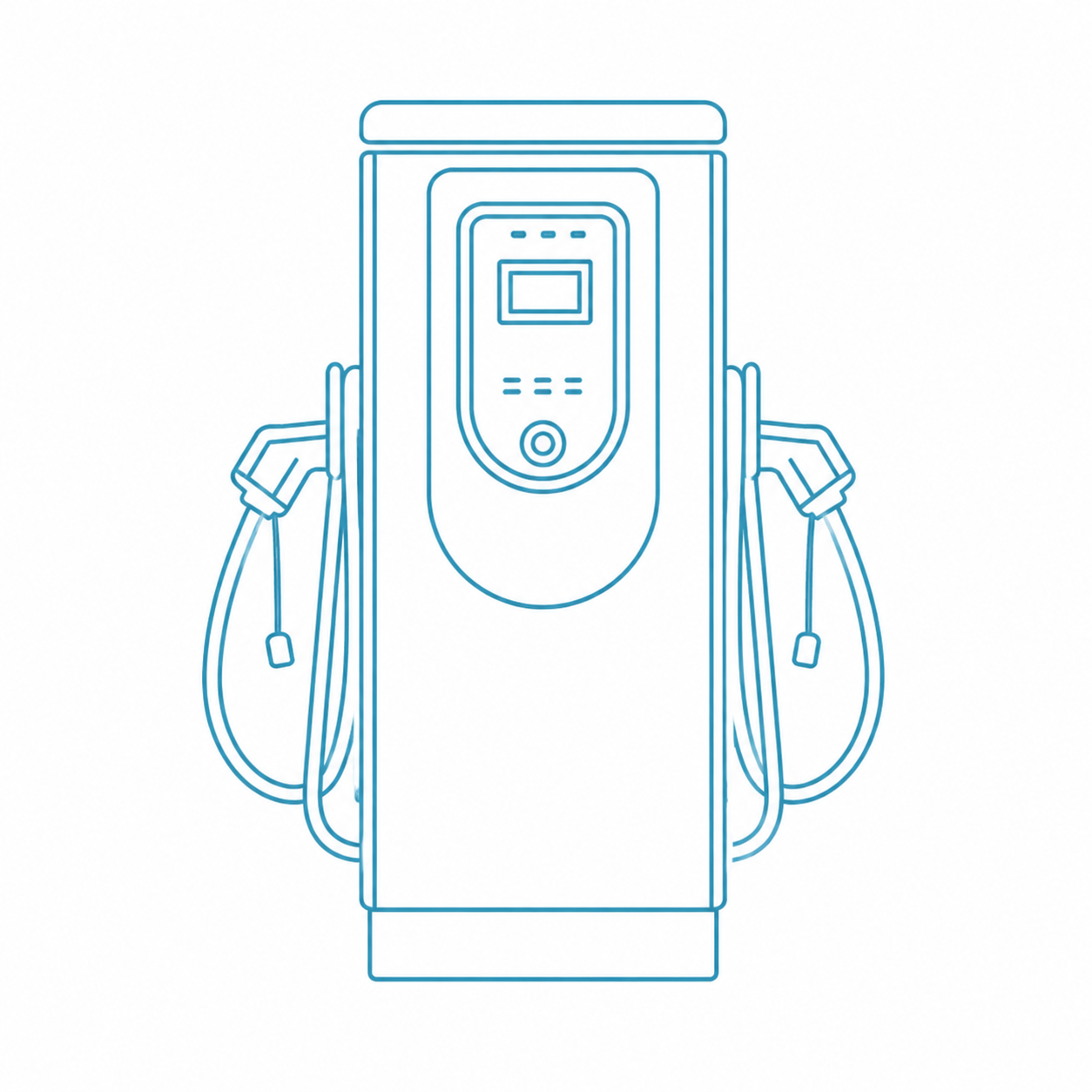
Where Liquid Cooling Shows Up
It is a top-of-the-band technology. The U.S. DOT puts DC fast charging at 50–350 kW, and liquid-cooled cables belong to the upper part of that band, on chargers built for sustained very high current. Below it, conventional cables remain the norm — including on compact DC units — because their current class never makes the passive cable unmanageable.
That placement matters on a spec sheet. Cable cooling is a stated specification line, not a default feature of DC charging. Ask which cable type is fitted: coolant and a pump are consumables a passive cable never has, and the cable is part of the charger’s tested assembly, not a field-swappable accessory.
What It Does Not Do
A liquid-cooled cable does not charge a car faster by itself. It permits the station to sustain a higher current without overheating. Session speed is still set by the station’s converter and the battery’s acceptance, as How Fast Is a DC Fast Charger? explains — a cooled cable on a modest charger changes nothing, and an uncooled one can be why a powerful charger cannot hold its peak.
The EVDANCE Position, Stated Plainly
EVDANCE’s DC model, the EV-RHDC30K-L, is a compact unit at 22 kW DC with OCPP 1.6J and an IP54 enclosure — a current class far below where liquid-cooled cables appear. Its listing states no cooling method for cable or cabinet, and none should be assumed — confirm both in writing before purchase. The wider range is on the products page; How Do DC Fast Chargers Work? covers the hardware the cable hangs off.

Frequently Asked Questions
Can a liquid-cooled cable be fitted to a charger that came with a plain one?
Treat the cable as part of the charger’s listed assembly, not an accessory. Whether a different cable type is approved for a model is a question for its manufacturer and documentation — not a field upgrade to improvise.
Do liquid-cooled cables leak?
They are sealed systems with an inspection and service life set by the manufacturer. A damaged cable is taken out of service under the operator’s procedures; users do not service the coolant circuit.
My DC charger’s cable gets warm. Is it faulty?
Some warmth is physics, not failure — the conductor carries the full session current. Heat you cannot keep a hand on, discolouration, damage or sessions cutting short are reasons to stop and contact the operator or manufacturer.

