
3.6 kW is almost exactly one third of 11 kW, and that fraction is the clue. Either your car is taking one phase of a three-phase charger, or the charger itself is being fed one phase by design. The two cases look identical on the car’s screen — but they have different owners, and one test tells them apart.
Key Takeaways
- 3.6 kW is one phase’s share of an 11 kW three-phase charger.
- The cause is either the car taking one phase or the unit being fed one phase — the screen cannot tell you which.
- One session with a known three-phase car separates the two cases.
- Car case: nothing to fix. Feed case: an installer and network-operator conversation.
Case One: The Car Takes One Phase
An 11 kW charger is a three-phase unit in the 16 A class: three phases at that current sum to about 11 kW. A car whose onboard charger is single-phase connects to one of those phases and takes its share — roughly a third, the 3.6 kW class. The same result appears when the car’s own stated AC maximum sits in that class by design, as on many smaller cars and plug-in hybrids. Our explainer on single-phase vs three-phase EV charging sets out the arithmetic. In this case the charger is blameless: it offers three phases to every car, this car uses one, and the symptom follows the car to any 11 kW charger.
Case Two: The Unit Is Fed One Phase
The mirror case sits on the supply side. A three-phase charger connected to a single-phase feed — or wired to one phase of the supply as an installation decision — can only pass on the phase it receives. Every car then gets one phase’s worth, including cars that could take all three. This happens where the property’s supply is single-phase and the unit was installed anyway, sometimes as a deliberate stopgap.
Two cautions. Whether a given three-phase unit may be connected to a single-phase feed at all is the maker’s stated position for that model, not an assumption from the rating plate. And how the unit was fed is the installer’s layer — their paperwork and test instruments, not a cover to open yourself.
The Test That Separates the Cases
| Test | If the car is the cause | If the feed is the cause |
|---|---|---|
| Charge a car that accepts 11 kW three-phase AC on this charger | It charges at about 11 kW | It also sits near 3.6 kW |
| Charge your car on a known three-phase charger elsewhere | Still near 3.6 kW | It rises to the rate its class allows |
| Read your car’s stated AC maximum | Single-phase, or in the 3.6 kW class | An 11 kW three-phase rating |
Run the first row before anything else: one borrowed car splits the problem in a single session. The CEE plug guide helps if your unit is a portable on an industrial socket, where a second known-good socket is an equally clean test.

What Each Case Means for Your Next Move
If it is the car, there is nothing to repair. 3.6 kW still adds range steadily overnight — the session times in our charging time explainer show what that rate covers — and a future three-phase car unlocks the full rating with no other change.
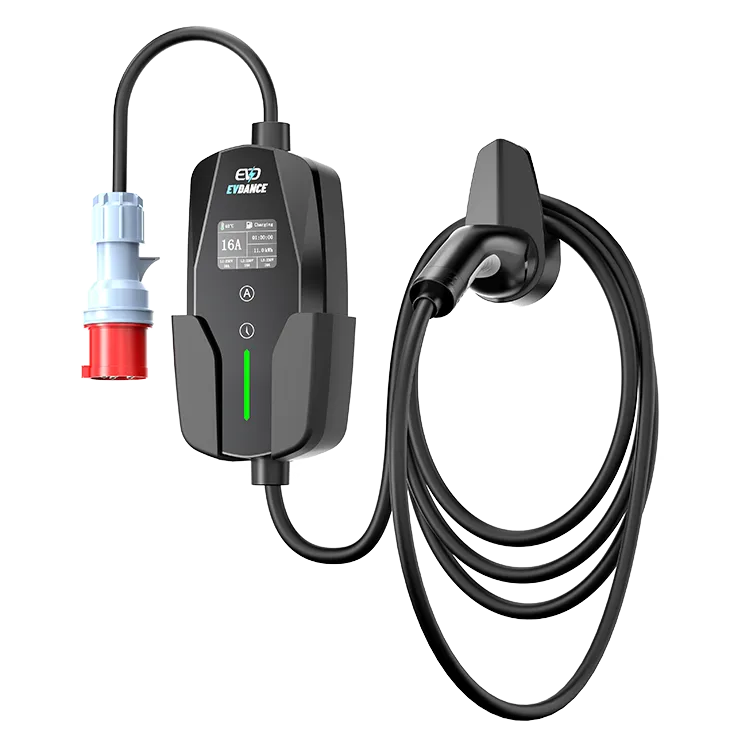
If it is the feed, the conversation belongs with your installer and, behind them, the network operator: a three-phase supply is their decision, with its own application and timetable. Until then, judge any charger by the supply you actually have. In the EVDANCE range, the ACS1605PE is the 11 kW three-phase portable in this story — 16 A three-phase, CEE five-pin plug, Type 2, 7.6 m cable, IP66. On a single-phase supply, the honest alternative is a single-phase unit such as the EV-ACS3210E, a 32 A Type 2 portable at about 7 kW single-phase — roughly twice the one-phase share, from a charger built for your feed.
Frequently Asked Questions
Is charging at 3.6 kW harmful to the car or the charger?
No. It is a normal rate for whichever link is limiting the session; charging simply takes longer.
Can I change a setting to unlock the full 11 kW?
A setting changes the current offered on the phases that are present. It cannot give a car phases its onboard charger does not take, and it cannot add phases to a single-phase feed.
My car is rated 11 kW three-phase and still gets 3.6 kW. What now?
Then the evidence already points at the feed or at a fault. Run the borrowed-car test to confirm the pattern follows the charger, then take that result to your installer — it is their layer to diagnose.
Related Reading
- Single-Phase vs Three-Phase EV Charging: 7kW, 11kW and 22kW Explained
- How Long Does It Take to Charge an EV at 7 kW, 11 kW and 22 kW?
- CEE Plugs Explained: Choosing 16A or 32A for a Three-Phase Portable EV Charger
- Portable EV Charger Types Explained: 10A, 16A, 32A and Three-Phase Models

