
SAE J3068 is the standard that defines three-phase AC charging for North America, using a coupler from the Type 2 family. It exists because the region’s everyday AC standard, J1772, is single-phase only — while many commercial and industrial buildings are wired with three-phase power. J3068 is a real, published standard, but a niche one: nearly every car sold in North America charges on single-phase J1772 or on NACS, so most drivers will never plug into a J3068 charger.
Key Takeaways
- J3068 is SAE’s three-phase AC charging standard for North America, on a Type 2-family coupler.
- It fills a real gap — J1772 is single-phase — but cars and sites adopted J1772 and NACS instead.
- Phases are set by the car’s inlet and onboard charger; no adapter can add one.
- Before specifying it for a site, check the actual vehicles with their makers.

The Gap It Fills
North American AC charging runs on J1772, a single-phase standard: the U.S. DOT puts typical Level 2 charging at 7–19 kW, which is what homes and most public AC posts deliver. Commercial sites are different — three-phase service is common in workshops, depots and industrial buildings, and a single-phase standard cannot use it. Europe never had this gap, because its Type 2 connector was designed for three-phase AC from the start; the difference is worked through in single-phase vs three-phase EV charging. J3068 adapts that three-phase coupler approach for North America under SAE, the same body behind J1772 and the J3400 standard for NACS.
| J1772 | SAE J3068 | Type 2 | |
|---|---|---|---|
| Standard body | SAE | SAE | IEC |
| Region | North America | North America | Europe and other Type 2 markets |
| Built for | Single-phase AC | Three-phase AC | Single- and three-phase AC |
| Typical setting | Homes and public AC charging | Commercial and fleet sites with three-phase service | Homes and public AC charging |
Why Three-Phase AC Needs Its Own Standard
Adding phases is not a plug-shape detail. A three-phase session delivers power over more conductors, and the car’s onboard charger has to be built to accept it — the phases a car can use are fixed by its inlet and its charger hardware, not by anything clipped onto the cable. No adapter turns a J1772 car into a three-phase car. The coordination is different too: J3068 pairs its coupler with digital communication between car and charger, rather than relying on the simple pilot arrangement alone, so both ends agree what the supply is before power flows. That is why three-phase AC could not simply be folded into J1772 as an option — it needed its own document, its own coupler specification and its own inlet on the car.
Why You Will Probably Never Use One
Standards succeed when cars and chargers arrive together, and in North America they arrived for J1772 and then NACS instead. Car makers sell into the installed base, sites install what the cars can use, and J3068 is left as a special case for fleets and commercial sites that deliberately specify it. The practical lesson cuts both ways. Drivers: your inlet decides your charging world, and it is not J3068. Site planners: a three-phase supply in your building does not by itself argue for J3068 chargers — check the actual vehicles first, with the vehicle maker, and have a licensed electrician confirm what your service can deliver. A published standard is permission to build, not evidence of an ecosystem.
Three-Phase AC, the Type 2 Way
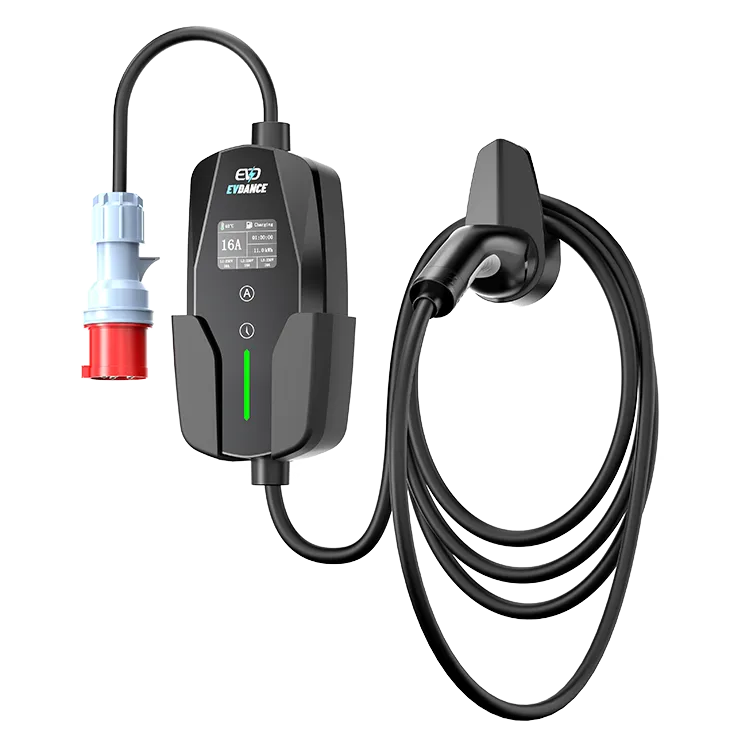
EVDANCE’s three-phase chargers serve the markets where three-phase AC is standard practice, in Type 2 form: the ACS1605PE delivers 11 kW from a 16 A three-phase CEE connection, and the EV-ACS3205PE delivers 22 kW at 32 A three-phase. EVDANCE does not list a J3068 charger — for North American sites, its range is the single-phase J1772 and NACS equipment on our products page.
Frequently Asked Questions
Is J3068 the same as Type 2?
They share coupler heritage, but they are separate standards, written by different bodies for different markets and supply rules. Do not assume a Type 2 car and a J3068 charger are interchangeable — check both ends with the manufacturers before relying on it.
Can a J1772 car charge on a J3068 charger?
No. The inlet is a different shape, and the car’s onboard charger is built for single-phase power. No adapter changes the phases a car can accept; adapters bridge connector shapes within the same kind of charging, not between them.
Is J3068 faster than J1772?
Three-phase exists to move more AC power where a three-phase supply is present. A session still runs at the lower of what the car accepts and the charger offers — and since almost no North American cars accept J3068 at all, the comparison rarely arises outside specified fleet sites.
Related Reading
- What Is J1772? The North American EV Plug Explained
- Type 2 vs J1772 vs NACS: Which EV Charger Connector Does Your Market Need?
- Single-Phase vs Three-Phase EV Charging: 7kW, 11kW and 22kW Explained
- Does J1772 Work With CCS? CCS Connectors Explained

