
Powerline communication is how a CCS fast charger and the car exchange data during a DC session: the data signals ride on the small control pilot wire inside the charging cable, instead of a separate data cable. AC charging manages with simple signals on that wire, but DC fast charging needs a real conversation — battery voltage, limits, state of charge and safety checks, updated continuously — and powerline communication is the carrier it runs on.
Key Takeaways
- Powerline communication carries the car-to-charger data conversation over the control pilot wire inside a CCS cable.
- DC fast charging needs that link because the station feeds the battery directly and must follow the car’s limits continuously.
- DIN 70121 and ISO 15118 define the messages; OCPP is a separate charger-to-network link.
- A plug can fit while the data conversation fails — a communication fault, not a power fault.
Why AC Gets By With Signals and DC Needs Data
On an AC charger, the two exchange very little. A signal on the pilot wire announces how much current the car may draw, and the car’s onboard charger does the rest. That is enough at Level 2 power, where the U.S. Department of Transportation puts charging at 7–19 kW.
DC fast charging is different. The station converts the power itself and feeds the battery directly at 50–350 kW, so it has to know, moment by moment, what the battery can accept. The car reports its voltage and limits; the station follows them; both sides watch for faults. That exchange is digital data, travelling through the same connector as the power — the plug described in our explainer of how J1772 works with CCS.
| Link | Who is talking | What travels on it |
|---|---|---|
| Pilot signals (AC charging) | Charger and car | Simple signals: connection state and the current the car may draw |
| Powerline communication (DC charging) | Charger and car | Digital data over the pilot wire: battery voltage, limits, charge level, fault messages |
| OCPP (network link) | Charger and the operator’s platform | Sessions, metering and billing — a separate link |

What “Powerline” Means Here
The idea is borrowed from ordinary powerline networking: instead of adding a data wire, you modulate a data signal onto a wire that is already there. In a CCS cable, the carrier is the control pilot conductor — the same thin wire that carries the basic connection signals. The heavy DC pins deliver the energy; the pilot wire carries the negotiation that makes it safe.
This is also why a DC session pauses briefly after you plug in: before power flows, the two sides find each other on the data link, exchange capabilities and agree limits. If that handshake fails, the session stops — the plug can fit perfectly while the conversation fails.
The Standards That Sit on Top of the Link
Powerline communication is only the carrier; what the messages mean is defined one layer up:
- DIN 70121 defines the basic message set most CCS fast charging still uses: the car states its limits, the charger reports what it delivers.
- ISO 15118 defines a richer version, adding features such as Plug and Charge, where the car identifies itself and billing follows automatically.
- The pilot signals underneath still handle the simplest jobs — detecting the connection and the latch — before the data link takes over.
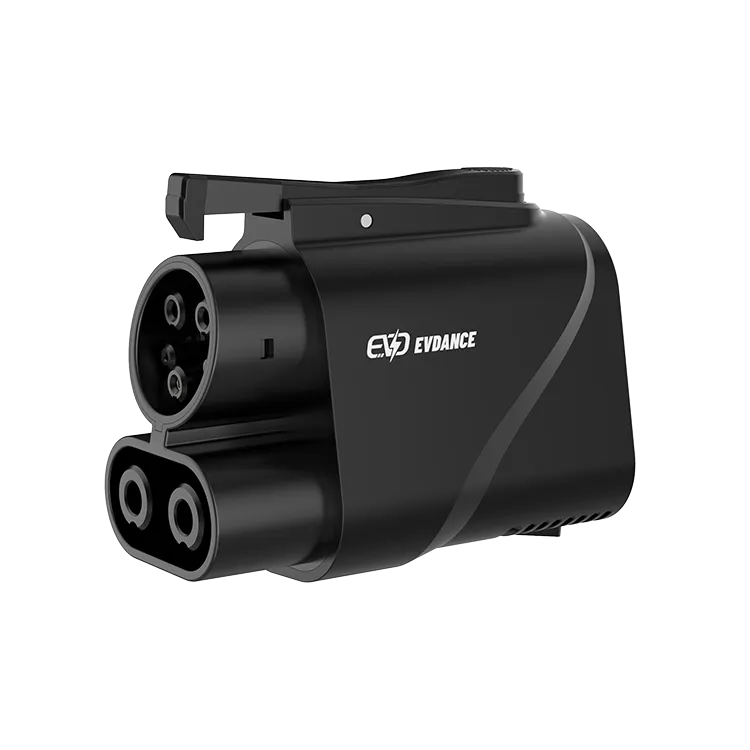
Adapters sit on this link too. A DC adapter such as the EVDANCE JT08 NACS-to-CCS1 adapter passes the connection through, data included — one reason DC adapters are only for use where the automaker approves them: the car’s data conversation has to survive the bridge intact.
The Other Conversation: Charger to Network
OCPP is a different link entirely: it runs between the charger and the operator’s platform, carrying session records and billing. A compact DC unit such as the EVDANCE EV-RHDC30K-L uses OCPP 1.6J for that back-end link while it talks to the car over the cable. When a session fails, which conversation broke is the first diagnostic question.
Frequently Asked Questions
Does my home AC charger use powerline communication?
No. Home AC charging uses the simple pilot signals: the charger announces the available current and the car charges within it. The data link belongs to DC fast charging, where the station feeds the battery directly and needs the car’s limits in real time.
Is powerline communication the same as OCPP?
No. Powerline communication runs between the car and the charger, over the charging cable. OCPP runs between the charger and the operator’s network platform, carrying metering and billing. A DC session uses both, for different jobs.
Can a worn or damaged cable break the data link?
Yes. The pilot conductor is a thin wire inside the same cable as the heavy DC conductors, so cable damage can interrupt the conversation while the plug still fits. A station that fails to start with several different cars usually has a cable problem — report it to the operator.
Related Reading
- Does J1772 Work With CCS? CCS Connectors Explained
- What Is J1772? The North American EV Plug Explained
- Are EV Chargers Universal?

