
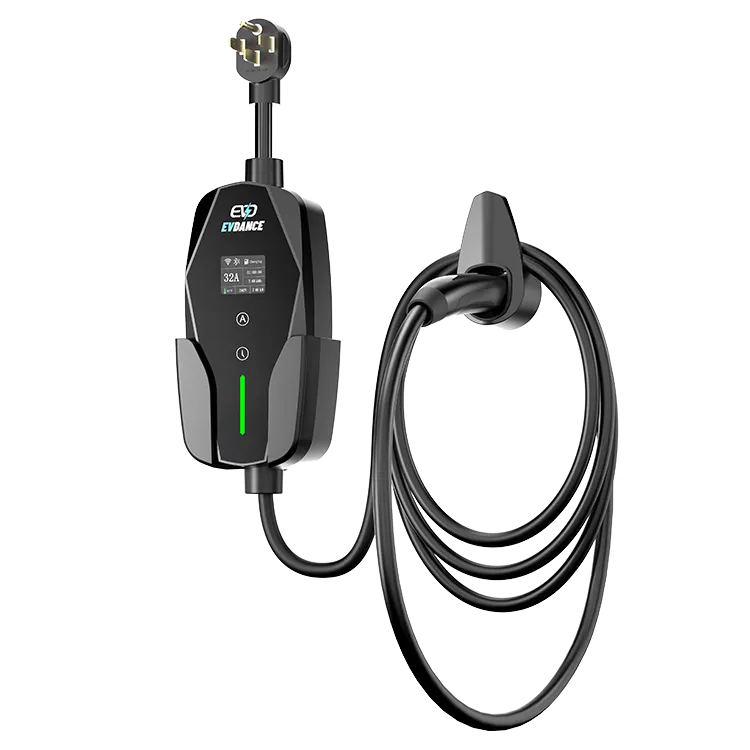
Not as it ships — two separate locks stop it. The EVDANCE EV-ACS3210T carries a NEMA 14-50 plug, and a NEMA 14-30 receptacle is a different shape, so the plug does not go in at all. The electrical side is the smaller problem: a 30 A circuit caps continuous charging at 24 A under the NEC 125% rule, and this charger has a 24 A step. Two locks — and only one of them is a setting.
Key Takeaways
- No, not directly: the EV-ACS3210T’s 14-50 plug does not fit a 14-30 receptacle — the shape is the first lock.
- The second lock is electrical: a 30 A circuit allows 24 A of continuous charging, and this charger has an exact 24 A step.
- An adapter does not change the circuit; treat shape-bridging as an electrician’s judgement, never a casual fix.
- The clean routes: a proper circuit from an electrician, or a 14-50 that already exists.
Lock One: The Plug Does Not Fit
NEMA numbers describe the arrangement of the slots and pins. A 14-50 and a 14-30 are both four-wire, 240 V outlets, but their pin layouts differ, and a 14-50 plug will not seat in a 14-30 — by design. A plug must never be forced or modified to fit: altering it defeats its listing and invites exactly the overheating the shapes exist to prevent.
One identification matters first: older homes often have the three-slot 10-30 instead of the four-slot 14-30, and the 10-30 has no separate equipment ground — a further question on an EV circuit. Telling them apart is covered in our guide to whether a 14-50 is a dryer outlet and how the 10-30 differs.
Lock Two: The Circuit Ceiling
Even where the shape is dealt with properly, the circuit sets the second limit. Charging is a continuous load: the National Electrical Code (NFPA 70) sizes the breaker at 125% of it, so the circuit delivers 80% of its rating to charging. How that lands on this charger:
| Circuit breaker | Maximum continuous charging | Step to select on this charger |
|---|---|---|
| 30 A — the 14-30 dryer circuit | 24 A | 24 A — an exact step exists |
| 40 A | 32 A | 32 A — the charger’s maximum |
| 50 A — a full 14-50 circuit | 40 A | 32 A — the charger itself is the ceiling |
At the 24 A step the session runs at about 5.8 kW — worked arithmetic, 24 A at 240 V. So the electrical half is genuinely solvable: the charger can be set to exactly the current a 30 A circuit allows. The plug half is not a setting at all.

Why an Adapter Is Not the Shortcut
It is tempting to treat the shape problem as a shopping problem. Resist that. An adapter changes the shape of the connection, not the circuit behind the wall — the 24 A ceiling applies with or without one, and EV charging holds a heavy load for hours, not minutes. Whether any adapter is listed and appropriate for continuous EV charging is a licensed electrician’s judgement — doubly so for a 10-30 with no separate ground.
The Routes That Do Work
- A proper circuit. An electrician converts the laundry run or adds a dedicated circuit with the correct receptacle and breaker. It is the permanent fix, and removes the dryer conflict.
- Charge where a 14-50 already exists. The charger is portable; a correct receptacle elsewhere takes it as it ships, at the step that circuit allows.
- Sharing, if the dryer stays. Sharing one outlet between dryer and charger has its own hard rule — never both at once: plugging a Level 2 charger into a dryer outlet.
The EV-ACS3210T in This Picture
The EV-ACS3210T is a 32 A NACS portable charger, adjustable in six steps — 10, 12, 16, 20, 24 and 32 A — with a NEMA 14-50 plug, a 1.77-inch screen and an IP66-rated body. The 24 A step is what makes a 30 A circuit workable at all; a fixed-output charger would have no compliant answer there. EVDANCE has built charging equipment since 2011; its chargers carry a standard three-year warranty.
Frequently Asked Questions
My charger has a 24 A setting — doesn’t that solve the whole problem?
It solves the electrical half — the current matches a 30 A circuit exactly. The plug still does not fit a 14-30; bridging that shape is an electrician’s judgement.
Can I modify the plug so it fits?
Never. Forcing or replacing the plug defeats its listing and is a fire and shock risk; changing a receptacle is fixed wiring work for a licensed electrician.
How much charging would the 24 A step actually give?
About 5.8 kW by simple arithmetic — roughly 46 kWh drawn in an eight-hour night, before charging losses. For most daily driving, that is a full recovery.
Related Reading
- Can I Plug a Level 2 Charger Into a Dryer Outlet?
- Is a NEMA 14-50 a Dryer Outlet? And Can You Convert a 10-30?
- What Size Breaker Do I Need for an EV Charger?
Sources & Standards
- National Electrical Code (NFPA 70) — continuous-load sizing.
- DOE Alternative Fuels Data Center — Charging EVs at Home — home charging levels and outlet types.

