
Start with arithmetic, not suspicion. The ACS1605PE delivers its 11 kW across three phases, so the number you see depends on how many phases your car takes: a car that charges on one phase only draws about 3.7 kW, a two-phase car about 7.4 kW, and only a car that accepts 11 kW three-phase uses the full rate — and even that car slows as its battery fills. Divide the energy added by the hours plugged in, and the average usually names the explanation before anything is faulty.
Key Takeaways
- On an 11 kW three-phase portable, power arrives in phase shares: about 3.7 kW per phase at 16 A.
- Session maths — energy divided by hours, losses allowed — separates expectation from fault before anything is opened.
- If the slowness follows the car, it is the car’s acceptance class: correct behaviour, nothing to repair.
- If it follows the socket, the supply is the suspect: the swap test is yours, the diagnosis is an electrician’s.
The Session Maths Check
Energy added (kWh) divided by hours plugged in gives a session’s average power. Allow roughly 10% for charging losses, then compare the average with the phase shares below — 230 V × 16 A is about 3.7 kW per phase.
| Your computed average | What it usually means | First check |
|---|---|---|
| Steady at about 3.7 kW | The car is charging on one phase — correct behaviour for a single-phase onboard charger | The car’s own AC specification |
| Steady at about 7.4 kW | The car takes two phases — or the supply is delivering one phase fewer than it should | The same car on a second three-phase socket |
| Near 11 kW early, falling later | The normal taper as the battery fills | The charge level when you plugged in |
| Different on every socket | The pattern follows the supply, not the car | Record the pattern per socket; the supply is an electrician’s diagnosis |
Branch One: The Car’s Acceptance Class
On AC charging, the car’s onboard charger sets the pace — the portable offers three phases, and the car takes the ones it was built for. A single-phase car on this unit is not underperforming; it is charging exactly as designed, at one phase’s share. A two-phase car lands in the middle for the same reason. No charger can add phases the car does not take, and no setting fixes a class difference. Our explainer on single-phase vs three-phase EV charging sets out where the 3.7, 7.4 and 11 kW figures come from.

Branch Two: The Supply Delivers Less Than Three Phases
If the evidence follows the socket instead — the same car slow here, at full rate on another three-phase socket — the suspect is the supply feeding that socket. The one isolation test you can safely run is a swap: same car, same charger, a second known three-phase socket, such as another bay’s outlet of the kind covered in our guide to CEE plugs for three-phase portable chargers. Anything beyond that swap is a licensed electrician’s diagnosis — never test a live three-phase circuit yourself. One stop rule overrides every branch: warmth, discoloration or a loose feel at the plug or socket means stop and have the socket checked.
What Not to Conclude
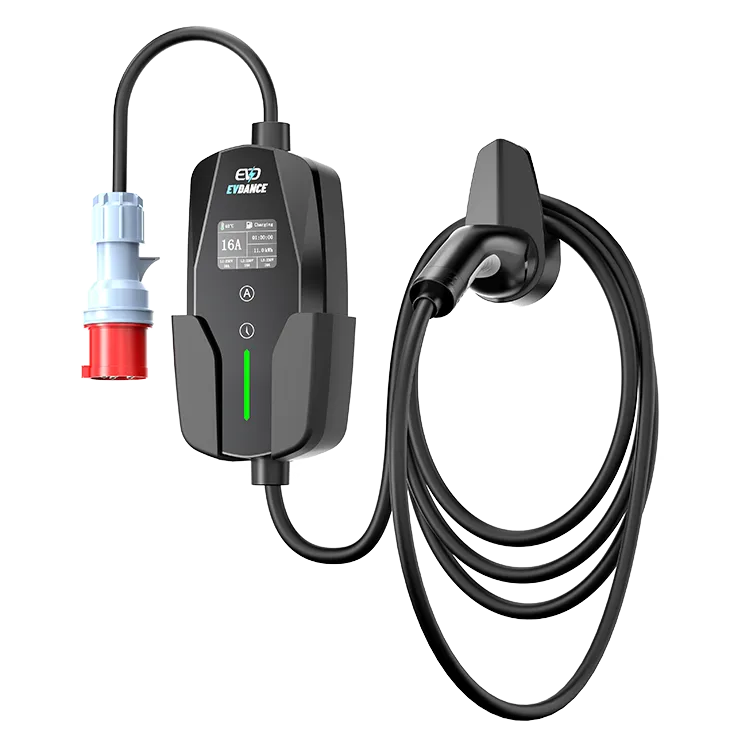
Do not credit the charger with diagnosing any of this. The published specification for the ACS1605PE — 11 kW, 16 A at 230/400 V, Type 2, CEE five-pin plug, 1.77-inch display, IP66, 7.6 m cable — states no phase-monitoring or self-diagnosis behaviour. Treat the unit as a witness, not a diagnostician: what it and the car show is evidence, and the split above is how to read it. If a low-power pattern is intermittent and follows neither car nor socket, record two or three sessions (car, socket, energy, hours) and send them to EVDANCE via the contact page, under the model’s 3-year standard warranty.
Frequently Asked Questions
Is charging at 3.7 kW a fault?
Not if your car accepts AC on one phase only — that is its normal rate on any three-phase charger. The same figure appearing with a car you know takes 11 kW three-phase points at the supply instead; run the swap test.
Is there a current setting I can raise on the unit?
The listing states no adjustable current settings for this model, so there is no dial to turn. When the average is low, the limit sits in the car’s acceptance class or in the supply — both branches above.
Why does the average sit below 11 kW even in my 11 kW car?
Because an average includes the taper — charging slows as the battery fills, as Why Does EV Charging Slow Down After 80%? explains — plus losses. Judge by the early-session rate at a low charge level, not the whole-session average.
Related Reading
- Single-Phase vs Three-Phase EV Charging: 7kW, 11kW and 22kW Explained
- CEE Plugs Explained: Choosing 16A or 32A for a Three-Phase Portable EV Charger
- Portable EV Charger Types Explained: 10A, 16A, 32A and Three-Phase Models
- Why Does EV Charging Slow Down After 80%?

