
Yes — a workshop with a 16 A five-pin CEE socket on a three-phase supply can charge customers’ cars with the ACS1605PE, at up to 11 kW. What makes it different from charging your own car: every car arrives unknown. Its onboard charger sets the rate, the session record belongs on the job card, and the charge level at hand-back is your workshop’s own practice, agreed with the customer — not a number any charger can promise.
Key Takeaways
- Customer cars set their own rate: 11 kW only where the car’s onboard charger accepts it, less otherwise.
- Record the session on the job card from observable readings — dashboard state of charge at both ends, times, the accepted rate.
Every Customer Car Sets Its Own Rate
The charger offers 11 kW of three-phase AC; the car decides how much it takes, and in a workshop the cars change daily. Plan around the car’s acceptance, not the charger’s headline:
| What the car accepts | What it draws from this unit | What that means for the job |
|---|---|---|
| 11 kW of three-phase AC | Up to the full 11 kW | A car in for a half-day job takes on a real amount of energy |
| 7.4 kW, single-phase AC | One phase’s share — about 3.7 kW (16 A at 230 V, labelled arithmetic) | The same visit adds less; plan the dwell, not the charger |
| A smaller onboard charger, as on many plug-in hybrids | Its own lower rate | A courtesy top-up alongside the job, not the job itself |
The practical rule follows: never quote a time or an amount before the car has shown its rate. Its screen shows what it is accepting within the first minutes — that reading, not the charger’s rating, is what a promise can be built on. Our explainer on single-phase vs three-phase charging covers why one charger feeds different cars at different rates.
The Session Record Belongs on the Job Card
A workshop runs on records; a session should leave the same trail as any other work on the car, and everything needed is observable:
- Start: the time, and the state of charge from the car’s dashboard.
- During: the accepted rate, read once at the start.
- End: the time and the dashboard state of charge again — the pair is the handover evidence.
- The unit’s side: its 1.77-inch display is the witness at the charger end; a dashboard photo at plug-in and hand-back settles most questions early.
One boundary: session energy is tracking information, useful for the shop’s own costing. The listing claims no metering certification for this unit, so treat it as a record, not a meter reading — any charge passed to a customer should rest on the workshop’s stated policy, not the display alone; where local rules govern selling electricity, that policy is one for the workshop’s adviser.
Handover Is a Conversation at Drop-Off
The charge level a car goes back with is the workshop’s own practice — agree it before the session, not after. “Enough to get home” and “as full as the visit allows” are both reasonable — just different promises, and the second depends on the car’s rate and the visit’s length. A slow-accepting car needs the honest version early.
Housekeeping is basic but real: wipe grit off the CEE plug before it goes in, cap the Type 2 connector between cars, and keep the 7.6 m cable out of drive-over paths and oil.

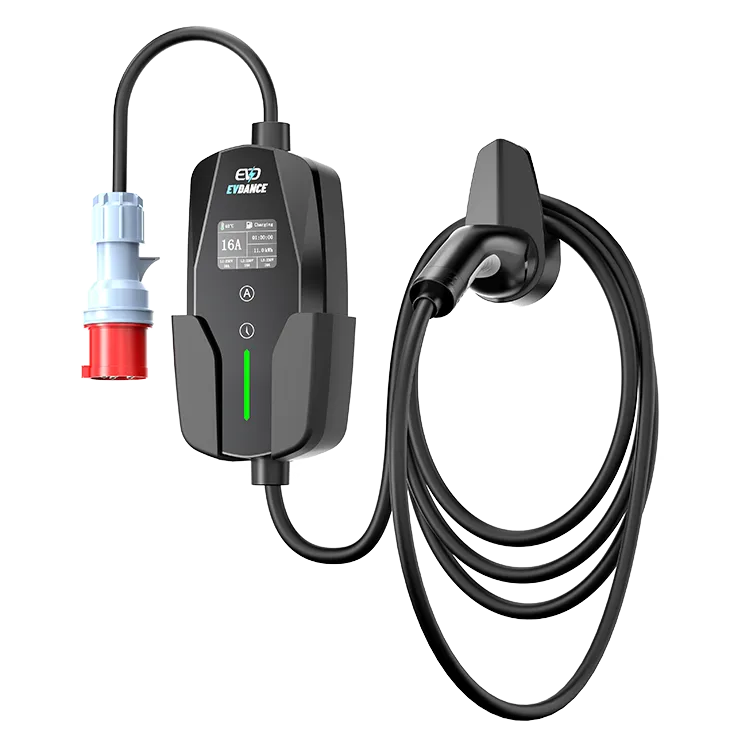
The unit in this scene is the ACS1605PE: EVDANCE’s 11 kW three-phase portable — 16 A at 230/400 V, CEE five-pin plug, Type 2 to the car, a 1.77-inch display, IP66 and a 7.6 m cable, with a 3-year standard warranty. No app or card layer is claimed for this model, so staff run and record the sessions — the normal workshop pattern anyway. Where the shop’s sockets are the 32 A class, the matching portable is the 22 kW EV-ACS3205PE.
Frequently Asked Questions
Will every customer’s EV charge at 11 kW?
No — only cars whose onboard charger accepts 11 kW of three-phase AC. Others take their own rate, shown on the car’s screen within minutes.
Can we bill a customer for energy using the charger’s display?
The listing claims no metering certification for this unit, so the display figure is a tracking record, not a certified meter reading. Build any customer charge on your own stated policy — and take advice where local rules govern selling electricity.
Our workshop sockets are the 32 A class. Does this unit fit?
No — the 16 A and 32 A CEE classes do not mate, and adapters are not an answer for continuous loads. The 32 A class is the EV-ACS3205PE’s ground; an electrician can advise on fitting one if the supply allows.
Related Reading
- CEE Plugs Explained: Choosing 16A or 32A for a Three-Phase Portable EV Charger
- Portable EV Charger Types Explained: 10A, 16A, 32A and Three-Phase Models
- Single-Phase vs Three-Phase EV Charging: 7kW, 11kW and 22kW Explained

