
Neither option wins outright — it depends on how long your cars stay. AC points serve more cars when each car parks for hours, because every point works its own bay for the whole stay. One compact DC unit serves more cars per day when stays are short, because it turns a single bay over many times. Most busy sites end up with both: DC where the short-stay queue forms, AC where cars settle.
Key Takeaways
- Compare cars per day, not kilowatts: a turning-over DC bay out-serves AC points at short stays.
- AC points win energy per car and cost per point; DC wins turnover per bay.
- Both choices land on the same load calculation — a row of AC draws can total more than one DC draw.
- The mix rule: DC for the short-stay queue, AC for the long-stay rows, decided by your observed dwell split.

Count Cars per Day, Not Kilowatts
The comparison that matters is throughput: how many cars each installed point can serve in a day. Labelled arithmetic from session lengths, over a notional ten-hour public day:
| One installed point | Session pattern (labelled) | Cars served in the day | What each car gets |
|---|---|---|---|
| 22 kW DC bay | Top-ups of about 45 minutes | Up to about 12, back to back | A part-charge sized to the stop — roughly 15 kWh class, before losses and taper |
| AC point, short-stay bays | Stays of about 3 hours | About 3 | A large charge, capped by the car’s onboard charger |
| AC point, long-stay bays | Cars parked all day | 1 | A full battery, with hours to spare |
Real days are not back-to-back: there are gaps, sessions taper, and AC rates are set by each car’s onboard charger. But the shape holds — the DC bay wins cars per day; the AC point wins energy per car.
What Each Choice Asks of the Site
The supply sees two shapes. One compact DC unit is a single draw in the 22 kW class. A row of AC points is several smaller draws that add up — a handful of busy AC points can total more than the DC unit — and the load calculation must find room for either shape. An installer runs it on the whole site.
The cost structure differs too. U.S. DOE-cited figures put public Level 2 at about $3,500 equipment plus $2,500 installation per connector, and corridor-class DC fast charging at about $38,000–$90,000 equipment plus $20,000–$60,000 installation — U.S. figures for their classes, not quotes: this compact unit sits below the corridor class and is priced per site. The shape stands: AC is cheaper per point, but every point is another installed connector, while DC concentrates its cost in one unit and one bay that must keep turning over — bay discipline: signage, time expectations, the operator’s policy.
The Mix Rule
- Short-stay queue → DC. Where cars arrive, do something brief and leave, one turning-over DC bay serves the queue.
- Long-stay rows → AC. Where cars park for work, sleep or a long visit, AC points deliver the full charge at lower per-point cost.
- Decide from your own dwell split. Watch the car park for a week: stays under an hour against stays over three hours is the input that chooses for you.
- Fund the binding constraint first. If supply capacity is the limit, it decides how much of either you can run; if bays are the limit, turnover is worth more.
Our comparison of charging levels covers the technologies; the mix above matches them to a site’s day.
The Two Options in EVDANCE Hardware
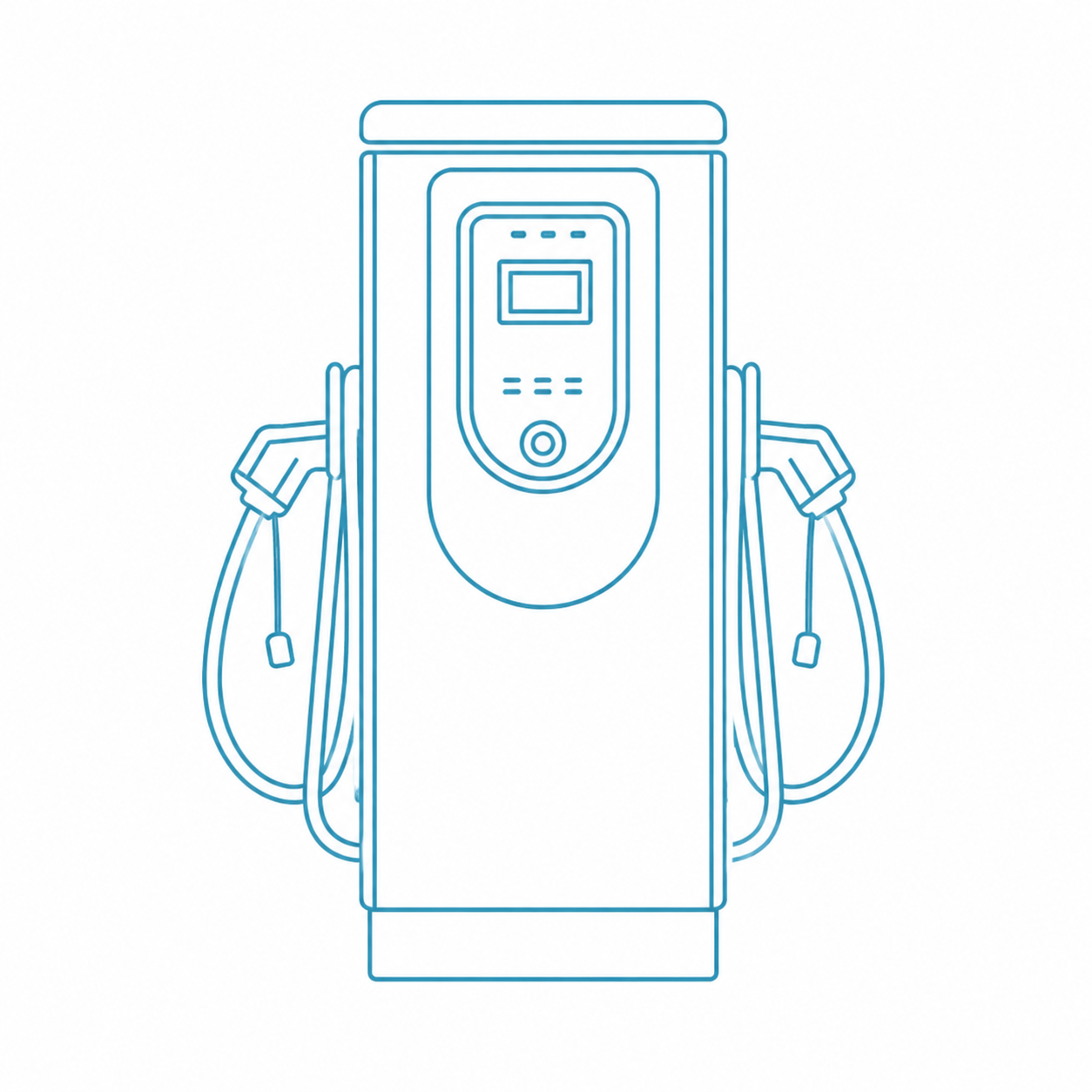
The EV-RHDC30K-L is the compact DC option: 22 kW DC as its page states it, floor-standing, single connector, IP54, LCD, OCPP 1.6J. On the AC side, the EV-AC03201T is a dual-connector AC station — two Type 2 connectors, up to 43 kW shared (22 kW per connector), OCPP 1.6J, RFID, IP54 — two long-stay bays per unit. Both speak OCPP 1.6J as listed, so one platform can run the mix. EVDANCE is a Shenzhen manufacturer founded in 2011; both carry its 3-year standard warranty. The commercial charging range covers the rest.
Frequently Asked Questions
Is one DC unit worth several AC points?
Only on one measure: cars per day at short stays. In energy per car and cost per bay, the comparison reverses. No fixed exchange rate exists — your dwell mix sets it.
Does adding AC points avoid the supply question?
No. Each point adds its draw, and a row of them can exceed one compact DC unit’s draw. The load calculation covers the whole site either way — an installer sizes the mix, not the individual units.
Can one platform manage both AC and DC?
Both units named here are listed with OCPP 1.6J, the link a platform uses to run sessions, access and pricing. A mixed estate on one platform is the normal arrangement.
Related Reading
- Level 1 vs Level 2 vs DC Fast Charging: A Practical Comparison
- Are EV Chargers AC or DC?
- How Do Commercial EV Charging Stations Work?

