
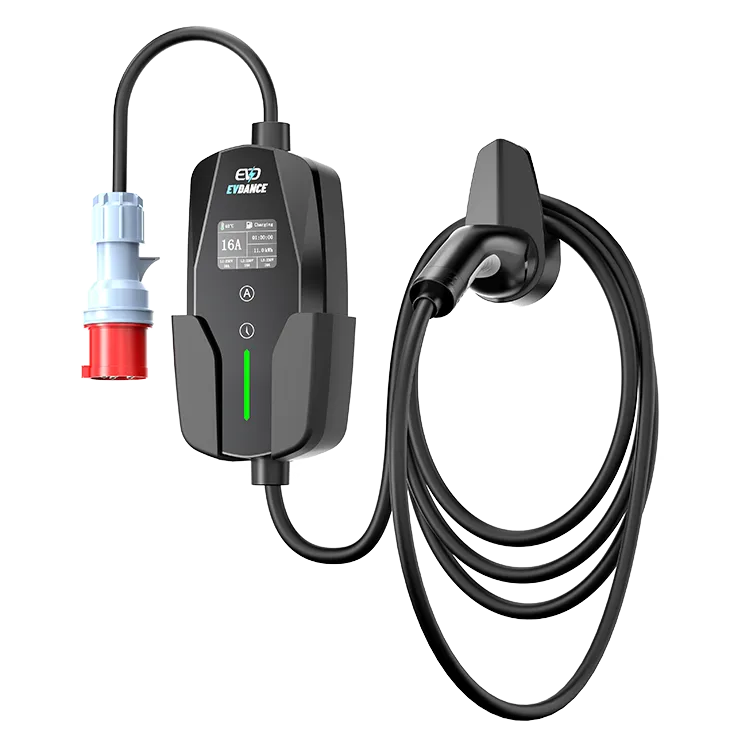
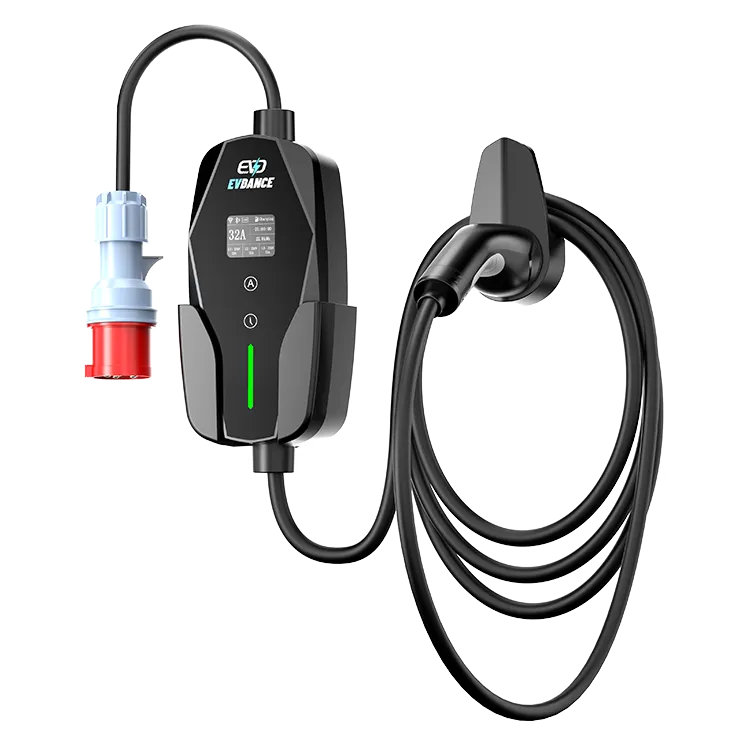
Read the rating printed on your socket — that number, not your car, decides. A red five-pin CEE socket marked 16 A takes the ACS1605PE, an 11 kW three-phase portable charger. A red five-pin socket marked 32 A takes the EV-ACS3205PE, a 22 kW three-phase portable. The two plug sizes do not interchange, and no other EVDANCE charger plugs into a CEE socket at all.
Key Takeaways
- The socket’s printed rating decides: 16 A points to the ACS1605PE, 32 A to the EV-ACS3205PE.
- The two CEE plug sizes do not interchange, and bridging adapters are not an option for continuous loads.
- After the socket, check the car: a single-phase car takes only one phase’s share from a three-phase charger.
- The EV-ACT3204PE wallbox is hardwired, not a CEE plug-in; supply checks belong to a licensed electrician.
Match the Socket First
| Your CEE socket | EVDANCE charger that fits | Power at the car |
|---|---|---|
| Five-pin, marked 16 A | ACS1605PE | Up to 11 kW, three-phase |
| Five-pin, marked 32 A | EV-ACS3205PE | Up to 22 kW, three-phase |
| Blue, single-phase | Neither of these two | A single-phase supply belongs to a different charger class |
| No CEE socket yet | Neither, yet | An electrician fits the socket your charger needs |
The rating is printed on the socket itself — read it rather than judging by colour or size, because the two classes look alike. Our explainer on CEE plugs, 16 A vs 32 A covers the family in full.
Why a 32 A Supply Is the Wider Choice
A 32 A socket, as found, takes only the 32 A plug — the 16 A plug is a different size and will not mate with it. But a 32 A supply is not a dead end for the smaller charger: an electrician can fit a 16 A socket on that supply, after which either unit has a home. The reverse does not work — a 16 A circuit cannot feed a 32 A charger, and adapters bridging the ratings are not an option for a load that runs for hours. The socket as found decides today; the supply rating decides what an electrician can add.
Then Check What the Car Accepts
The charger sets the ceiling; the car decides what it actually draws. A three-phase car with an 11 kW onboard charger takes 11 kW from either pairing. A car that accepts 22 kW on AC needs the 32 A pairing to see it. A single-phase car plugged into a three-phase charger draws on one phase only — as labelled arithmetic, about 230 V × 16 A ≈ 3.7 kW, or 230 V × 32 A ≈ 7.4 kW. If your car is single-phase, neither CEE portable is your fastest route; a single-phase charger class fits it better — see how portable charger speed depends on the outlet.
The Honest Exclusions
- The wallbox is not a CEE plug-in. The EV-ACT3204PE is hardwired on the supply side in both its cable and socket versions. It is the fixed alternative when a site wants a permanent 22 kW point — not something that plugs into an existing CEE socket.
- A socket on the wall is not proof of the supply behind it. Whether three-phase is really present, and whether the circuit is fit for hours of continuous load, is an electrician’s confirmation — worth having before a portable becomes a daily habit.
- Single-phase CEE variants are a different question. Neither three-phase unit in this article fits them.
The Two EVDANCE CEE Portables
The ACS1605PE is an 11 kW three-phase portable charger: 16 A, CEE five-pin plug, Type 2 connector, 7.6 m cable, a 1.77-inch display and an IP66 rating. The EV-ACS3205PE is the 22 kW step up: 32 A three-phase, CEE 32A plug, Type 2, display and IP66. Its listing does not state a cable length — confirm it in writing before ordering if reach matters. Neither unit lists an app, RFID or adjustable current steps — with this class of charger, the socket and the car decide the session.
Frequently Asked Questions
Can I use an adapter to run the 22 kW charger from a 16 A socket?
No. The ratings exist so a charger cannot draw more than the socket and circuit were built for, and bridging adapters are not an option for continuous loads. An electrician can say what your supply can be fitted with instead.
My car charges at 11 kW. Is there any point in the 32 A charger?
Only if a 32 A socket is what you have, or other vehicles will use the point later. On a 16 A socket the 11 kW unit is the complete answer.
How do I confirm my supply is really three-phase?
The socket’s form is a clue, not proof. A licensed electrician can confirm the supply and its protection — the right check before a portable settles into daily use.
Related Reading
- CEE Plugs Explained: Choosing 16A or 32A for a Three-Phase Portable EV Charger
- Do Portable EV Chargers Work? How Speed Depends on the Outlet
- Is NEMA 14-50 Three-Phase?
- What Is the Fastest Portable EV Charger?

