
A relay and a contactor do the same basic job — both are electrically controlled switches — and the difference is duty. Relays handle smaller currents and board-level switching; contactors are built to carry and break a charger’s full session current, thousands of times, including under load. The choice is decided by rated current, breaking duty, switching frequency and ageing — the charger’s whole safety case ends at a switch that must open every time.
Key Takeaways
- Relays and contactors are the same principle at different duty levels; ratings decide, not names.
- Current, breaking duty, switching frequency and AC-versus-DC arc behaviour drive the choice.
- Heavier duty makes welded-contact detection part of the design, whatever the switch is called.
- The switching device inside a model is a design-file question — ask it in OEM and procurement discussions.
Two Names, One Job
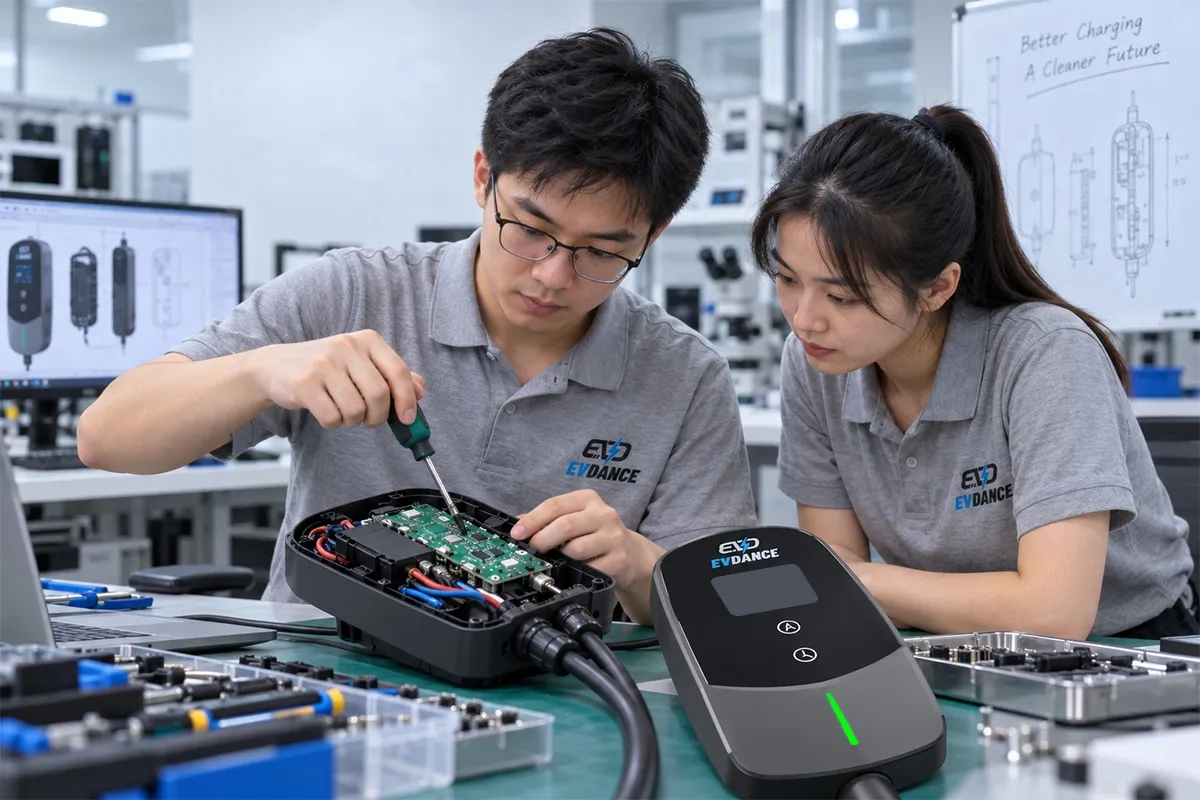
Both devices use a coil: energise it and the contacts close; remove the coil power and springs pull them open. That fail-open behaviour is why chargers use them as the main switch. The names are a convention of size and duty rather than different principles. A relay is typically a smaller, often board-mounted device with contacts rated for modest currents. A contactor is a larger, usually panel-mounted device whose contacts, arc handling and mechanical life are designed for power circuits. Suppliers draw the boundary differently, so a specification should always state ratings, never just the device name. Our overview of how home EV chargers work shows where the switch sits in the sequence.
Where Each One Fits in a Charger
At portable-charger currents a correctly rated relay-class device can carry the main switching duty; relays also do small jobs throughout a design — indicators, interlocks, auxiliary circuits. Wallboxes and stations at higher currents — and any charger switching many sessions a day for years — move to a contactor for the main path. DC fast chargers add a further demand: their output contactors must break direct current, where an arc has no natural zero-crossing to help extinguish it — DC-rated contactors with arc control are a different class of part. The DC fast charger explainer covers why that output side is engineered separately.
The Factors That Decide
| Factor | Points toward a relay-class device | Points toward a contactor |
|---|---|---|
| Continuous current | Lower session currents, within the device’s contact rating with margin | Higher session currents, or several outputs switched in one cabinet |
| Breaking duty | Switching mostly at session start and end, at modest load | Must be able to break full load current reliably, repeatedly |
| Switching frequency | A few operations a day in private use | Many operations a day in public or fleet service, over years |
| Current type | AC circuits, where the waveform helps quench arcs | DC output circuits, which need DC-rated arc handling |
| Failure behaviour | Lower stored energy behind the switch | Detection of a stuck-closed (welded) contact becomes essential |
The last row matters most: the heavier the duty, the more the design depends on proving the switch opened. Contact welding grows with current and operations, and it is answered by detection, not by device name.

What a Buyer Asks the Manufacturer
No EVDANCE product page names the switching device inside a model — normal across the industry; it is a design-file fact, not a brochure fact. In an OEM or private-label discussion it becomes four questions: which device class switches the main path, what current and operations it is rated for in this design, how a welded contact is detected, and what the service replacement concept is. EVDANCE is a Shenzhen manufacturer founded in 2011, exporting to 30+ countries, with private label from 100 units and a 3-year standard warranty; its OEM and private-label programme is where those questions are settled, with answers available in writing through the contact page. A switching device correctly rated for its duty — relay or contactor — is the engineering answer; a familiar name on a datasheet is not.
Frequently Asked Questions
Is a contactor always better than a relay?
No. An oversized contactor in a light-duty charger adds cost and coil draw without adding safety. What matters is a device rated, with margin, for the current, breaking duty and operations the design will actually see.
Why do I hear a clunk when a session starts?
The main switching device closing once the charger’s checks pass — often with a second sound from the car, which connects its battery with contactors of its own. One clunk at start and stop is normal; repeated clicking with no start is a fault to have diagnosed.
Can a worn relay or contactor be replaced on site?
It depends on the design — some are service parts, others are replaced as an assembly with the power board. Never open a charger yourself; ask the manufacturer for the service concept and spare-parts route.
Related Reading
- How Do Home EV Chargers Work?
- How Do DC Fast Chargers Work?
- Does an EV Charger Need GFCI Protection?
- EV Charger Certifications Explained: CE, UKCA, UL, ETL, CB and What Buyers Should Ask For

