
Buying the RDC-DD part means buying a complete, tested detecting device — sensing and evaluation electronics as one specified component — not a bare current transformer. The device watches the supply conductors for smooth DC residual current and signals the charger to disconnect at 6 mA, the threshold the standards set. A sound purchase turns on evidence: the standard it was tested to (IEC 62955), its trip interface to your controller, and documentation your certification file can stand on.
Key Takeaways
- An RDC-DD is a complete tested device — sensor plus evaluation electronics — never a bare current transformer.
- The purchase turns on evidence: IEC 62955 test reports for the exact part, a defined trip interface, and a failure behaviour that announces itself.
- Component evidence supports the finished charger’s certification; it does not replace it.
- Fix the protection architecture first, then buy the module it calls for.
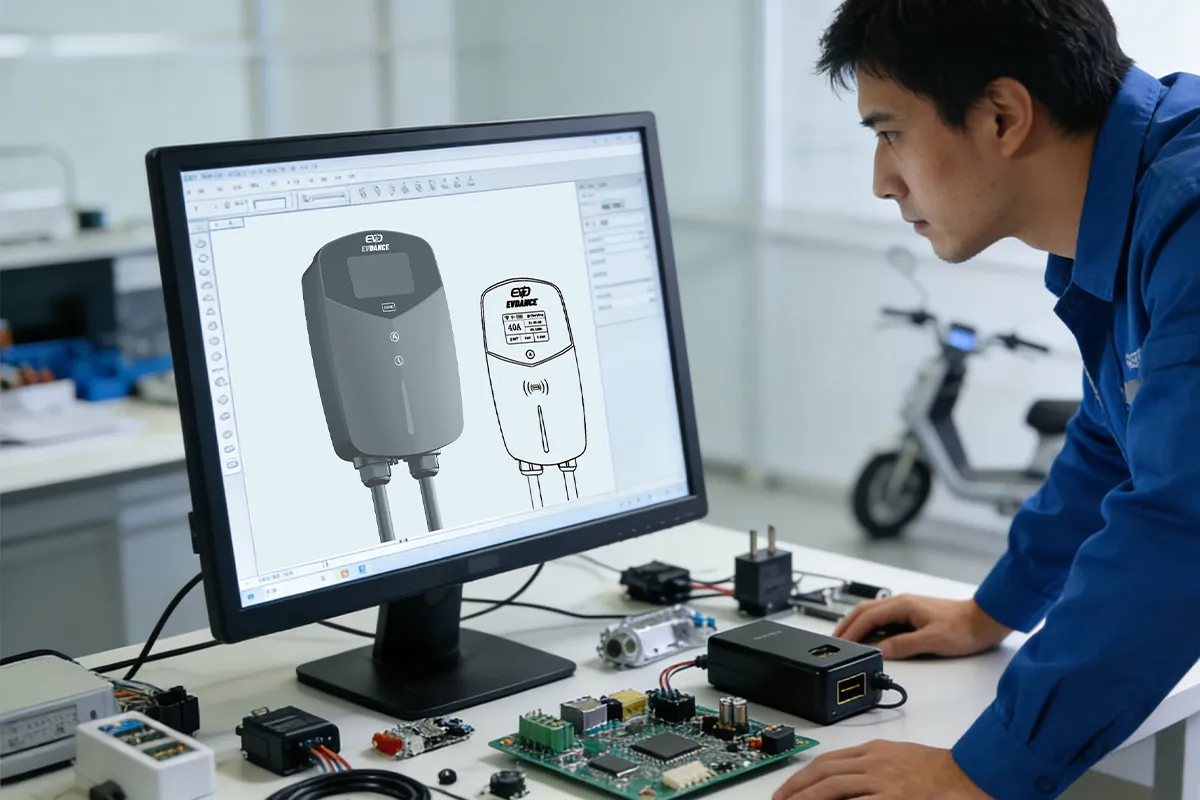
What You Are Actually Buying
The device sits around the supply conductors and evaluates the residual current — out versus return — including the smooth DC component a fault in charging electronics can produce. At the 6 mA threshold it outputs a trip signal, and the controller opens the main switching device. The common sourcing trap is the two-part illusion: a toroidal sensor alone only measures. Without the matched evaluation electronics — the part that decides, self-checks and signals — there is no RDC-DD, whatever the sensor datasheet implies. It can be bought as a standalone module or designed-in on the manufacturer’s own board; the standalone route is where supplier evidence matters most. Why the DC fault exists at all is covered in our explainer on RCD protection and 6 mA DC detection.
The Specification Lines That Matter
| Spec line | Why it decides the purchase |
|---|---|
| Detection function and threshold | Smooth DC residual current detection acting at 6 mA; an AC-only device is a different part |
| Standard and test evidence | Tested to IEC 62955, the standard written for this device; ask for the test report, not a declaration alone |
| Trip output and interface | Signal type and behaviour on device failure — a detector that fails silently undermines the design |
| Electrical environment | Rated voltage, conductor arrangement (single- or three-phase) and current path, matched to your charger’s rating |
| Form and self-test | Footprint and mounting, plus how the device self-checks and reports its own electronics failure |

Integration Responsibility Stays With the Charger
A tested module supports the finished charger’s certification; it never replaces it. The complete equipment is what gets assessed — mounting, wiring and the controller’s response included — which is why certification bodies want the component’s reports inside the charger’s technical file. The architecture is likewise an equipment-level decision: a charger with an RDC-DD inside is normally paired with a simpler upstream RCD, while one without pushes the requirement to a Type B device in the installation — the installation-side choice is set out in the RCD protection explainer. Fix the architecture first, then buy the module it calls for.
Sourcing Questions, and the EVDANCE Angle
- Will the supplier provide the complete IEC 62955 test report for this exact part, or only a summary?
- Is the part a certified component in its own right, and under whose file?
- When the module itself fails, does the failure announce itself to the controller?
- Will the supplier notify design changes, so a silent revision cannot invalidate the charger’s file?
- Is there a second source if the part is discontinued?
EVDANCE is a Shenzhen charger manufacturer founded in 2011, exporting to 30+ countries, with private label from 100 units and a 3-year standard warranty. For a brand building or private-labelling a charger — around a wallbox in the class of the EV-ACT3204PE 22 kW wallbox, for example — this conversation belongs in the design file from the start, as our OEM and private-label guide sets out. Component evidence can be discussed through the OEM programme or the contact page.
Frequently Asked Questions
Is a current sensor labelled “6 mA” the same as an RDC-DD?
No. An RDC-DD is the complete device — sensor plus evaluation electronics that decide and signal — tested as a unit to IEC 62955. A sensor alone only measures; it decides nothing and holds no device-level evidence.
Does buying a tested RDC-DD module certify my charger?
No. The module’s reports join the finished charger’s technical file, and the complete equipment still goes through its own assessment. A supplier claiming a component “certifies the product” is a reason to examine their evidence harder.
Should the design use an RDC-DD module or a Type B RCD instead?
An equipment-architecture decision, not a component preference — it interacts with the market’s installation rules and the lab’s reading of the design. Fix the architecture with the lab’s input first, then source the part it requires.
Related Reading
- RCD Protection for EV Chargers: Type A, Type B and 6 mA DC Detection Explained
- EV Charger Certifications Explained: CE, UKCA, UL, ETL, CB and What Buyers Should Ask For
- OEM and Private-Label EV Chargers: A Complete Guide for Brands

