
An EV charging cable is built in layers: strands are bunched into conductors, each conductor is insulated, the cores are laid up together, and a jacket is extruded over the bundle before printing, testing and reeling. Much of it comes from specialist plants in China; the buying questions are the same anywhere.
Key Takeaways
- A charging cable is made in layers: stranded conductor, extruded insulation, laid-up cores, extruded jacket.
- Cross-section follows rated current and phase count; insulation quality by wall thickness and concentricity.
- The printed legend and type test report are the quickest cross-checks against the specification.
- Evaluate any cable plant by its layer specifications and test records, not its catalogue.
The Conductor: Stranded Copper, Sized by the Job
The line starts with copper drawn to fine strands and bunched into a flexible conductor. Stranding is the first design decision: a cable coiled and dragged daily must flex without fatiguing, where a solid core would work-harden and crack. Strand count and lay follow that duty.
Cross-section follows rated current and phase count: three power cores for three-phase, one for single-phase, alongside a protective earth and thin signal cores for the control pilot and proximity circuits. Copper is also where the heat budget starts — an undersized conductor runs warm, the mechanism behind our guide to whether EV charging cables get hot. The stated cross-section is the first specification line to cross-check.
Insulation: The Layer That Keeps the Cores Apart
Each conductor passes through an extruder coating it with a uniform insulation wall. Two things are controlled: wall thickness, which sets the dielectric margin, and concentricity — an off-centre conductor leaves a thin spot no later step can repair. The core then passes a spark test flagging pinholes while they can still be cut out, and cores are colour-coded. For a buyer, insulation is specified, not seen: material and wall thickness belong on the specification; the finished type’s test report proves the system.
Laying Up and the Jacket
The insulated cores are twisted together — laid up — with fillers keeping the bundle round, so the cable bends evenly rather than kinking. Some constructions add tapes or screens.
The jacket is extruded over the bundle in one pass, giving abrasion, moisture, UV and oil resistance. Compound and wall thickness are specification choices, so two cables with the same rating can be built quite differently — one reason the answer to whether all EV charging cables are the same is no. Before reeling, the jacket is printed with the maker’s legend: type, ratings, standard. That print line is the buyer’s first cross-check.
Testing the Finished Cable — and Checking the Plant
Finished cable is tested as a type and sampled as a product: conductor resistance, insulation and dielectric checks, dimensions and print verified against the specification, with the type’s report from a recognised laboratory (OSHA’s NRTL programme covers US recognition) tying construction to ratings. DC cables sit at the demanding end — the U.S. DOT’s charging speeds overview puts DC fast charging at 50–350 kW, and moving that power is why DC conductors grow.
| Layer | How it is made | What the buyer checks |
|---|---|---|
| Conductor | Fine copper strands bunched and twisted | Cross-section for the rating; stranding for flex duty |
| Insulation | Extruded over each core; spark-tested on the line | Material and wall thickness on the spec; test report |
| Laying up | Cores twisted with fillers into a round bundle | Sample: roundness, flex, core identification |
| Jacket | Final extrusion, then printed legend | Legend matches the spec; claims backed by the test file |
Evaluating a cable plant comes down to those records. Whether a supplier runs such a line itself is a separate check: see factory, trading company and marketplace seller.
The Cable as Part of an EVDANCE Charger
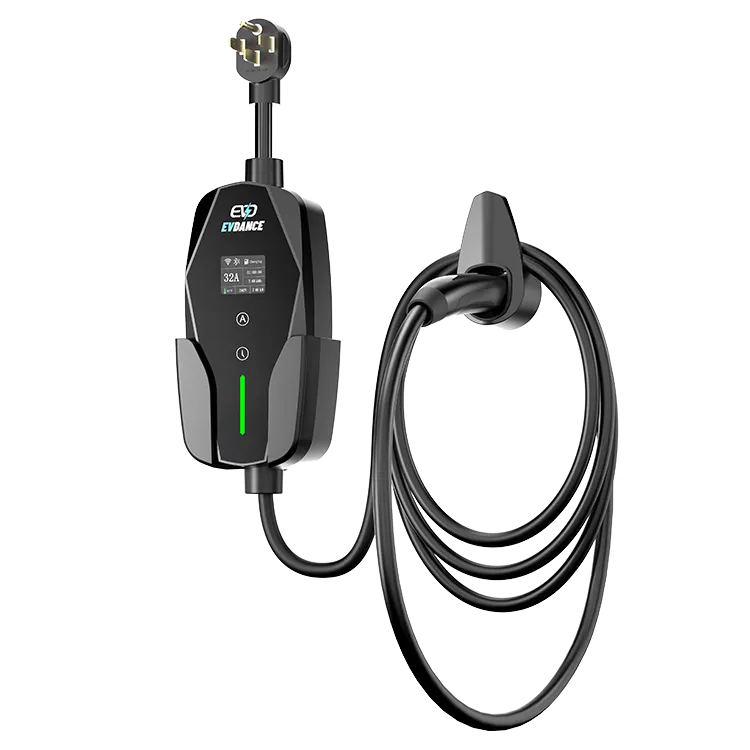
EVDANCE supplies cables as part of finished chargers, to the product’s stated specification — the EV-ACS4005T 40A NACS portable charger is listed with a 25 or 28 ft cable, the ACS1605PE 11 kW three-phase portable with 7.6 m. A brand specifying its own build confirms cable type, layer specifications and test reports in writing before production, through the OEM and private-label programme or the contact page.
Frequently Asked Questions
Why stranded conductors instead of solid ones?
Flex life: fine strands bend without the work-hardening that would crack a solid core in a cable handled daily. That is why strand class appears on a proper specification.
Are the materials the same from every manufacturer?
No. Compounds, wall thicknesses and strand classes are specification choices — two cables can share a rating and differ in build. Judge by specification and test reports.
What makes a DC fast-charging cable different?
Current. DC fast charging moves far more power, so conductors grow and the cable gets heavier and stiffer. The layers and sequence are the same; the dimensions are not.
Related Reading
- Which EV Charging Cable Do I Need?
- Are All EV Charging Cables the Same?
- Do EV Charging Cables Get Hot?
- How Long Do EV Charging Cables Last, and Can They Be Repaired?

