
Open-source EV charger designs are some of the best teaching material in the industry. The schematics, board layouts and firmware are published, so engineers can see exactly how a charger talks to a car and to a network. They stop where commerce begins. An open design carries no safety certification, no production quality system, no enclosure rated for outdoor life, and no one who is liable for it in the field.
Key Takeaways
- Open designs expose charge control, safety logic, metering and OCPP behaviour for study.
- They carry no certification, no production system, no outdoor rating and no liable maker.
- Mains-connected public equipment is not a DIY project: certified hardware and licensed installation are the line.
- A brand’s commercial route from this knowledge is a manufactured, certified product with its name on it.
What Open Designs Teach Well
| Area | What an open design shows you |
|---|---|
| Charge control | How the pilot signal tells the car how much current it may draw, and how the charger supervises that conversation |
| Safety monitoring | How protective checks — ground fault, temperature, welded contacts — are arranged in a real design |
| Metering | How session energy is measured, recorded and reported |
| Network behaviour | Readable OCPP client code: the message flow that a sealed commercial product hides |
| Mechanical choices | Connector, cable and enclosure decisions, with the reasoning argued in public |

Where They Stop
- Certification. A charger you sell, or install for others, must be certified as a finished product. Design files are not a certified product, and building from them transfers nobody’s test results to your unit.
- Production. A design that works on a bench still needs component sourcing, tolerances and end-of-line testing — and the same result across thousands of units.
- Outdoor life. Ingress protection, UV exposure and thermal behaviour are engineered and tested as a complete enclosure, not implied by a parts list.
- Responsibility. When a field unit fails, someone must answer for it: warranty, spare parts, firmware maintenance. A public repository has no support desk.
The Safety Line
A charger is mains-connected equipment that runs unattended, outdoors, in the hands of the public. Open designs are study material for engineers. They are not a route to a home-built commercial product, and they are not installation instructions. Anything offered for sale, or installed for other people, needs certified hardware and a licensed installer.
What a Brand Can Take From Them
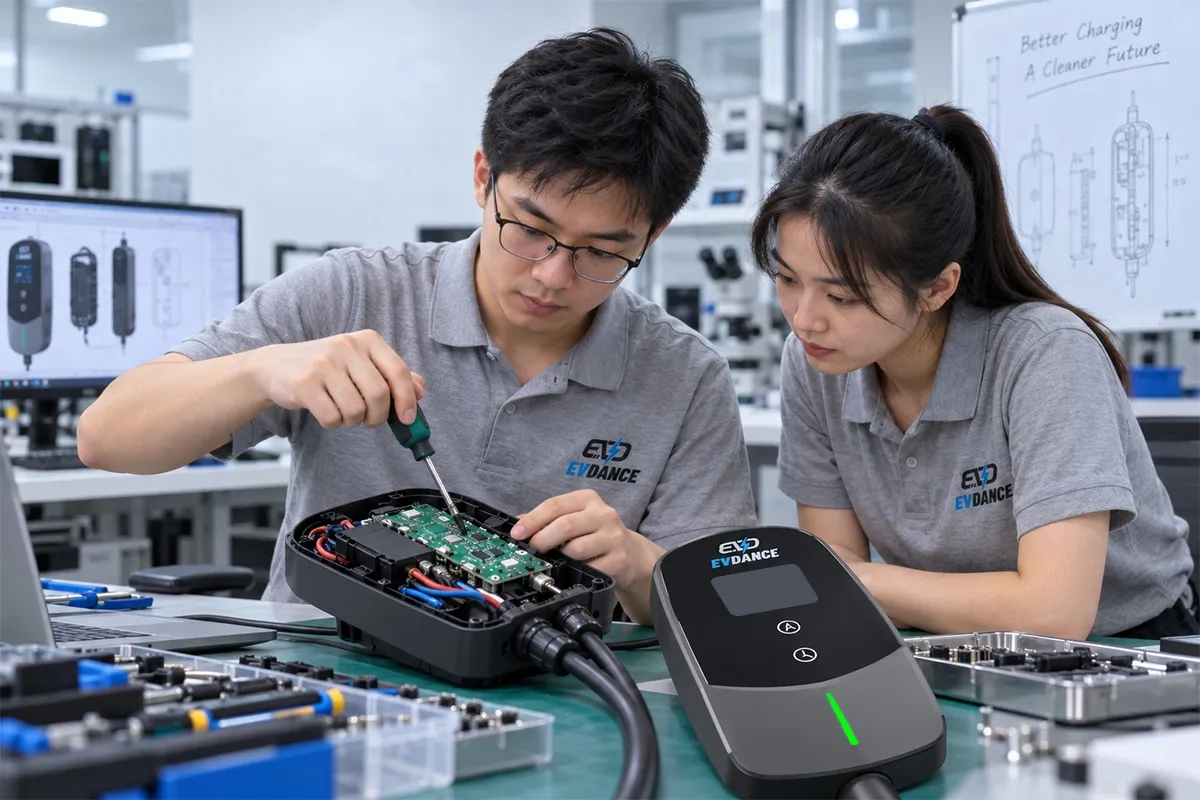
Used properly, open designs make buyers smarter. They teach the vocabulary for writing a product specification, show what an OCPP implementation looks like before integration testing begins, and sharpen the questions a brand puts to a factory. The commercial route from that knowledge is not a circuit board from a repository. It is a manufactured product with your brand on it, built and certified by a factory that stands behind it.
EVDANCE is a Shenzhen EV charger manufacturer founded in 2011, exporting to more than 30 countries, with private label from 100 units and a 3-year warranty. Browse the product range, see how the OEM and private-label program works, or contact the team with the specification your market needs.
Frequently Asked Questions
Can we sell a charger built from an open-source design?
Not on the strength of the design files. The finished product needs the destination market’s safety certification in your name, and your brand carries the product liability. For most brands, an OEM factory product is the shorter and safer route.
Do commercial chargers contain open-source software?
Open-source components appear inside many connected products. What a buyer is sold, and what gets certified, is the finished charger — its tested behaviour, its enclosure and its support — not the list of software licences inside it.
Is an open-source design a good way to learn OCPP?
Yes. A readable client implementation lays the message sequence out plainly — exactly the understanding a team needs before it writes specifications or runs integration tests of its own.
Related Reading
- OEM and Private-Label EV Chargers: A Complete Guide for Brands
- OEM vs ODM EV Chargers: How Private-Label Charging Works
- Product Liability for Private-Label EV Charger Brands
- EV Charger Certifications Explained: CE, UKCA, UL, ETL, CB and What Buyers Should Ask For

