
ESD — electrostatic discharge — is the static spark you feel on a door handle, scaled down. A discharge too small to feel can damage or weaken components on a charger’s control board, and the damage may not show until the unit is in service. That is why assembly lines treat static as a controlled process: protected areas, grounded operators, training and audits. A buyer cannot see latent damage, so the control system — and its records — is what you verify.
Key Takeaways
- Static discharges too small to feel can weaken board components, with damage hidden until the unit is in service.
- Control is a system: a marked protected area, grounded surfaces and operators, safe packaging, training and audits.
- Prevention is the only real control — no end-of-line test can prove a board was never exposed.
- Verify the records: tester logs, training records and audit reports, on any maker including EVDANCE.
Where Boards Are at Risk
A charger’s control board runs the charging session, the metering and the protective functions, so it is handled repeatedly between board assembly and final test. The exposure points are predictable: boards coming off the SMT line for inspection and fitting, the station where the board goes into the enclosure, firmware loading and test benches, and any rework bench. Every hand-off outside a protected area is a chance for a discharge nobody notices.
The harder case is the weakened component that passes every production test and fails early in the field, returning as a warranty claim with no obvious cause. Prevention at the bench is the only real control, because no end-of-line test can prove a board was never zapped.
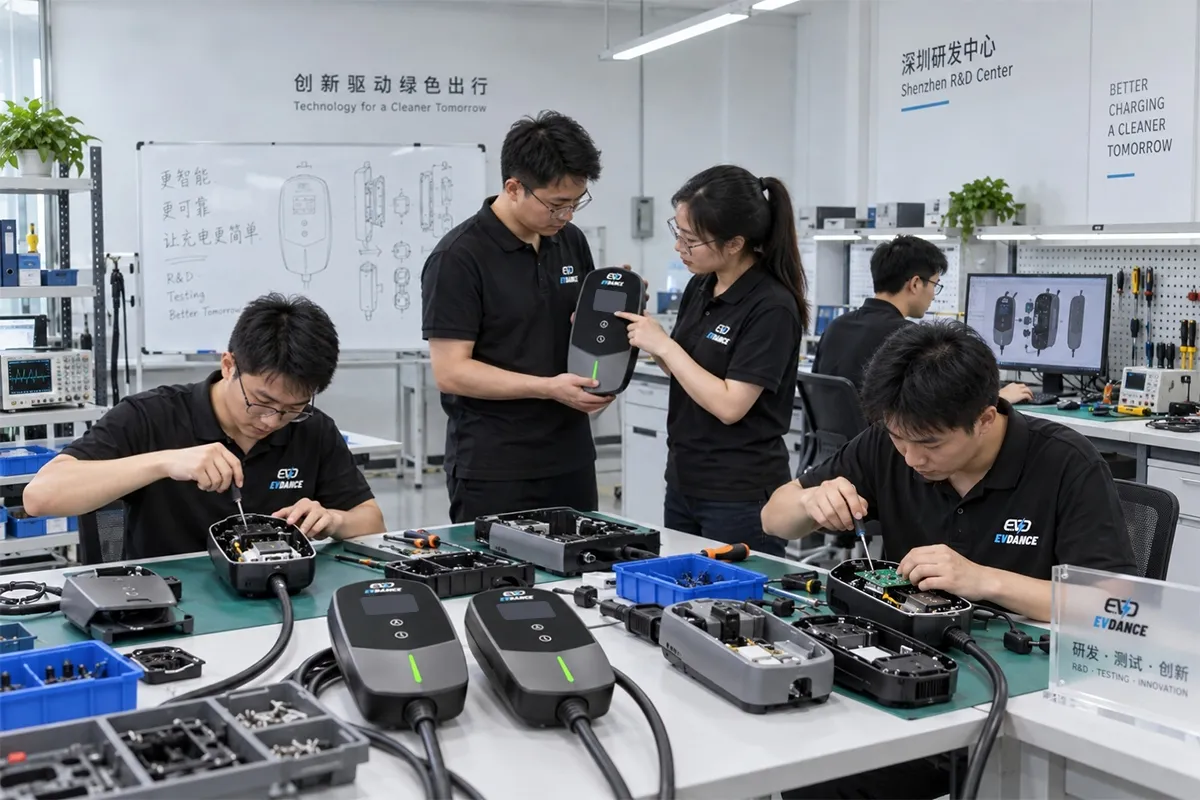
What an ESD-Controlled Area Looks Like
Factories organise this as an electrostatic protected area: a marked zone where every surface, tool and person is kept from building up or delivering a charge. The elements are mundane, and that is the point.
- Marked boundaries and signage, so everyone knows where the rules apply.
- Grounded, static-dissipative work surfaces and flooring, so charge drains away instead of sparking.
- Wrist straps and grounding footwear for operators, checked on a tester at entry.
- ESD-safe packaging — shielded bags and conductive totes — whenever boards travel between areas.
- Handling rules: boards held by their edges, ordinary plastics and personal items kept away from the bench.
- Ionisation where non-conductive materials cannot be removed from the process.
| Control | What it does | Evidence to ask for |
|---|---|---|
| Workstation grounding | Drains charge from surfaces and tools | Daily check logs for benches and ground points |
| Wrist straps and footwear | Keeps the operator at ground potential | Tester records at the area entry |
| Packaging and handling | Boards stay protected between stations | Shielded bags and totes in use on the floor |
| Training | Makes the habits hold under time pressure | Training records for everyone who handles boards |
| Internal audits | Verifies the system instead of assuming it | An audit schedule and recent audit reports |
Checking It as a Buyer
On a visit, ask where boards travel outside the protected area, and how wrist-strap testing is logged. Ask what happens to a board handled unprotected: a controlled line has a quarantine-and-retest answer, not a shrug. Our factory audit checklist for importers lists ESD protection as an assembly checkpoint; this article is the detail behind that line. Between visits, the paper trail is audit reports, tester logs and training records — ask for them by name, alongside the topics in our guide to how an OEM EV charger project works.
ESD Questions for EVDANCE — and Any Maker
EVDANCE is a Shenzhen manufacturer founded in 2011, with its own factory, exports to more than 30 countries, a private-label programme from 100 units and a 3-year standard warranty. This article describes the industry control system, not a claim about any one line: put the same questions to us as to any maker, and ask for records rather than a verbal assurance. Start through the products page, the OEM and private-label programme or contact us.
Frequently Asked Questions
Can ESD damage pass end-of-line testing?
Yes, it can. A weakened component may work normally through production tests and fail early in service. That is why ESD control is prevention at the bench, not another test at the end of the line.
Is ESD control the same as electrical safety testing?
No. ESD control protects the product during manufacture. Dielectric and protective-function tests protect the user in service. Different risks, different systems, both necessary.
Does a simple portable charger need the same discipline?
The sensitivity follows the board, not the product’s size. A portable’s control board carries session control and protection functions just as a wallbox board does, so the discipline is the same.
Related Reading
- EV Charger Factory Audit Checklist for Importers
- How an OEM EV Charger Project Works, Step by Step
- Pre-Shipment Inspection and AQL Sampling for EV Charger Orders
- Chinese EV Charger Manufacturers: Factory, Trading Company or Marketplace Seller?

