
The claim that EV charger failures cluster in the first 90 days is plausible but unproven: no verified source publishes a 90-day failure rate for chargers, so treat any quoted percentage as unverified. The pattern behind the claim is real in electronics — engineers call it infant mortality — but whether it holds for your product line is a question your own return data can answer, if structured to do so.
Key Takeaways
- No verified 90-day failure rate for chargers exists; treat quoted percentages as unproven.
- Early returns mix product defects with installation, setup and expectation faults — the finding is what counts.
- Days in service, a finding split and a denominator are what prove or disprove clustering.
- Factory screening moves early failures onto the bench; the records are the evidence to request.
The Bathtub Curve: Where the 90-Day Idea Comes From
Reliability engineers describe failure rates across a product’s life as a bathtub curve. The rate starts high in early life, when latent defects — a marginal solder joint, a component at the edge of tolerance — fail under first real use. It then settles into a long, low period before rising again at wear-out. The “first 90 days” version is that early slope with a calendar label attached: the curve is a shape, not a measurement — it predicts early failures exist, not how many.
Why Early Returns Overstate Product Failure
A return in the first weeks is not the same event as a charger defect — the first days are also when installation and setup problems surface:
- Installation faults — a circuit or breaker mismatched to the charger’s load, or an outlet worn before the charger arrived.
- Configuration faults — vehicle schedules, app pairing and network setup that make a working charger look dead.
- Expectation faults — charge speed limited by the car or circuit, reported as product failure.
All three cluster at the start, because commissioning happens once — so raw early-return counts mix product defects with site problems. The inspection finding, not the return, is what matters.
The Data That Would Prove — or Kill — the Claim
Testing the claim needs days in service, not days since shipment, plus a denominator: units in service while returns arrived. These fields are the minimum log that can answer it.
| Log field | What it lets you test |
|---|---|
| Serial number and production batch | Whether failures concentrate in one batch — a production signal, not a product-life one |
| Commissioning date and failure date | Days in service per return — the number the claim is about |
| Symptom and fault code, as reported | Whether early returns share one symptom or scatter across many |
| Finding after inspection | Product defect, site fault, or no fault found — the split that decides the claim |
| Units in service in the same period | The denominator: 30 returns mean different things from 300 units, or 30,000 |
Group returns by days-in-service bands and compare rates, not counts. A true infant-mortality pattern falls from the first band onward; a flat plot — or a spike traced to one batch or one installer — tells a different story.

Where Test Equipment Fits the Question
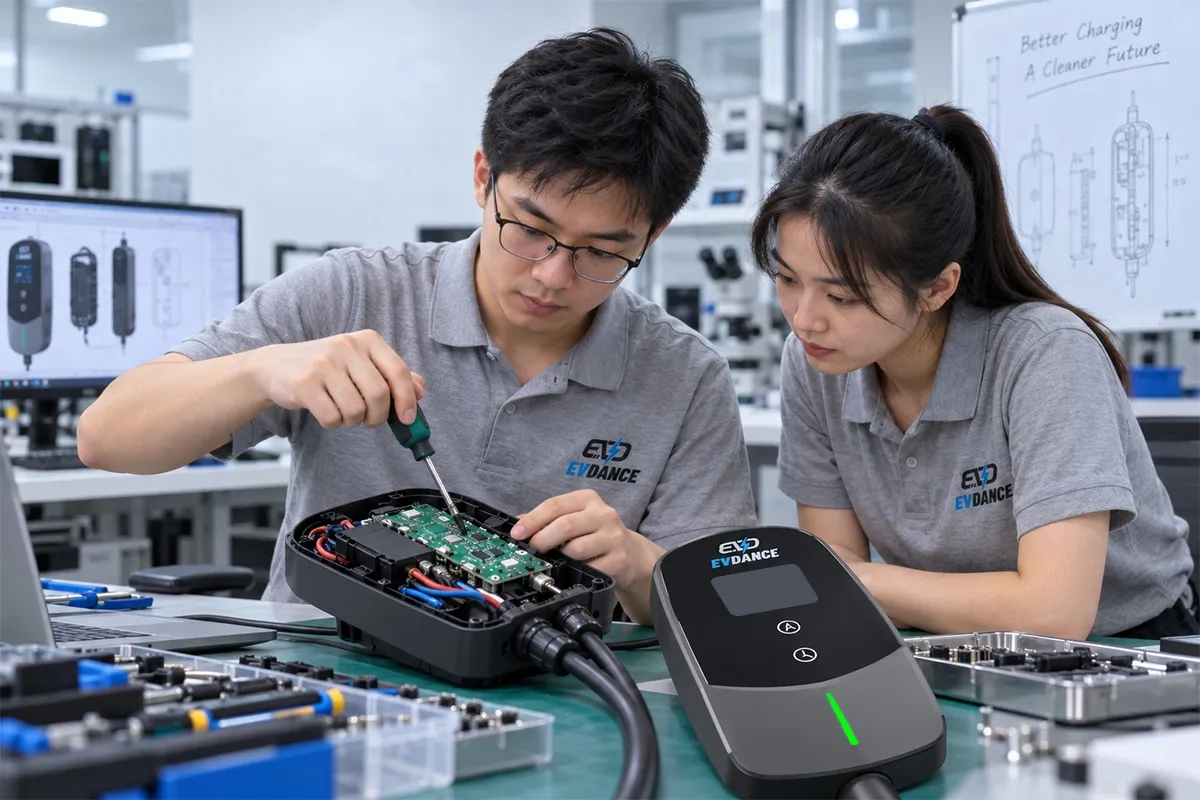
The factory’s answer is screening: charger test equipment — load banks, EV simulators, safety testers — and load runs before packing move latent defects onto the bench. For a buyer, the paperwork matters more: which tests every unit passes, whether results are kept per serial number, and whether a return can be matched to its record. Our factory audit checklist for importers shows where those questions sit.
Asking EVDANCE About Early-Life Reliability
EVDANCE is a Shenzhen manufacturer founded in 2011, with its own factory, exports to more than 30 countries, private label from 100 units and a standard 3-year warranty. We do not publish a 90-day failure figure — be wary of any factory that quotes one without the log behind it. Ask instead for the end-of-line test specification for your models, in writing — for a wallbox such as the EV-ACT5006T or the commercial range. Start through the OEM and private-label programme or contact us.
Frequently Asked Questions
Is there a proven percentage of chargers that fail in the first 90 days?
No verified figure exists for a buyer to check. The bathtub-curve pattern is established for electronics generally, but a model’s rate comes only from its own return log — ask for the log’s structure, not a headline number.
Our early returns doubled last quarter. Does that prove a product problem?
Not by itself. More units in service, one batch, one installer or a setup change can lift early returns while the defect rate stays flat. The finding split — defect, site fault, no fault found — is the deciding column.
What should an order say about early failures?
Define them in writing first: what counts as a warranty fault, how findings are reported, and what records are kept per serial number. Our spare parts and RMA process guide covers the terms to agree.
Related Reading
- EV Charger Factory Audit Checklist for Importers
- EV Charger Spare Parts and RMA Process for Distributors
- Common EV Charger Faults and How Suppliers Should Handle Them

