
When a faulty charger arrives back at a factory, field failure analysis follows a fixed order: confirm the unit’s identity and history, reproduce the reported symptom on the bench, inspect it without opening it, then open it, and finally write a root-cause record that feeds a corrective action. For a buyer, the value is not the repaired unit — it is the written finding.
Key Takeaways
- A factory trace runs in a fixed order: identity, reproduction, external inspection, teardown, root-cause record.
- “No fault found” is a real outcome — bench evidence, not a defect story, is what closes a case.
- One unit proves little; per-serial records are what reveal a batch pattern.
- Require the report’s contents and response times in the supply agreement, before the first order.
Stages One and Two: Identity, Then Reproduction
At intake, the serial number is checked against the production batch and the order, and the unit is set aside so handling does not disturb the evidence; the reported symptom, photos and the distributor’s test results are filed with it. Then the factory tries to make the fault happen again, running the unit on a bench with an EV simulator and a load. Many returned units pass at this stage — and that is itself a finding.
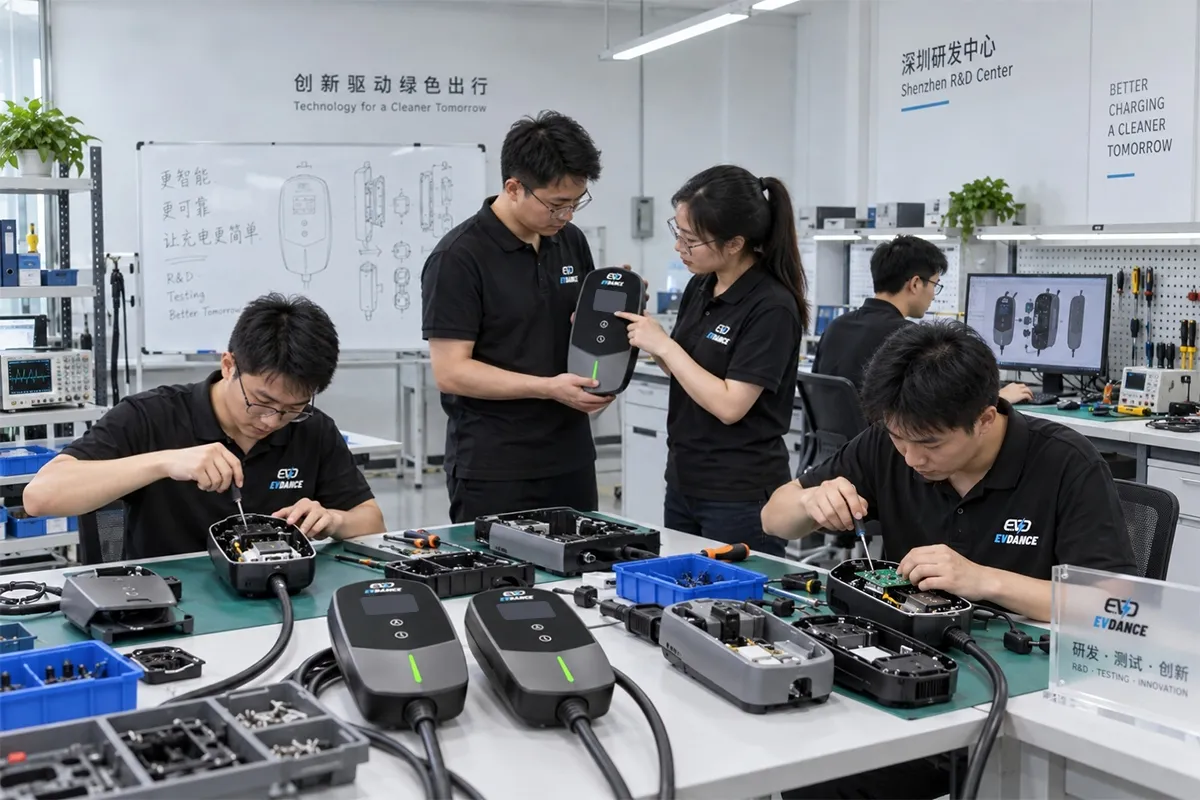
Stages Three and Four: Inspection, Then Teardown
External inspection comes before any screwdriver: connector pins, cable damage, housing cracks, signs of water entry, and any fault history the unit has stored. Only then does teardown begin — board-level inspection for the failure signature, such as heat-damaged components, connector wear or corrosion. Findings are photographed and recorded before parts are swapped, because a board replaced too early takes the evidence with it.
What Each Stage Rules In or Out
| Stage | The question it answers |
|---|---|
| Intake and identity | Is this the unit the report describes — and which batch built it? |
| Reproduction on the bench | Does the reported fault happen under controlled conditions? |
| External inspection | Is the cause outside the sealed unit — cable, connector, or the site? |
| Teardown | Which component failed, and does the damage pattern match the symptom? |
| Root-cause record | Is this a one-off, a pattern across a batch, or not a product fault at all? |
The Outcomes Nobody Puts in a Brochure
“No fault found” is a legitimate result. A unit that passes every bench test points back to the installation, the vehicle or the network — and a credible factory reports that plainly instead of inventing a defect to close the ticket. A single traced unit also proves only something about that unit. Batch conclusions need repeated findings, which is why per-serial records matter more than any one teardown. Expect one of three findings: a product defect with a corrective action, an external cause with evidence, or no fault found with the test results attached.
What to Require in the Written Report
Our guide to the spare parts and RMA process covers the distributor side — triage, RMA numbers, replacement from stock. The factory’s report back to you should carry:
- Serial number and production batch of the unit analysed.
- The symptom as reported, and as found on the bench — the two often differ.
- The root-cause category and the evidence for it, not just a conclusion.
- The corrective action — and whether it changes units still in production.
- Whether the same finding has appeared before in that batch.
A factory that cannot produce this is offering replacements, not analysis.

Failure Analysis at EVDANCE
EVDANCE is a Shenzhen manufacturer founded in 2011, exporting to more than 30 countries, with private label from 100 units and a standard 3-year warranty. We do not publish a standalone failure-analysis procedure document — treat the report’s contents and its response times as terms to settle in your supply agreement before the first order, for site equipment such as the EV-AC03201T dual-connector station as much as for portables. Start through the OEM and private-label programme or contact us.
Frequently Asked Questions
How long does a factory failure analysis take?
It varies with shipping, the queue at the bench and whether the fault reproduces quickly. There is no honest universal figure — which is why response times for a first reply, for analysis and for settlement belong in the supply agreement, not in a verbal promise.
What if the factory reports “no fault found”?
Ask for the bench results behind it, then check the site side with your installer — supply, network and vehicle settings are the usual places. A rising no-fault-found share is itself information — it usually points to triage or installation training, not the product.
Should every faulty unit be shipped back to the factory?
Agree it in advance. Photos, fault codes and local test results settle some returns; a physical unit is needed when teardown is the only route to the cause, or when a batch pattern is suspected.
Related Reading
- EV Charger Spare Parts and RMA Process for Distributors
- Common EV Charger Faults and How Suppliers Should Handle Them
- EV Charger Warranty and After-Sales Terms: A Distributor’s Checklist
- EV Charger Factory Audit Checklist for Importers
